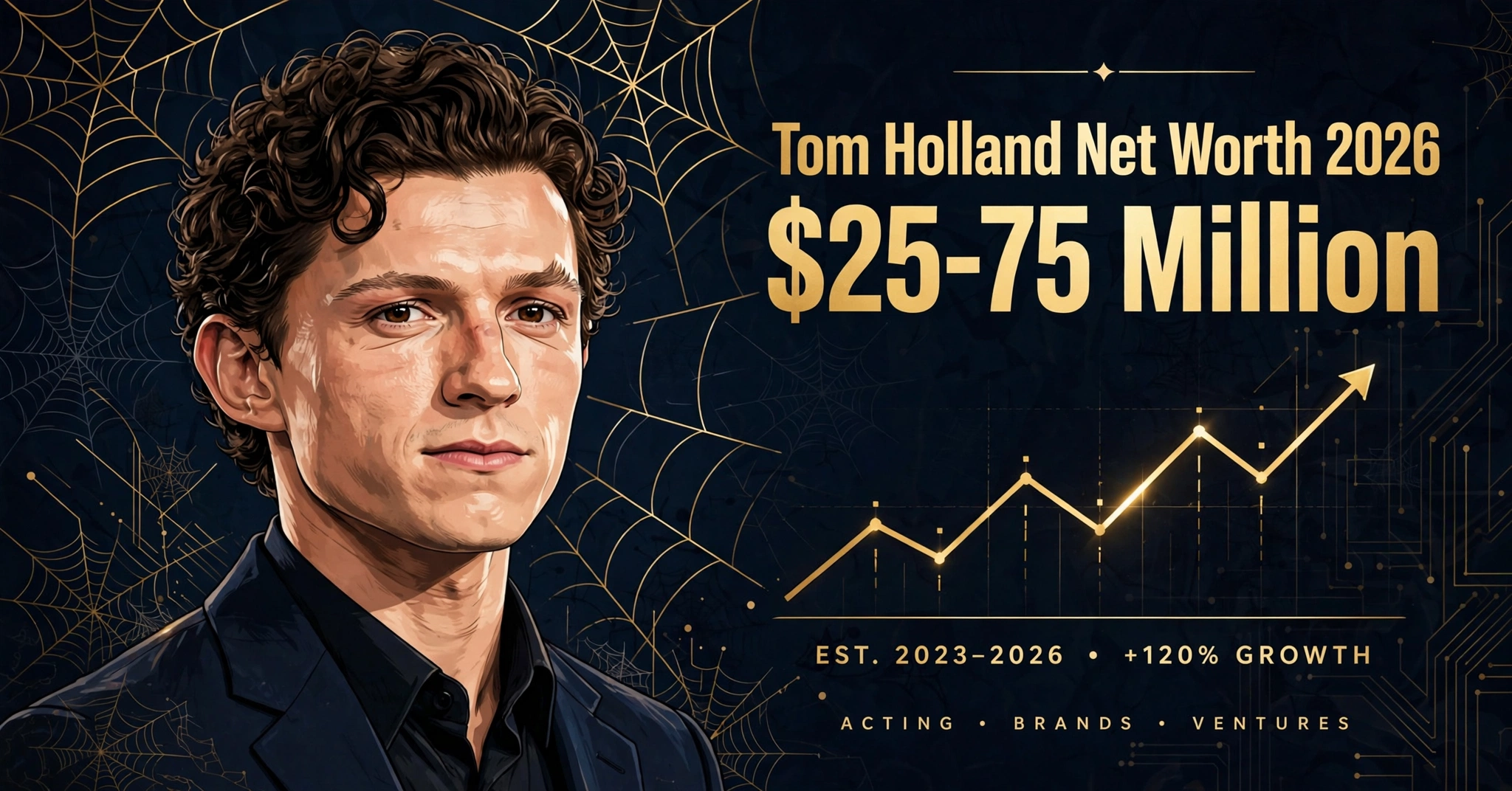
Tom Holland’s net worth in 2026 is estimated at $25–75 million. We break down every reported Spider-Man salary, the uncapped Brand New Day backend deal, Bero, endorsements, and real estate — with estimates labeled honestly.
Last updated: September 30, 2026
By Nathan Cole
Tom Holland’s movies have now earned more money than any other actor’s in cinema history — roughly $15.5 billion and counting — yet published estimates of his personal fortune disagree with each other by a factor of three. Some outlets say $25 million. Others say $75 million.
This figure is an independent estimate — Tom Holland has never disclosed his finances publicly. Our process: gather every credibly reported salary, deal, and asset; cross-check them across reputable outlets; allow for taxes, representation fees, and spending; and publish a range wherever sources disagree, with the reasoning shown in the article. Anything uncertain is labeled as an estimate, not a fact.
Estimated net worth, career earnings, and the business behind the number.
Both camps are looking at the same man, the same films, and the same reported salaries. The difference is a single contract clause: an uncapped backend deal on 2026’s Spider-Man: Brand New Day that could reportedly pay Holland $100 million for one film — or, depending on how Hollywood accounting shakes out, considerably less.
This profile does what most net-worth pages don’t. It shows you the number, then shows you the math: every reported Spider-Man paycheck from a $250,000 debut to a $20 million base salary, how backend bonuses actually work, what his beer company and endorsement deals contribute, what he owns in property, and why honest outlets land in different places. Every figure below is either a reported salary attributed to its source or an estimate clearly labeled as one. Holland has never publicly disclosed his finances, so anyone giving you a single precise number is guessing.
The short answer: Tom Holland’s net worth in 2026 is estimated between $25 million and $75 million. The lower end reflects his banked, verifiable earnings through 2025. The upper end — published by Celebrity Net Worth — prices in the Brand New Day backend, which has been reported but not confirmed by Holland or the studios. Until that money is actually paid, treat the top of the range as a forecast, not a fact.
Here’s the roadmap: first, why honest outlets disagree (and what each number actually measures). Then the Brand New Day deal itself — what “uncapped backend” means, how Hollywood takes its cut, and what Holland likely keeps. Then every reported paycheck in order, the contract structure behind them, his non-Marvel income, the Bero business, real estate, the Zendaya household math, and what the next five years could pay. Numbers first, narrative second, estimates labeled throughout.
Co-founder of Bero; brand ambassador/investor in Vuori
Real estate
West London townhome (£2.5M, 2018) plus shared transatlantic footprint with Zendaya
Partner
Zendaya — reportedly married in early 2026
Why One Actor Has Three Different Net Worths
Search “tom holland net worth” and you’ll find $25 million (Parade, OurCultureMag), $45 million (CelebTrendNow), and $75 million (Celebrity Net Worth, Wealthy Gorilla) — all published in 2026. This isn’t a case of someone being wrong. It’s a case of three different questions being answered.
The $25 million figure is the pre-backend snapshot: Holland’s accumulated earnings from salaries, endorsements, and investments through roughly 2025, minus the spending, taxes, and fees that net-worth trackers model in. It’s conservative by design. It treats the Brand New Day backend as uncollected income — which, strictly speaking, it still is.
The $45 million figure is a middle path: banked earnings plus a partial, discounted credit for the backend. It assumes the deal pays out but applies a haircut for taxes, agent commissions, and Hollywood’s famously creative accounting.
The $75 million figure prices in the backend nearly in full. Celebrity Net Worth added roughly $50 million to Holland’s estimated worth in 2026 alone on the strength of Brand New Day‘s box office. That is a legitimate way to estimate — backend participation is a real asset — but it depends on money that flows in over months and years, not a wire transfer that has already landed.
None of these outlets has seen Holland’s bank statements. What you’re choosing between is really a philosophy: count only what’s banked, or count what’s been earned on paper. This article gives you both, and labels which is which.
The 0 Million Deal: How Backend Actually Works
In August 2026, TheWrap reported that Holland made between $20 million and $25 million as a base salary for Spider-Man: Brand New Day — and that his total compensation could reach or exceed $100 million once backend bonuses were included. The Guardian and Men’s Journal echoed the reporting: roughly $20 million upfront, with another $80 million or more expected from the backend after the film crossed $2 billion worldwide.
To understand why that number is both real and uncertain, you need to know what “uncapped backend” means. Most actors are paid a flat salary: the studio’s risk, the studio’s reward. A-list stars with leverage negotiate something extra — a percentage of the film’s profits, paid after release. “Uncapped” means there’s no ceiling written into the contract: the bigger the box office, the bigger the check. Holland’s previous Spider-Man contract reportedly expired after No Way Home, and his team — WME agents Andrew Dunlap, James Farrell, and Liam Buckley, plus lawyer Robert Offer — negotiated the new deal from scratch. Ten years after a $250,000 debut, Holland finally had the bargaining power to demand a share of the upside.
The film gave them plenty of upside to share. Brand New Day opened to $932 million globally in its first weekend — including a $360 million domestic opening, the biggest in history — and crossed $2 billion worldwide in about three weeks, the second-fastest climb to that milestone ever after Avengers: Endgame. It went on to pass $2.4 billion globally, with a $936.7 million domestic total that reportedly made it the highest-grossing film of all time in North America, edging past Star Wars: The Force Awakens.
Here’s the part most net-worth pages skip: backend is not profit in the way you think. Studio “profits” are calculated after distribution fees, marketing costs, interest, and overhead — a formula Hollywood has spent a century optimizing in its own favor. An “uncapped share” softens that, but the payout still arrives in installments, gets taxed at the top marginal rates in two countries (Holland works in both the US and UK), and loses roughly 10–15% to agents, managers, and lawyers before it reaches him. A reported $100 million payday might realistically net $45–55 million after everyone takes their cut. That’s still life-changing money — it’s just not $100 million in a bank account.
The closest precedent is instructive. Robert Downey Jr. earned a reported $500,000 for the first Iron Man, then negotiated backend that turned Iron Man 3 into a $50 million payday and the Avengers finales into nine-figure hauls. Holland’s trajectory — $500,000 for Homecoming, $10 million for No Way Home, now a $20 million base with uncapped backend — mirrors Downey’s almost exactly, a decade later.
And if you doubt backend bonuses are real money rather than press-release fiction, consider the strangest anecdote in this whole story. On Late Night with Seth Meyers, actor Tom Hollander recalled once accidentally receiving Tom Holland’s backend bonus check for Avengers: Infinity War — a misdirected envelope containing, in his words, an “astonishing,” seven-figure first installment. “It was more money than I’ve ever seen,” Hollander said. “It was not his salary. It was his first box office bonus.” Someone in Hollywood accounting literally mailed Spider-Man’s bonus to the wrong Tom. The money, at least, was undeniably real.
Gross Points, Net Points, and the Hollywood Haircut
Not all backend is created equal, and the distinction decides whether a “$100 million payday” becomes $55 million or $25 million. In studio contracts, there are roughly two kinds of profit participation. “Gross points” (a share of box-office gross or first-dollar gross) are the gold standard: money flows from the first ticket sold, before the studio recoups its costs. “Net points” (a share of net profits) are famously worthless — studios define “net” after distribution fees, marketing, interest, and overhead charges, a formula one producer memorably called “an accounting fiction.” Net points on a $2 billion film can still pay zero.
Holland’s deal is described as an “uncapped share” of backend bonuses — the reporting doesn’t specify gross vs. net, but the expected $80M+ payout on a $2B+ grosser strongly suggests meaningful gross participation, not token net points. Studios don’t hand uncapped gross to just anyone; it took Holland ten years and the expiration of his old contract to earn that negotiating power.
Then comes the haircut, and it’s steep. Walk through illustrative math on a hypothetical $100 million total payday — clearly labeled as illustration, since the real contract terms are private:
Representation (~15%): agent (10%), manager, and lawyer combined typically claim 15% off the top. Remaining: ~$85M.
US federal tax (37%): film income earned in the US is taxed at top marginal rates. Remaining: ~$53.6M.
State tax: California’s top rate is 13.3%. (Holland’s UK domicile complicates this — the UK/US tax treaty prevents double taxation, but the combined effective rate stays brutal.) Remaining: roughly $42–45M.
UK considerations: as a UK resident, Holland also answers to HMRC, with treaty credits offsetting US tax paid.
So a “reported $100 million” might realistically leave $40–55 million in his accounts — and it arrives in installments over many months, not as a single wire. None of this makes the payday small. It makes it real. Net-worth trackers that model in taxes and fees (the $25–45M camp) versus those that price gross participation at face value (the $75M camp) are largely disagreeing about this haircut, not about the underlying deal.
Every Spider-Man Paycheck, From 0,000 to Million
Holland’s Marvel salary history is one of the best-documented pay progressions in modern Hollywood, reported across Variety, The Hollywood Reporter, TheWrap, and Celebrity Net Worth. The table below compiles the reported figures. Asterisks mark salaries that exclude backend bonuses.
Film
Year
Reported salary
Captain America: Civil War
2016
$250,000
Spider-Man: Homecoming
2017
$500,000 base (reported ~$1.5M after box-office bonuses)
Avengers: Infinity War
2018
$3 million
Avengers: Endgame
2019
$3 million
Spider-Man: Far From Home
2019
$4 million
Spider-Man: No Way Home
2021
$10 million*
Spider-Man: Brand New Day
2026
$20–25 million base; reportedly $100M+ with backend*
A few things worth noticing in that progression. First, the Avengers films paid Holland $3 million each — serious money, but modest next to the ensemble’s top earners, reflecting that he was still a supporting player in someone else’s movie. Second, the jumps between solo films are steep and consistent: $500K → $4M → $10M → $20M. Each film roughly doubled or more the last, which is what happens when every installment outgrosses the one before it. Third, Homecoming‘s true earnings were reportedly around $1.5 million once box-office bonuses kicked in — an early hint that Holland’s contracts have included performance incentives from the start.
His non-Marvel paychecks tell a different story — the story of what Holland earns when he’s not wearing the suit:
The Impossible (2012): a reported $100,000 — the paycheck of a 15-year-old unknown, and the last small one he’d ever see.
Uncharted (2022): roughly $2 million, per Parade’s reporting — notably modest for a film that grossed over $400 million, suggesting Holland took a competitive quote to prove he could open a non-Marvel action film.
The Crowded Room (2023, Apple TV+): a reported $4 million as star and executive producer of the 10-episode limited series.
The Odyssey (2026): a reported $10 million to play Telemachus in Christopher Nolan’s epic — his biggest non-Marvel salary to date, and a signal of where his quote is heading.
Beyond the films themselves, there’s the Spider-Man annuity most profiles ignore: voiceover work for Disneyland’s Avengers Campus, Marvel short films (Peter’s To-Do List, Science Fair), The Daily Bugle web series, video games, and commercials. Each pays modestly on its own; together they form a steady five-to-six-figure-per-engagement stream that has run for a decade. And Parade has reported that Holland signed on for three more Sony/Marvel films beyond Brand New Day — meaning the salary table above is about to get longer, with each new negotiation starting from the $20 million base rather than the old $10 million one.
From $250,000 to $20 million a film: the salary ladder, step by step.
How a 19-Year-Old Dancer Won the Biggest Role in Hollywood
The casting story matters to the money story, because Holland’s entire negotiating position traces back to how he got the part. In 2015, Marvel and Sony conducted one of the most public casting searches in recent memory, reportedly screen-testing a generation of young actors. Holland — then known mainly for The Impossible and Wolf Hall — reportedly tested opposite Robert Downey Jr. himself, playing scenes as Peter Parker against Tony Stark. The chemistry read worked. In June 2015, the studios announced the 19-year-old as the new Spider-Man, and the six-picture deal was signed.
Why does a dancer keep winning action roles? The Billy Elliot years gave Holland something casting directors can’t teach: complete physical confidence. He does many of his own stunts, learned gymnastics-style movement as a child, and famously turned a Lip Sync Battle “Umbrella” performance into a viral moment that showcased the same athletic showmanship. When Marvel needed a Peter Parker who could plausibly flip through the air, the former ballet kid was the lowest-risk choice in the room. Low risk at 19 became maximum leverage at 30 — the through-line of this entire fortune.
The Six-Picture Deal That Built the Fortune
When Holland was cast as Spider-Man, he reportedly signed a six-picture deal: three Sony-distributed solo Spider-Man films plus appearances in Disney-released Marvel Studios ensemble movies. That structure explains both his wealth and its shape.
The solo films — Homecoming, Far From Home, No Way Home — were where his salary compounded, because each negotiation referenced the last film’s box office. The ensemble appearances — Civil War, Infinity War, Endgame — paid flat fees that looked small by comparison but kept him visible in the biggest movies on earth, which is its own form of compensation: every Avengers film raised the quote for the next solo outing.
Crucially, that original deal expired with No Way Home. Holland wasn’t contractually obligated to return. That’s why Brand New Day required a fresh negotiation — and why the fresh negotiation produced a $20 million base with uncapped backend instead of another incremental raise. When the studio needs you more than you need the studio, the deal terms flip.
The same logic now applies to his future. Holland is reportedly expected to appear in Avengers: Doomsday (2026) and Avengers: Secret Wars (2027). Whatever those paychecks look like, they’ll be negotiated at post–Brand New Day rates — meaning his Endgame-era $3 million ensemble fee is ancient history.
There’s a corporate subplot worth understanding, because it shapes every negotiation. Spider-Man is a Marvel character whose film rights are held by Sony Pictures — a legacy of Marvel’s 1990s rights sales. The solo Spider-Man films are financed and distributed by Sony; the character appears in Disney’s Avengers films under a sharing agreement whose exact terms have never been disclosed (the two studios briefly and publicly split in 2019 before reconciling). For Holland, this means two paymasters with different incentives: Sony, which needs Spider-Man as its flagship franchise, and Disney/Marvel, for whom he’s one Avenger among many. His agents have spent a decade playing that dynamic — and the $20 million base with uncapped backend is what winning that game looks like.
Life Beyond the Mask: Non-Marvel Income
A common knock on Holland is that he’s a one-character actor. The box office says otherwise — and so does his non-Marvel résumé, which has quietly become one of the more interesting in his age group.
The Odyssey (2026) is the headline. Cast by Christopher Nolan as Telemachus, Holland co-headlined a film that reportedly grossed between $1.3 billion and $1.6 billion worldwide, becoming Universal’s highest-grossing film ever. Starring in the two biggest films of the same summer — Brand New Day and The Odyssey — is a feat few actors have ever managed, and it permanently changed his negotiating position: he’s no longer just Marvel’s Spider-Man, he’s a Nolan leading man.
The rest of the non-Marvel ledger shows deliberate range-building: the gritty crime drama The Devil All the Time (2020), the troubled-veteran drama Cherry (2021), the sci-fi misfire Chaos Walking (2021), voice work in Spies in Disguise and Pixar’s Onward, and the Fred Astaire biopic still to come. Not all of them paid well or performed — that’s rather the point. Actors buy credibility with these roles and cash it in later. The $10 million Odyssey salary is what the earlier investments returned.
Then there’s the work nobody puts on a poster: voiceover for Disneyland’s Avengers Campus, Marvel shorts, commercials, and video games. Individually small; collectively, the kind of steady ancillary income that separates working actors from wealthy ones.
Bero and the Business of Being Tom Holland
In 2024, Holland co-founded Bero, a non-alcoholic beer brand, and put his face on it. The origin story is personal: Holland has spoken openly about sobriety since a 2023 interview in which he described a problematic relationship with alcohol. Building a brand around the choice that changed his life is either savvy marketing or genuine mission — the two aren’t mutually exclusive, and in the NA-beer boom, authenticity sells.
The business results are striking. TheStreet reported that Bero secured private-equity backing worth $100 million within two years of launch. Holland’s exact ownership percentage hasn’t been disclosed — he’s described as a co-founder alongside other investors and partners — so nobody can responsibly put a dollar value on his stake. But a founder’s slice of a nine-figure-backed beverage brand is a meaningful asset, and it’s the kind of equity that compounds while he sleeps. If Bero ever sells to a major brewer, this could become the largest single line item in his fortune. That’s speculative; the brand’s traction is not.
The timing was sharp. The non-alcoholic beer category has been one of beverage’s fastest growers, with category leader Athletic Brewing reportedly raising money at an $800 million valuation in 2024. Holland entered a proven boom with a personal story competitors couldn’t copy — sobriety as brand identity rather than marketing gloss. Whether Bero becomes a nine-figure exit or a solid lifestyle business, the structure of the bet is what matters: equity, not just an endorsement fee. It’s the difference between renting your fame and owning something.
The endorsement portfolio around it is classic A-list diversification: Prada (and Prada Beauty), Aston Martin, Chase Sapphire, Audi, Beats by Dre, Gymshark, and a 2019 Final Fantasy XIV: Shadowbringers commercial. In 2026 he added Vuori, the lifestyle apparel brand, as both global ambassador and investor — the ambassador-plus-equity structure being the modern celebrity deal template: get paid to promote, get rich if it grows. Wealthy Gorilla also reports a minority stake in the luxury gym franchise Dogpound.
None of these deals has a publicly reported dollar value, which is worth stating plainly. Endorsement income is the foggiest part of any celebrity fortune. What’s verifiable is the roster’s breadth — fashion, automotive, finance, gaming, fitness, beverages — which suggests annual endorsement income in the low seven figures at minimum, comfortably into eight figures in a Brand New Day year when his face is everywhere.
The Vuori deal deserves a closer look because it represents the template modern stars now demand: ambassador plus investor. The old model was simple — a brand pays a celebrity a flat fee to appear in ads, and the celebrity’s wealth doesn’t change when the brand grows. The new model gives the celebrity equity alongside the fee, so a successful partnership pays twice: once in cash, once in appreciation. Holland’s team negotiated this structure at exactly the moment his star power peaked — the summer he headlined the two biggest films on earth. It’s the same instinct as the uncapped backend: stop renting out fame by the day, and start owning a share of what the fame creates. Between Bero, Vuori, and Dogpound, Holland now holds equity in beverages, apparel, and fitness — three categories where celebrity-led brands have produced nine-figure exits in recent years. None has exited yet. All three are lottery tickets he didn’t have to pay full price for.
Real Estate: The West London Base
Fresh off Homecoming and Infinity War, Holland moved out of his parents’ house in 2018 and bought a three-story West London townhome for £2.5 million (about $3.3 million), according to the Daily Mail. In 2020 he began a multi-year, multi-million-pound renovation — repointing the slate roof, adding an orangery out back — and Zendaya reportedly moved into the six-bedroom home later that year.
The couple’s combined footprint is transatlantic. Architectural Digest has reported Zendaya’s Southern California holdings: a $1.4 million starter home, a $3.97 million ranch-style home in Encino, and a $4.9 million Brooklyn Heights penthouse purchased at the end of 2020. Together, the household controls an estimated $12–15 million in residential real estate across London, Los Angeles, and New York — the kind of property base that both stores wealth and quietly appreciates beneath the headlines.
What’s missing from the portfolio is as telling: no reported private island, no fleet of investment properties bought at the peak, no crypto-era speculation. For a couple with a combined nine-figure estimated fortune, the property strategy reads as conservative — homes they actually live in, in markets they know, bought before the biggest paydays arrived. In wealth management terms, that’s the profile of people being advised well, not people spending to be seen.
From Billy Elliot to Billion-Dollar Box Office
Thomas Stanley Holland was born June 1, 1996, in Kingston upon Thames, southwest London, to photographer Nicola Holland and writer-comedian Dominic Holland — who acted as his son’s unofficial early manager. At nine, Holland enrolled at the Nifty Feet Dance School, obsessed with Janet Jackson. A scout spotted him at a White Lodge Ballet School festival; two intense years of Royal Ballet training later, he was starring as Billy Elliot in the West End musical — first as Billy’s friend, then in the title role from 2008.
That dance foundation is the invisible engine of everything after: the physicality that won him Spider-Man, the “Umbrella” Lip Sync Battle performance that went viral, the stunt work he famously does himself. His film breakthrough came at 15 with The Impossible (2012), playing a teenager separated from his family in the 2004 Indian Ocean tsunami, followed by How I Live Now, In the Heart of the Sea, and the miniseries Wolf Hall.
The awards followed the fame: a BAFTA Rising Star Award, a Hollywood Film Award, and MTV Movie & TV Awards. And in 2026, the box-office record that reframes his entire career: with Brand New Day approaching the domestic all-time record, Holland reportedly passed Zoe Saldaña (about $15.46 billion) and Scarlett Johansson (about $15.4 billion) to become the highest-grossing actor in history at roughly $15.5 billion in cumulative theatrical gross — the youngest performer ever to top that list. To be clear, that’s the studios’ money, not his. But it’s the reason his quote is what it is.
$15.5 billion in global box office: the number that funds every backend check.
Tom Holland vs. Zendaya: Who Is Richer?
It’s the internet’s favorite couples-finance question, and the honest answer is: it depends on the month you ask. Pre–Brand New Day, most outlets had Zendaya ahead — Parade put her at $30 million to his $25 million, crediting her Disney Channel years, Euphoria salary, and deep endorsement bench (Louis Vuitton, Lancôme, Bulgari). Celebrity Net Worth’s 2026 update flipped the table: $75 million for Holland against $40 million for Zendaya, with the entire gap attributable to the Brand New Day backend.
Strip out the backend and they’re remarkably close — two 29/30-year-olds with $25–40 million each, which may be the most useful framing. As a household, they’re working with a combined estimated fortune of $65–115 million, a transatlantic property portfolio, and complementary income streams: his franchise paydays, her prestige-TV and fashion money. Wedding planning, whenever the private celebrations conclude, is not a budget concern.
The couple reportedly married in early 2026 — stylist Law Roach confirmed at the March 2026 Actor Awards that “the wedding had already happened,” and the pair held a private celebration in Surrey, near Holland’s childhood home, in July 2026 after the summer premieres. They met, fittingly enough, at a 2017 screen test for Spider-Man: Homecoming.
Looked at as a household rather than a rivalry, the economics are more interesting than the headline question. Holland’s income is lumpy — enormous in franchise years, modest in between — while Zendaya’s is steadier: prestige television (Euphoria, where her per-episode salary was widely reported at around $1 million by the later seasons), film leads (Dune, Challengers), and a deep fashion endorsement bench. His spikes and her baseline hedge each other. It’s the kind of diversification most couples can’t buy, and it means neither career has to carry the household alone — which, in turn, is what lets Holland take a Cherry or a Crowded Room without worrying about the mortgage.
Where the Money Goes
For someone with a nine-figure career gross, Holland’s public lifestyle is notably restrained. No fleet of supercars on Instagram, no private-jet controversy, no headline-grabbing splurges. The spending that is documented looks deliberate: the West London townhome and its multi-million-pound renovation, the shared property footprint, and — more quietly — philanthropy.
The Holland family runs The Brothers Trust, a UK-registered charity founded by Tom and his three brothers (with their parents), which raises money for a rotating set of causes through events and merchandise. It’s a small operation by celebrity-charity standards, which is rather the point: it’s a family project, not a brand vehicle. Holland has also supported various children’s hospitals and disaster-relief efforts over the years, typically without the announcement machinery that accompanies such gifts.
The restraint is financially meaningful. Wealth managers will tell you the fastest way to stay rich after a windfall is to not change your spending when the windfall lands. Holland bought his house in 2018 — before the $10 million paydays — and renovated rather than relocated. If the reported $100 million backend materializes, the gap between his lifestyle and his income will be enormous, which is exactly how fortunes compound instead of evaporating.
What the Next Five Years Could Pay
Holland’s earnings curve is about to be tested by its own success. The reported Doomsday (late 2026) and Secret Wars (2027) appearances will be negotiated at post–Brand New Day rates — ensemble fees likely an order of magnitude above the $3 millionEndgame era. Marvel has a well-documented history of paying its anchor stars backend on ensemble films too (Downey’s nine-figure Avengers hauls being the template), so Holland’s team will almost certainly push for participation, not just a flat fee.
The Fred Astaire biopic offers a different kind of upside: prestige. A transformative musical-drama performance is exactly the role that converts “franchise star” into “actor” in awards voters’ minds — and awards convert into dramatic-role quotes that don’t depend on spandex. The Crowded Room was the small-scale test of that thesis (star + executive producer, a reported $4 million); the Astaire film is the full-scale attempt.
And Bero’s trajectory — $100 million in private-equity backing two years in — could make his founder’s stake the sleeper asset of the whole portfolio. A beverage exit typically values brands at multiples of revenue; even a modest outcome there could rival a film salary, with none of the press tours.
The risk is the one every franchise actor faces: converting a mask into a career. The early returns — a Nolan epic, a $10 million non-Marvel quote, a producing credit on The Crowded Room — suggest Holland is managing the transition deliberately. Whether the $75 million estimate proves conservative or optimistic depends almost entirely on two things: how much of the backend actually clears Hollywood accounting, and what he does with that power while he has it.
The Honest Math
So what is Tom Holland worth? If you want the number you can defend: $25–30 million banked, the product of a decade of reported salaries, endorsements, and investments, minus the taxes and fees that always apply. If you want the number that reflects his current market reality: up to $75 million, pricing in a backend deal that has been credibly reported by TheWrap and corroborated by the film’s historic box office — but not yet confirmed in Holland’s accounts.
Anyone who tells you it’s exactly one number is selling certainty they don’t have. The range is the truth. And the most interesting thing about Tom Holland’s fortune isn’t its size — it’s that at 30, with the biggest box-office track record in history and his first real backend deal just paying out, the compounding hasn’t really started yet.
One final note on how to read this profile — and every net-worth profile, including ours. The figures above come from entertainment-industry reporting: trade outlets, studio-adjacent sources, and estimators who model taxes and spending. They’re the best public information available, and we’ve attributed every number to its source and labeled every estimate as one. What they aren’t is a bank statement. If Brand New Day‘s backend pays in full, the $75 million end of the range will look conservative. If Hollywood accounting takes its usual toll, the $25–45 million middle will prove closer. We’ll update this profile as the payouts become clearer — because a net-worth figure is a snapshot, and this particular snapshot is still developing.
WRITTEN BY
Nathan Cole
Nathan Cole is the editor of Guide Net Worth. He covers celebrity wealth the way a business desk covers earnings: reported figures first, estimates labeled as estimates, and no invented numbers. Every profile on this site passes through his desk before it publishes. About Guide Net Worth · Corrections: figures are updated when new reporting emerges — contact us via the About page if you spot an error.
Sources & Reporting
Figures in this profile reflect reporting through September 2026. Key sources: Parade (the $25 million baseline figure; per-film pay reporting including roughly $2 million for Uncharted; the three-picture Sony/Marvel commitment); The Hollywood Reporter (franchise deal reporting). The wide $25–75 million range reflects how much of his backend participation and future franchise pay is counted — the article shows the math both ways.
Frequently Asked Questions
What is Tom Holland’s net worth in 2026?
Tom Holland’s net worth is estimated between $25 million and $75 million as of September 2026. Most outlets cluster around $25–30 million based on banked earnings; Celebrity Net Worth’s $75 million figure prices in his reported backend deal on Spider-Man: Brand New Day. All figures are estimates — Holland has never disclosed his finances publicly.
How much did Tom Holland make for Spider-Man: Brand New Day?
TheWrap reported a base salary of $20–25 million plus an uncapped backend deal that could bring his total to $100 million or more, given the film crossed $2 billion worldwide. The backend portion is reported, not confirmed, and will pay out over time after studio accounting, taxes, and fees.
How much did Tom Holland make for his first Spider-Man movie?
He reportedly earned $250,000 for his debut as Peter Parker in Captain America: Civil War (2016), then $500,000 base for Spider-Man: Homecoming (2017) — reportedly about $1.5 million once box-office bonuses were included.
Is Tom Holland or Zendaya worth more?
It depends on the estimate. Pre–Brand New Day, most outlets had Zendaya slightly ahead (around $30 million vs. $25 million). Celebrity Net Worth’s 2026 update puts Holland at $75 million vs. Zendaya’s $40 million — with the entire gap coming from his reported backend deal. Excluding the backend, they’re closely matched.
Does Tom Holland own a beer company?
Yes. Holland co-founded Bero, a non-alcoholic beer brand, in 2024, inspired by his own sobriety journey. The brand reportedly secured $100 million in private-equity backing within two years. His exact ownership stake has not been disclosed.
How much did Tom Holland make for Uncharted?
Parade reported roughly $2 million for Uncharted (2022) — modest next to his Marvel pay, suggesting he took a competitive quote to prove he could carry a non-Marvel action film.
What is Tom Holland’s highest-grossing movie?
As a cumulative record, his films have reportedly grossed about $15.5 billion worldwide, making him the highest-grossing actor of all time — ahead of Zoe Saldaña and Scarlett Johansson. His biggest single film as a lead is Spider-Man: Brand New Day, which reportedly passed $2 billion globally and set the North American domestic record.
Is Tom Holland married to Zendaya?
Multiple 2026 reports say yes. Stylist Law Roach confirmed at the March 2026 Actor Awards that the wedding had already happened, and the couple reportedly held a private celebration in Surrey, England, in July 2026. Neither Holland nor Zendaya has issued a formal announcement.
References & Sources
This article has been fact-checked and verified against multiple public sources, financial disclosures, SEC filings, Forbes reports, Celebrity Net Worth databases, and official records. All net worth estimates are based on publicly available information and financial analysis.
Last Updated:September 30, 2026
Fact Checked:✓ Verified
Research Method:Public Records & Financial Analysis
Celebrity Net Worth Researcher & Biography Analyst
Nathan Cole is the editor of Guide Net Worth. He covers celebrity wealth the way a business desk covers earnings: reported figures first, estimates labeled as estimates, and no invented numbers.