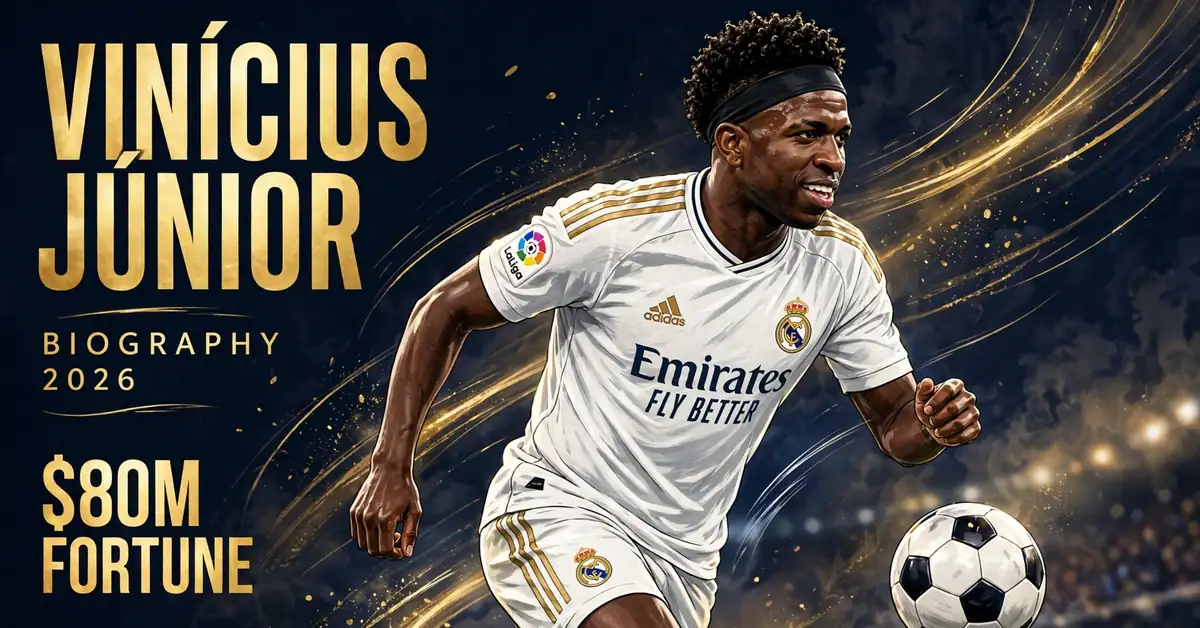
Vinícius Júnior biography 2026: born July 12, 2000 in São Gonçalo, the $80M Real Madrid star rose from Flamengo at 16 to two Champions League final goals.
Last updated: November 15, 2026 · By Nathan Cole
Vinícius Júnior is 26 years old in November 2026, born July 12, 2000, in São Gonçalo, Brazil, and he is already one of the most decorated footballers of his generation. The Real Madrid winger has won the Champions League twice, scored in both finals, finished runner-up in the 2024 Ballon d’Or, and was named The Best FIFA Men’s Player for 2024. His net worth in 2026 sits at an estimated $50 million to $100 million, anchored around $80 million, after Real Madrid tied him to the club through June 2032 with a deal worth €31.25 million a year gross.
His story starts a long way from the Bernabéu. He grew up in Mutuá, a working-class neighbourhood of São Gonçalo, across the bay from Rio de Janeiro, playing futsal on concrete before Flamengo spotted him as a small boy. At 16 he was a professional. At 17, before he had played a full season, Real Madrid paid €45 million for him — a record fee for a player under 18. Nine years later he is the face of the club, the number 7, and the player Brazil built its 2026 World Cup attack around.
This biography follows the whole arc: the São Gonçalo childhood, the Flamengo breakthrough, the slow first years in Madrid that nearly broke the gamble, the two Champions League finals he decided, the Ballon d’Or night that went to Rodri, the €1 billion Saudi offer he turned down, the racism fight that produced Spain’s first criminal convictions for abuse at a football match, and the institute he built for the children back home.
Quick Facts
| Full Name | Vinícius José Paixão de Oliveira Júnior |
| Born | July 12, 2000, São Gonçalo, Rio de Janeiro, Brazil |
| Age (Nov 2026) | 26 (turns 27 on July 12, 2027) |
| Height | 1.76 m (5 ft 9 in) |
| Position | Forward, left winger — Real Madrid #7 |
| Net Worth (2026) | $50M–$100M (anchor ~$80M, Celebrity Net Worth / Essentially Sports) |
| Salary | €31.25M gross a year (€600,962 a week) under the 2026 extension — Capology |
| Contract | Real Madrid through June 30, 2032; €1B release clause |
| Champions League | 2 titles (2022, 2024) — scored in both finals |
| Biggest Honours | The Best FIFA Men’s Player 2024; Ballon d’Or runner-up 2024 |
| Real Madrid Record | 375 appearances, 128 goals, 14 titles (club, July 12, 2026) |
| Brazil | Senior debut 2021; Copa América runner-up 2021; 2026 World Cup top scorer for Brazil |
| Off the Pitch | Instituto Vini Jr. (founded 2021); UNESCO Goodwill Ambassador (2024) |
| Partner | Not married; relationship with Virginia Fonseca ended October 2026 |
How This Estimate Was Made
Vinícius Júnior has never published a balance sheet, so the $50–100 million figure is triangulated from reporting, not a single source. The anchor is $80 million, the number Celebrity Net Worth, Essentially Sports (July 2026) and SportsLeo (August 2026) all carry. SureBets’ July 2026 method, built on Capology’s tracked career salary and a Forbes earnings estimate, lands at $55–80 million. Older $40–50 million figures date from before the August 2026 contract extension, which lifted his gross pay by roughly half, so they are treated as stale. Forbes reported $60 million earned in the 12 months to May 2026 — $40 million on the field, $20 million off it — and that is an earnings figure, not a net worth. Gross wages are read against Spain’s top marginal tax rate of roughly 47% before they are counted toward wealth. Where sources disagree, this article gives the range and names the source for each end of it.
+
Early Life in São Gonçalo
Vinícius José Paixão de Oliveira Júnior was born on July 12, 2000, in São Gonçalo, a working-class city of more than a million people across Guanabara Bay from Rio de Janeiro. His father, Vinícius José Paixão de Oliveira, worked to keep the family going; his mother, Fernanda, raised him in Mutuá, the neighbourhood where his football story begins. Money was tight. The family lived in a small house, and the boy’s first pitches were concrete futsal courts and dusty streets, where the ball rarely bounced true and a player learned to keep it close or lose it.
His footballing career began in 2006, when his father took the six-year-old to the branch offices of Flamengo in Mutuá. The club’s scouts saw a child who was quicker than everyone else on the court and who treated the ball like it belonged to him. Futsal shaped everything that followed: the tight control, the feints in phone-box spaces, the habit of beating a man twice because once was never enough. He joined Flamengo’s youth system and stayed in it for eleven years, from 2006 to 2017, rising through age groups that were full of boys with the same dream and very different odds.
The first proof that he was different came with Brazil’s youth teams. He was named Player of the Tournament when Brazil won the 2015 South American Under-15 Championship, then finished as top scorer when Brazil won the 2017 South American Under-17 Championship. By then the European scouts were already in the stands. The question was not whether he would leave Brazil, but how much someone would pay for a teenager who had barely played senior football.

Flamengo: The 16-Year-Old Prodigy
Vinícius made his senior debut for Flamengo on May 13, 2017, as an 82nd-minute substitute in a 1–1 Brazilian Série A draw against Atlético Mineiro. He was 16 years and 10 months old. The debut lasted eight minutes plus stoppage time, and it changed his life twice over: within ten days, Real Madrid had agreed to buy him.
His first season at Flamengo was short but loud. He played 50 senior matches and scored 11 goals across all competitions in 2017–18, numbers that look modest until you remember the age on the team sheet. He was a winger who took defenders on from a standing start, and Brazilian crowds, who have seen that act from the greats, recognised the shape of it early. The fee Madrid agreed — £38 million, about €45 million — was a national record for a player under 18. No Brazilian club had ever sold a teenager for that much.
The deal had a catch built into it by law: an international transfer cannot be completed before a player’s 18th birthday. So Vinícius stayed at Flamengo for another year, playing in front of crowds who knew he was already sold, wearing a shirt he would soon trade. He handled it the way he handles a full-back — head down, straight at the problem. When he finally left, in the summer of 2018, he had a professional season behind him and a price tag that would follow him for years.
The €45 Million Teenager: Real Madrid’s Record Gamble
Real Madrid signed the contract on May 23, 2017. The announcement landed like a thunderclap in Brazil, where €45 million for a 16-year-old with a handful of senior appearances looked like madness, and in Spain, where the club’s own fans wondered whether Florentino Pérez had bought a highlight reel. Madrid’s logic was simple: the next Neymar would cost €222 million, as Paris Saint-Germain had just proved. Buying the one after him early was the cheaper bet.
He arrived in Madrid in July 2018, days after his 18th birthday, and the first season was a lesson in patience. He played mostly for Real Madrid Castilla, the reserve side, and made cameo appearances for the first team under Julen Lopetegui and then Santiago Solari. The raw materials were obvious — the acceleration, the balance, the willingness to run at anyone — and so were the gaps. His finishing was erratic. His decision-making in the final third was rushed. Spanish defenders, who had seen quick wingers before, fouled him early and often, and he spent long stretches of matches on the floor.
Those first two seasons are the part of the story his critics like to forget and his defenders like to remember. The fee never shrank, the expectations never softened, and the Bernabéu is not a patient place for a teenager learning to finish. He scored 4 goals in 31 appearances in 2018–19 and 5 in 38 the season after. By any normal measure for an 18-year-old at the biggest club in the world, that was fine. By the measure of a €45 million record signing, it was a problem. Madrid stuck with him anyway, and the patience is the hinge this whole biography turns on.
Breakthrough: From Prospect to First-Team Regular
The turn came in 2021–22, under Carlo Ancelotti. Vinícius scored 22 goals in all competitions that season, more than in his first three Madrid seasons combined, and added 20 assists. The change was not one thing. His finishing got calmer. His partnership with Karim Benzema, who dropped deep and dragged centre-backs with him, gave the winger the half-yard he needed. And he stopped trying to beat every defender twice. The season ended with a La Liga title and a Champions League final in Paris.
That final, against Liverpool on May 28, 2022, is the night his career split into before and after. In the 59th minute, Federico Valverde’s low cross ran across the face of goal and Vinícius arrived at the far post to tap it in. It was the only goal of the game. Real Madrid won their 14th European Cup, and the 21-year-old who had cost €45 million as a boy had scored the winner in a Champions League final. The fee stopped being a question after that night. Nobody in Madrid has asked about it since.
He backed it up. In 2022–23 he scored 23 goals; in 2023–24, 24, including a hat-trick in the Spanish Super Cup final against Barcelona. The boy who could not finish had become the player Madrid looked for when a game needed deciding. By the summer of 2024 he was wearing the number 7 shirt — the number of Cristiano Ronaldo and Raúl — and nobody at the club treated that as a stretch.
2024: Player of the Season and the Ballon d’Or Heartbreak
The 2023–24 season was the best of his life and the cruellest. Real Madrid won La Liga and the Champions League, and Vinícius was the player of the tournament in Europe: he scored in the semi-final against Bayern Munich and again in the final against Borussia Dortmund at Wembley, a composed finish that made it 2–0 and ended the contest. UEFA named him the Champions League Player of the Season. He was, by any reasonable reading, the best player in the best team in the world.

Then came the Ballon d’Or. Through the autumn of 2024, the reporting said the award was his. Real Madrid prepared a delegation. The club’s television channel planned its coverage. On the night, the prize went to Rodri, Manchester City’s Spanish midfielder, and Madrid boycotted the ceremony in Paris entirely. Vinícius finished runner-up. He was 24, and the margin was thin, but the snub stung because the season had been built for exactly that coronation.
He answered the only way that counts. In December 2024, FIFA named him The Best FIFA Men’s Player for 2024, the award voted on by national team coaches, captains, journalists and fans. It was the first time a Brazilian had won it since the award’s current format began, and it put a trophy on the season that the Ballon d’Or had denied him. His Madrid teammate Jude Bellingham, whose own rise to a $50 million fortune by 23 ran on a parallel track that season, finished third in the Ballon d’Or voting — the two of them, plus Kylian Mbappé, who arrived in Madrid in 2024 on one of football’s biggest paydays, now form the attack the club is built around.
The 2032 Extension and the M Fortune
The money story has three chapters, and the latest one rewrote the other two. On August 6, 2026, Real Madrid announced a six-year extension that keeps Vinícius at the Bernabéu through June 30, 2032. Capology’s data from early October 2026 prices the new deal at €31.25 million gross a year — €600,962 a week — with a net figure of roughly €22–24 million a year once bonuses and the signing fee are counted. The €1 billion release clause stayed in place. On the day the club announced the deal, it also confirmed the scale of what he had already done: 375 appearances, 128 goals and 14 titles in eight seasons.
| Source | Date | Net worth figure |
|---|---|---|
| Celebrity Net Worth | Aug 2026 | ~$80M (anchor) |
| Essentially Sports | Jul 2026 | ~$80M |
| SportsLeo | Aug 2026 | $80M |
| SureBets | Jul 2026 | $55–80M |
| Forbes (earnings, not net worth) | Jun 2026 | $60M earned in 12 months ($40M on-field + $20M off-field) |
The second chapter is the offer he turned down. In 2024, Saudi Arabia’s Al Hilal reportedly offered €1 billion over five years — a figure so large it would have made him the best-paid footballer on the planet by a distance. He said no, and Madrid answered by keeping the €1 billion release clause in the new deal. Saudi sources later denied a formal offer had ever been made, which is worth recording, but the reporting at the time was consistent across outlets, and the extension to 2032 settled the question either way. He is a Madrid player for the prime of his career.
The third chapter is the endorsements. Nike renegotiated his deal from an estimated $4 million a year to around $10 million, and his portfolio — Nike, Pepsi, EA Sports and Apple, managed by Roc Nation Sports — now brings in roughly $20 million a year off the field, per Forbes. His salary has climbed in four clear steps: about €3.5 million in his early Madrid years, around €10 million after the 2021–22 renewal, €20 million after the 2023 extension, and €31.25 million under the 2032 deal. The full breakdown of the contract, the Saudi offer and the endorsement math is covered in our companion piece on Vinícius Júnior’s net worth in 2026, and the same story from the sister site’s angle is at Vinícius Júnior’s $80 million Real Madrid fortune on NetWorthCraft.
Brazil: From Youth Star to World Cup Leader
His international career followed the same pattern as his club one: early promise, slow burn, then the stage catching up with him. He made his senior Brazil debut in 2021 and helped the Seleção to a runner-up finish at that year’s Copa América, losing the final to Argentina at the Maracanã. He went to the 2022 World Cup in Qatar, where Brazil fell in the quarter-finals to Croatia on penalties, and to the 2024 Copa América in the United States.
The 2026 World Cup was his tournament as a leader. Britannica records that he finished as Brazil’s top scorer at the tournament, with a goal in the opening draw against Morocco, another in the 3–0 win over Haiti, and a brace in the 3–0 win against Scotland. It was the first World Cup in which he was not the youngster learning from Neymar, the previous generation’s Brazilian superstar, but the attacker the team was built around. The generational handover that Brazilian football had been waiting for since Neymar’s debut in 2010 finally happened on the biggest stage, with the number 7 from São Gonçalo wearing it.
The comparison with Neymar follows him everywhere, and it is mostly unfair to both men. Neymar was a prodigy at 17 and a global celebrity at 21; Vinícius was a project at 17 and a Champions League final match-winner at 21. What they share is the burden: Brazil expects its number 10s and its wingers to win World Cups, and the country has not won one since 2002. At 26, Vinícius has at least two more tournaments in him. The 2026 campaign was the first where the team was his.
The Fight Against Racism
No biography of Vinícius Júnior is honest without the racism. On May 21, 2023, during a league match at Valencia’s Mestalla stadium, he was subjected to sustained racist abuse — chants of “mono, mono” from sections of the crowd. He stopped the game, pointed out the abusers to the referee, and was sent off late in the match for striking Hugo Duro after the Valencia player had grabbed him by the neck. The red card was later overturned. Valencia were fined and ordered to close part of their stadium.
What happened next is why this section matters beyond football. On June 10, 2024, three Valencia fans were each sentenced to eight months in prison, with two-year stadium bans, after pleading guilty — the first criminal conviction for racist abuse at a football match in Spanish history. Vinícius said at the time: “I’m not a victim of racism. I am a tormentor of racists. This first criminal conviction in the history of Spain is not for me. It’s for all black people.” The convictions kept coming. In May 2026, five Valladolid fans were given suspended one-year prison sentences and fines for abusing him in December 2022, in the first ruling in Spain to condemn racist insults in a stadium as a hate crime. In November 2026, four people were convicted of hate crimes for hanging an effigy of him from a bridge before a Copa del Rey tie against Atlético Madrid in January 2023. Real Madrid said in November 2026 that 14 people have now been criminally convicted for racially abusing their players.
He has never treated the fight as a side project. In 2021 he founded the Instituto Vini Jr., which works on public education for children from disadvantaged neighbourhoods in Brazil, and in 2024 UNESCO appointed him a Goodwill Ambassador for Education for All. The activism and the football are the same story: a boy from Mutuá who reached the top of the game and decided to send the lift back down. The Netflix documentary “Vini Jr”, released in May 2025, tells both halves — the player and the campaigner — and it is the best single introduction to him for anyone who has only seen the highlights.
Playing Style: What Makes Vini Jr. Different
Watch him for ten minutes and the scouting report writes itself: left foot, left wing, defender on his heels from the first touch. His pace over the first five yards is the weapon — he reaches top speed while the full-back is still turning — and his balance at that speed is what separates him from other quick wingers. He rides tackles that would put most players on the floor, and he does it without breaking stride, which is why defenders foul him so often and why he spends so much of every match picking himself up.
The futsal background shows in the details. He receives the ball side-on, already facing the defender, and his first touch is usually a feint. The stepovers are not showmanship; they are a way of asking the defender a question he cannot answer in time. What changed between 2020 and 2022 was the ending. The early Vinícius beat his man and then shot into the stands. The current one cuts inside onto his right foot or squares the ball low across the six-yard box, and his assist numbers — 20 in 2021–22 alone — are the proof. He is also a better defender than his reputation suggests, tracking back in Ancelotti’s system and pressing from the front in a way that lets Madrid defend with ten men behind the ball when they need to.
His weakness, if it is one, is the same as his strength: he wants the ball, every time, in every situation. When a game is tight and Madrid need control, his instinct is still to take his man on. It has cost Madrid possession in big matches, and it is also why he has decided two Champions League finals. Coaches have learned to live with the trade. At 26, with 375 Madrid appearances behind him, the rawness is mostly gone. What is left is a winger who has learned when to dribble and when to pass, and who still chooses to dribble more often than the textbooks say he should.
Trophies and Records
| Honour | Detail |
|---|---|
| UEFA Champions League | 2021–22, 2023–24 — scored in both finals; Player of the Season 2023–24 |
| La Liga | 3 titles (2019–20, 2021–22, 2023–24) |
| The Best FIFA Men’s Player | 2024 |
| Ballon d’Or | Runner-up 2024 (behind Rodri) |
| FIFPRO World 11 | 2023, 2024 |
| Real Madrid total | 375 appearances, 128 goals, 14 titles (club, July 12, 2026) |
| Brazil youth | South American U-15 champion 2015 (Player of the Tournament); South American U-17 champion 2017 (top scorer) |
| Brazil senior | Copa América runner-up 2021; top scorer for Brazil at the 2026 World Cup |
| Transfer record | €45M from Flamengo (2017) — national record for a player under 18 |
For scale, his place among the young stars of the game is clear in the numbers: Lamine Yamal, the Barcelona teenager whose own fortune is already estimated at $15 million, is the only player of his generation with a comparable early arc, and Yamal was still a child when Vinícius was scoring in a Champions League final. The two will define the next decade of the rivalry between Madrid and Barcelona, and the Ballon d’Or race, the way Messi and Ronaldo defined the last one.
Personal Life: Faith, Family and the Institute
Vinícius is a Roman Catholic, and his faith is visible in the way he celebrates goals — pointing to the sky, a gesture for his family and for the neighbourhood he left. In November 2024 he shared the results of a genetic ancestry test from African Ancestry, which traced his maternal lineage to the Tikar people of Cameroon, a discovery he spoke about publicly as a link to a history his family had never been able to name.
He is not married. His relationship with the Brazilian influencer Virginia Fonseca ended in October 2026, when Fonseca confirmed the split to CNN Brasil on October 11. He keeps his private life mostly out of the press, and the reporting on his relationships has been careful rather than constant — a contrast with the coverage of his football, which is relentless.
The institute is the part of his life he talks about most. The Instituto Vini Jr., founded in 2021, works with public schools in Brazil to bring sport and technology into classrooms in disadvantaged areas, and it has grown every year since. His UNESCO appointment in 2024 gave it an international platform. For a player who is still only 26, the foundation already looks like a second career waiting to happen — and like the answer to the question of what a boy from Mutuá does with €31.25 million a year.
Vinícius Júnior vs the Greats: Where He Ranks at 26
Comparisons are the currency of football debate, and at 26 Vinícius invites three of them. Against Neymar at the same age, the numbers favour the younger man on the biggest stage: Neymar had a Champions League title by 24, won with Barcelona in 2015, but he had never scored in a European final; Vinícius has scored in two. Neymar’s club career was already drifting toward Paris by 25, while Vinícius has spent his entire European career at one club and signed to stay until 2032. The difference is temperament as much as talent — Neymar collected headlines, Vinícius collects finals.
Against the other Ballon d’Or contenders of his generation, the 2024 vote is the sharpest measure. Rodri won it on the strength of an unbeaten season with Manchester City and a European Championship with Spain, and the vote was close enough that Madrid expected their man to win it. What the vote missed is the weight of the moments: Vinícius decided a Champions League final and a semi-final in the same campaign, while Rodri’s case was built on control across a whole season. Both cases are legitimate. Only one of them involves scoring the goal that wins the trophy.
Against the legends of his own club, the trajectory is the most striking. Cristiano Ronaldo arrived at Madrid at 24 and needed four seasons to win his first Champions League with the club; Vinícius won his first at 21. Raúl, the number 7 Vinícius now wears, won his first European Cup at 20 but never won a Ballon d’Or and never finished runner-up. If the next six years follow the last four — a trophy roughly every 27 appearances, a goal roughly every three games — Vinícius will retire as one of the five greatest players in Real Madrid’s history, and the argument about whether he belongs in that company will be settled by the arithmetic.
What’s Next in 2026–27
As of mid-November 2026, Vinícius is serving the final match of a four-game suspension, imposed after he pulled Villarreal’s Nathaniel Saliba by the hair during Madrid’s match on October 10. His league return is set for the clash with Celta on November 21, after the international break, and he is due to travel with Brazil for friendlies against Japan in Singapore. The suspension is a footnote, but it is a reminder that the edge in his game — the temper that flares when he is kicked all afternoon — is still being managed.
The bigger picture is settled for the first time in his career. The contract runs to 2032, the number 7 is his, the Ballon d’Or is the one prize missing from the cabinet, and the next World Cup cycle will be built around him. He has 128 Madrid goals at 26; Raúl, the club’s great number 7, finished with 323. That is the kind of number that decides a legacy, and it is now a realistic target rather than a fantasy. If he stays fit and Madrid keep winning, the boy from Mutuá will leave the Bernabéu as one of the club’s all-time greats — and the €45 million gamble will look, in hindsight, like the cheapest signing of the century.
Sources & Reporting
This biography was researched from live reporting in November 2026. Biographical facts, career statistics and honours: Wikipedia (Vinícius Júnior) and Britannica (Vinícius Júnior biography, updated 2026). Net worth and contract figures: Celebrity Net Worth, Essentially Sports (July 6, 2026), SportsLeo (August 2026), SureBets (July 28, 2026, Capology salary data and Forbes earnings via AS), and the Real Madrid contract announcement of August 6, 2026. Racism cases and convictions: LaLiga announcements and court reporting via Football Mad, All Football and BeSoccer (June 2024 – November 2026). Personal life and the Fonseca split: CNN Brasil (October 11, 2026). The 2026 World Cup account follows Britannica. More profiles of football’s richest stars sit in our Celebrity Net Worth archive. Reporting window: October–November 2026. Figures are estimates unless marked as official club or court records, and they will be updated when new reporting emerges.
About the Author
Nathan Cole covers celebrity wealth and the business of sport for Guide Net Worth. He reports from named sources and dated reporting, and he publishes ranges where sources disagree rather than a single invented number. Read more on the About Guide Net Worth page. Corrections: figures are updated when new reporting emerges — contact us via the About page if you spot an error.
Frequently Asked Questions
How old is Vinícius Júnior in 2026?
Vinícius Júnior is 26 years old in November 2026. He was born on July 12, 2000, in São Gonçalo, Rio de Janeiro, Brazil, and he turns 27 on July 12, 2027. He made his professional debut for Flamengo at 16 and joined Real Madrid at 18.
What is Vinícius Júnior’s net worth in 2026?
Vinícius Júnior’s net worth in 2026 is estimated at $50 million to $100 million, anchored around $80 million. Celebrity Net Worth, Essentially Sports and SportsLeo all carry the $80 million figure, and SureBets’ July 2026 method lands at $55–80 million. The range exists because his wealth depends on his new Real Madrid contract and endorsement income, neither of which he discloses in full.
How much does Vinícius Júnior earn at Real Madrid?
Under the six-year extension announced on August 6, 2026, Vinícius Júnior earns about €31.25 million gross a year — €600,962 a week — according to Capology’s data from early October 2026. His net pay is roughly €22–24 million a year with bonuses and the signing fee. The contract runs through June 30, 2032, and keeps his €1 billion release clause.
How many Champions League titles has Vinícius Júnior won?
Vinícius Júnior has won the Champions League twice with Real Madrid, in 2022 and 2024 — and he scored in both finals. He scored the only goal of the 2022 final against Liverpool in Paris, and the second goal of the 2024 final against Borussia Dortmund at Wembley. UEFA named him the Champions League Player of the Season for 2023–24.
Did Vinícius Júnior win the Ballon d’Or?
No. Vinícius Júnior finished runner-up in the 2024 Ballon d’Or voting, behind Manchester City midfielder Rodri, despite a season in which he won La Liga and the Champions League and was named the Champions League Player of the Season. He did win The Best FIFA Men’s Player award for 2024, announced in December of that year.
Where is Vinícius Júnior from?
Vinícius Júnior is from São Gonçalo, a city in Rio de Janeiro state, Brazil, where he grew up in the Mutuá neighbourhood. His father took him to a Flamengo youth branch in Mutuá when he was six, in 2006, and he stayed in Flamengo’s academy until his senior debut in 2017.
What happened to Vinícius Júnior at Mestalla in 2023?
On May 21, 2023, Vinícius Júnior was subjected to racist abuse — chants of “mono, mono” — during a league match at Valencia’s Mestalla stadium. He pointed out the abusers and the game was stopped. On June 10, 2024, three Valencia fans were each sentenced to eight months in prison with two-year stadium bans, the first criminal conviction for racist abuse at a football match in Spain. Further convictions followed in 2026 for the Valladolid abuse and the effigy hung from a bridge in January 2023.
Is Vinícius Júnior married?
No, Vinícius Júnior is not married. His relationship with Brazilian influencer Virginia Fonseca ended in October 2026; Fonseca confirmed the split to CNN Brasil on October 11, 2026. He keeps his private life largely out of the press.
References & Sources
This article has been fact-checked and verified against multiple public sources, financial disclosures, SEC filings, Forbes reports, Celebrity Net Worth databases, and official records. All net worth estimates are based on publicly available information and financial analysis.