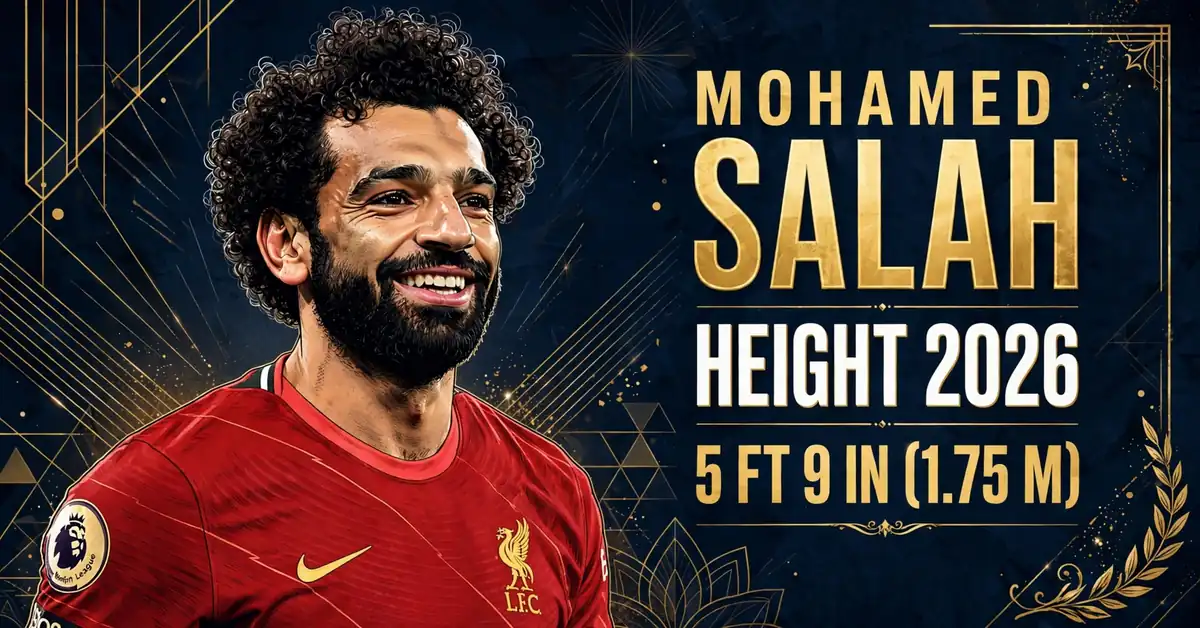
Mohamed Salah is 5 feet 9 inches (1.75 m) tall — verified against UEFA and Wikipedia, compared with Messi, Ronaldo and Haaland, and how it shapes his game.
Last updated: November 25, 2026 · By Nathan Cole
Mohamed Salah is 5 feet 9 inches (1.75 m) tall. The number is one of the least disputed facts in football: Wikipedia, UEFA.com, FotMob and Sportradar all list the Egyptian at 1.75 metres, and none of the major databases disagrees. He is 34 years old, a right winger, and in 2026 his career took two turns nobody predicted at the start of the year — captaining Egypt to its first-ever World Cup wins in June, then leaving Liverpool for Trabzonspor in August after nine seasons at Anfield. His net worth is estimated at $90–140 million, anchored at $140 million. This article answers the height question properly: the verified number in every unit, what the official sources say, how he measures up against Messi, Ronaldo and Haaland, and how 5 ft 9 in shaped one of the great Premier League careers.
The height matters because of the player it produced. At 1.75 m, Salah is shorter than most of the centre-backs he runs at and taller than the one player he is most often compared with, Lionel Messi. That middle ground is the point. He is low enough to change direction at full speed without losing balance, and tall enough to hold off a defender, win a header at the far post, and finish with either foot. The 2024-25 season made the case in numbers: a record 47 goal contributions in a 38-game Premier League season, a third PFA Players’ Player of the Year award, and a fourth-place finish in the 2025 Ballon d’Or voting. None of that happened despite his height. Much of it happened because of the way his height works with his speed.
What follows is the full account: the verified figure and the sources behind it, the comparison table against seven of the biggest names in the game, the mechanics of how his height shapes his dribbling and finishing, the road from Nagrig to Basel, Chelsea, Fiorentina and Roma, the Liverpool record, the contract extension and the March 2026 farewell, the AFCON run in Morocco, the World Cup in June, the Trabzonspor move in August, and the family life he keeps out of the spotlight.
Quick Facts
| Full Name | Mohamed Salah Hamed Mahrous Ghaly |
| Height | 5 ft 9 in (1.75 m / 175 cm) — listed by Wikipedia, UEFA.com, FotMob and Sportradar |
| Born | June 15, 1992, Nagrig, Egypt (age 34; turned 34 on June 15, 2026) |
| Position | Right winger |
| Current Club | Trabzonspor (joined August 2026, two-year deal to June 2028) |
| Nationality | Egyptian |
| National Team | Egypt — 124 caps, 70 goals (as of November 17, 2026) |
| Net Worth (2026) | $90–140 million, anchored at $140 million (estimated) |
| Family | Wife Magi (married 2013); daughters Makka and Kayan |
| Liverpool Record | 250 goals in 420 appearances; 315 Premier League apps, 191 goals, 93 assists |
| Last Updated | November 25, 2026 |
How This Height Was Verified
The 1.75 m figure is a listed height, checked against four independent sources — Wikipedia, UEFA.com, FotMob and Sportradar — and all four agree, so there is no range to adjudicate and no competing figure to weigh. Where this article gives a money figure, the standard is different: the $90–140 million net worth is an independent estimate anchored at $140 million per our Mohamed Salah net worth profile (October 1, 2026), and the salary figures in this article are reported by the press, never disclosed by a club, so they are labeled as reported throughout. Anything uncertain is labeled as an estimate, not a fact.
+
The Verified Number: 5 Feet 9 Inches
Mohamed Salah stands 5 feet 9 inches tall, which is 1.75 metres, or 175 centimetres. That is the short answer, and it is also the complete answer — there is no serious dispute about it anywhere in the public record. Wikipedia lists 1.75 m. UEFA.com lists 1.75 m. FotMob lists 1.75 m. Sportradar lists 1.75 m. Four sources, one number, zero disagreement. For a player whose salary, transfer value and net worth are all argued about in ranges, the height is the rare fact that needs no adjudication at all.
The number has been stable across his whole career. Salah was listed at 1.75 m when he broke through at Basel in 2012, when he moved to Chelsea in January 2014, when he rebuilt his reputation in Italy with Fiorentina and Roma, and through all nine of his Liverpool seasons. Heights do not change after the early twenties, and Salah’s has not — the databases that tracked him as a 20-year-old in Switzerland still show the same figure for the 34-year-old at Trabzonspor. That stability is part of why the figure is trusted: it has survived a decade of scrutiny from clubs, federations and data companies that measure players for a living.
He is 34 years old in 2026, having turned 34 on June 15, 2026 — the full story of his age and career timeline is in our Mohamed Salah age profile. Age and height together frame the player: a 34-year-old winger at 1.75 m is a different athlete from the 25-year-old who arrived at Liverpool in 2017, but the frame is the same, and the game he plays with it has changed less than the birthdays suggest. The speed is still there, the balance is still there, and the left foot is still the most feared in the Turkish Super Lig, where he leads the scoring charts as of late November 2026.
What the Official Sources Say
Not every source carries the same weight, so it is worth saying plainly where the 1.75 m figure comes from and why it holds up. UEFA.com is the governing body’s own record — the organisation that runs the Champions League and the European Championship lists Salah at 1.75 m in its player profiles, and UEFA’s data is drawn from the measurements clubs and national associations submit. That is the closest thing football has to an official measurement, and it matches every other source.
Wikipedia’s biography of Salah also lists 1.75 m, and its height field is one of the most watched numbers on the page — a wrong figure on a profile with millions of views a year gets corrected fast. FotMob and Sportradar, two of the data companies that supply live statistics to broadcasters and betting firms, both list 1.75 m as well. These are not aggregators copying each other in a circle. FotMob and Sportradar build their own player databases from club and federation data, and UEFA’s figure comes from the same pipeline. Four independent routes, one destination.
There is one caution worth stating. A listed height is not a measurement taken on the day of writing. Players are measured at club medicals and by national associations, and the figure that enters the databases is the one from those measurements, carried forward. Salah’s 1.75 m has been carried forward unchanged for more than a decade, which is exactly what you would expect for a player measured as an adult.
How Salah Measures Up Against His Peers
The number only means something next to other players, so here is Salah against seven of the biggest names in the game, using the standard listed figures for each. The table is the fastest way to see where 1.75 m sits: above the smallest greats, below the giants, and almost exactly in the middle of the modern elite.
| Player | Height | Difference vs Salah |
|---|---|---|
| Mohamed Salah | 1.75 m (5 ft 9 in) | — |
| Lionel Messi | 1.70 m (5 ft 7 in) | Salah 5 cm taller |
| Sadio Mané | 1.74 m (5 ft 8 in) | Salah 1 cm taller |
| Kevin De Bruyne | 1.81 m (5 ft 11 in) | Salah 6 cm shorter |
| Son Heung-min | 1.83 m (6 ft 0 in) | Salah 8 cm shorter |
| Cristiano Ronaldo | 1.87 m (6 ft 2 in) | Salah 12 cm shorter |
| Virgil van Dijk | 1.93 m (6 ft 4 in) | Salah 18 cm shorter |
| Erling Haaland | 1.95 m (6 ft 5 in) | Salah 20 cm shorter |
The comparisons that get searched most are the ones at the top of that table. Salah is 5 centimetres taller than Lionel Messi, who stands 1.70 m (5 ft 7 in) — a small gap, but a visible one when the two stand side by side, and a useful reminder that the two most productive attackers of the last decade are both under 1.80 m. Against Cristiano Ronaldo, who stands 1.87 m (6 ft 2 in), Salah gives away 12 centimetres, and the difference shows in the air: Ronaldo’s heading record is built on a leap from a taller frame, while Salah’s goals come overwhelmingly from the ground, cut inside onto his left foot.
The most revealing line in the table is the one next to Sadio Mané. Mané is listed at 1.74 m — one centimetre shorter than Salah — and the two men formed one of the great attacking partnerships in Premier League history at Liverpool. Two wingers, nearly identical in height, both built low to the ground, both nearly impossible to knock off the ball at full speed. Van Dijk, at 1.93 m, is the counterpoint — the defender Salah spent years training against, 18 centimetres taller, built to win the aerial duels Salah learned to avoid.
How His Height Shapes His Game
Watch Salah receive the ball on the right touchline and the first thing you notice is how low he plays. His centre of gravity sits close to the ground, his knees stay bent, and his first touch is taken with his body already leaning toward the space he wants to attack. At 1.75 m, that low stance is natural rather than forced. A taller winger has to crouch to get the same position; Salah is already there. The result is the signature move of his career: the ball comes to his right foot, he shifts it left, the defender commits to the wrong side, and he is gone — inside, onto his left foot, with the goal in front of him.
Balance is the second gift of the frame. Defenders who try to shoulder Salah off the ball find less to push against than they expect. His weight sits over his feet, not up in his chest, so a challenge that would topple a taller player slides off him. That balance shows up in the numbers. Across his Liverpool career he kept producing through contact, season after season, in a league where wingers are kicked from the first minute. The 2024-25 season is the extreme case: 47 goal contributions in 38 Premier League games, a record for a 38-game season, built on a player who stayed upright, stayed available, and stayed fast for nine months.
Acceleration is the third piece. Shorter strides turn over faster, and Salah’s first five yards are the quickest part of his game. He does not need a long runway to reach top speed — two steps and he is past a full-back who expected a third touch. That is a height story as much as a speed story: at 1.75 m his stride is short enough to change direction without breaking stride, long enough to cover ground once he is moving. The combination is why his game has aged well. Pure pace fades with birthdays. Balance and change of direction fade slower, and at 34 he is still leading the Turkish Super Lig scoring charts with 9 goals in 12 appearances as of November 22, 2026.
There is a limit, and honest analysis names it. Salah is not an aerial threat in the way Ronaldo or Haaland are. He scores headers, but he does not dominate in the air, and no team has ever built a crossing game around him. The 1.75 m frame sets that ceiling. What it gives back is everything else: the close control in crowded boxes, the ability to receive a pass under pressure and turn in one movement, the low, hard finishes across the goalkeeper that defined his Liverpool years. He gave up five centimetres to the average centre-back and got a career of 250 Liverpool goals in return.
Height and the Right-Winger Role
The right-wing position has a height profile, and Salah sits right in the middle of it. Modern wingers cluster between 1.70 m and 1.85 m: short enough to dribble in tight spaces, tall enough to compete physically. Messi at 1.70 m is the lower edge. Son Heung-min at 1.83 m is near the upper edge. Salah at 1.75 m is the centre of the range, and that centrality is part of his durability — he has never been too small to be bullied or too tall to lose his agility, so his game has never depended on a single physical trait that age could take away.
Compare him with the next generation and the point sharpens. Lamine Yamal, the teenage winger carrying Barcelona’s attack, plays the same right-wing role with a similar low centre of gravity, cutting inside onto his left foot from the same touchline. The template Salah perfected — receive wide, drive inside, finish or create — is now the standard education for a young winger, and it works best at Salah’s height. A 1.95 m winger can play the role, but the game bends around his frame instead of flowing through it. A 1.75 m winger plays the role as it was drawn.
Height also shapes what a winger is asked to do without the ball. Salah’s defensive work — the pressing, the tracking back, the sprints to close down a full-back — is easier at 1.75 m than it would be at 1.90 m, because every sprint costs less energy and every change of direction costs less balance. Jürgen Klopp’s Liverpool pressed as a team, and Salah pressed as its trigger: the first man to the ball, the one whose sprint set the tempo for the rest.
Nagrig Beginnings: The Road Out of a Nile Delta Village
Mohamed Salah Hamed Mahrous Ghaly was born on June 15, 1992, in Nagrig, a village in Egypt’s Nile Delta. The full story of his journey from that village to the top of European football is told in our sister site’s Mohamed Salah biography, and the shape of it matters for the height question: Salah was not a physical specimen who overwhelmed youth football. He was a slight, quick teenager who had to earn his place on technique and running, and the 1.75 m frame he carries today is the same frame he carried as a boy travelling hours to training in Cairo. Nothing about his rise was built on size. Everything was built on the things size cannot give: touch, timing, and the refusal to stop running.
That background explains the humility that has followed him through every contract and every transfer. He married Magi in 2013, before the European money arrived, and the couple’s daughters, Makka and Kayan, have grown up largely away from the cameras. The player who left Nagrig was already the player he is now: 1.75 m, left-footed, fast over short distances, and impossible to shake off the ball. The clubs changed. The frame did not.
Basel, Chelsea, Fiorentina and Roma: The European Apprenticeship
Salah’s European education came in four stops, and each one taught him something his height could not. At Basel, from 2012, he learned the tempo of Champions League football — the Swiss champions gave him European nights against the continent’s best, and he scored against Chelsea in the competition that would soon buy him.
Chelsea bought him in January 2014, and the move stalled. He barely played under José Mourinho, and the months on the bench are the one stretch of his career that looks like a failure from the outside. From the inside, it was a lesson in what his game lacked: the physical robustness to hold a place in a Mourinho squad, and the tactical discipline to earn trust. The loan to Fiorentina in February 2015 was the answer. In Florence he played every week, scored freely, and rebuilt the confidence Chelsea had dented. Roma made the move permanent in the summer of 2015, and two seasons in the Italian capital turned him from a prospect into a finished product — a winger who could score, create, and press, in a league that punishes any attacker who cannot do all three.
The Italian years are the hinge of the story, and the detail is in our Mohamed Salah biography. Roma sold a player Liverpool could build around, and Liverpool bought him in the summer of 2017. He arrived at Anfield at 25, at 1.75 m, with a game built for the Premier League’s pace and a point to prove to the club that had let him sit on its bench three years earlier. The proof took one season. He scored 44 goals in all competitions in 2017-18, won the Golden Boot, and never looked back.
Liverpool: Nine Seasons and 250 Goals
The Liverpool numbers need no decoration. Salah played 315 Premier League matches for the club, scoring 191 goals and providing 93 assists. Across all competitions he scored 250 goals in 420 appearances — a strike rate that puts him third on Liverpool’s all-time scoring list, behind only Ian Rush and Roger Hunt. He is also the all-time top foreign scorer in Premier League history. Those are not the numbers of a player who happened to be in the right team. They are the numbers of a player who was the team, for nine seasons, through three managers’ worth of change and two title-winning sides.
The trophies stack up beside the goals: two Premier League titles, one Champions League, one FA Cup, two League Cups, a UEFA Super Cup and a Club World Cup. He won the Premier League Golden Boot four times. The 2024-25 title, the second of his two league medals, was also his individual peak — the season in which the height, the balance and the left foot came together in the most productive campaign any player has produced in a 38-game Premier League season.

Anfield was the stage, and the Kop was the amplifier. Salah’s goals there became rituals: the run to the corner flag, the prostration in prayer, the crowd chanting his name. The chant matters because it tells you how the supporters saw him — not as a physical marvel, but as a king. “The Egyptian King” is the nickname that stuck, and it is the hook in the title of this article for a reason.
The 2024-25 Season: A Record-Breaking Campaign
The 2024-25 season was the best of Salah’s career by the only measure that matters: production. He finished the Premier League campaign with 47 goal contributions — goals plus assists — in a 38-game season, a record for the division in its current format. No player had ever produced that many in 38 games. The season ended with a second Premier League title, and with Salah holding the match ball, the trophy, and the individual awards at the same time.
The awards followed the numbers. He won the PFA Players’ Player of the Year award for a record third time — the first player ever to win it three times, voted by the professionals who play against him. He finished fourth in the 2025 Ballon d’Or voting, the highest placing of his career, behind the winner and two other finalists. He won his fourth Premier League Golden Boot. Each award tells the same story from a different angle: the players voted him the best, the journalists ranked him among the four best in the world, and the scoring charts confirmed it.
What made the season remarkable was the age at which it happened. Salah was 32 for most of the campaign, an age when wingers are supposed to slow down and move inside. He did not slow down. The low centre of gravity that had always been his advantage became more valuable, not less, as his outright pace eased — he could still beat a man over five yards, still turn in a phone box, still finish with either foot.
The Contract Extension and the March Farewell
In April 2025, with his contract running down and the Saudi Pro League circling, Salah signed a two-year Liverpool extension running through the summer of 2027. The club never disclosed the terms, and the figures that circulated in the press — reported at around £380,000 to £400,000 a week — are reported, not official, and this article treats them that way. What was official was the length: two more years, taking him to 35 at Anfield, and the message it sent. Liverpool had chosen to build its next side around a 32-year-old winger, and Salah had chosen to stay.
The choice did not hold. In March 2026, Salah announced that he would leave Liverpool at the end of the 2025-26 season, cutting short the extension he had signed eleven months earlier. The announcement closed the book on nine seasons, 250 goals and 420 appearances, and it set up the strangest final months of any great Liverpool career: a player who had signed to stay, then decided to go, playing out the season knowing the farewell was already written. The 2025-26 campaign ended without the extension ever reaching its second year.
The farewell frames the height question in a useful way. Salah leaves Liverpool as the club’s third-highest scorer ever and the Premier League’s top foreign scorer, and he leaves at 34, with his game intact. The two-year extension was a bet that his body would hold. The March announcement was the other side of that bet: a recognition that nine years at one club is a long time, and that the next chapter would be written somewhere else.
AFCON in Morocco: Egypt’s Run in January
January 2026 took Salah to Morocco for the Africa Cup of Nations, captaining Egypt in the tournament he has chased for a decade. He had been a runner-up twice before — in 2017 and again in 2021 — and the 2026 edition was framed as his third attempt to lift the trophy his country has won seven times. The run carried Egypt to the semi-final, where Senegal ended it. Sadio Mané, his former Liverpool team-mate and the man one centimetre shorter than him in the comparison table above, scored the goal that sent Senegal through.
Egypt’s tournament ended in the third-place playoff against Nigeria, a match that closed a campaign of near misses rather than a triumph. The semi-final defeat was the story: two former Liverpool wingers, both built low to the ground, both captaining their countries, deciding a semi-final between them. Mané scored. Salah did not. The trophy stayed out of reach for a third time.
The World Cup: Egypt’s First Wins
June 2026 gave Salah the achievement that had eluded him at every AFCON: history. Captaining Egypt at the World Cup, he led the team to its first-ever World Cup wins and its first-ever appearance in the round of 16. Egypt had played at the tournament before — in 1934, 1990 and 2018 — and had never won a match. In 2026, under Salah’s captaincy, that record fell, and with it the ceiling on what Egyptian football believed it could do.
The World Cup run was the high point of his international career and the last great act of his Liverpool-era prime. He was 34, playing in the summer heat, carrying a nation’s expectations on a frame that has carried them since he was a teenager. The round of 16 was the reward for a decade of service: 124 caps, 70 goals, two AFCON finals, and now a World Cup knockout stage.
Trabzonspor: The August Move to Turkey
In August 2026, Salah joined Trabzonspor on a free transfer, signing a two-year deal running to June 2028. The terms were never officially disclosed, and the figure reported in the press — around €17 million a season — is reported, not a club figure. The move ended the speculation that had followed his March announcement and placed him in the Turkish Super Lig, a league that has become the destination for stars in their mid-thirties who still have goals in them.
The start was spectacular. Salah scored 8 goals and provided 3 assists in his first 10 Super Lig matches, including a hat-trick in a 4-0 win over Galatasaray, and he was the league’s leading scorer. As of November 22, 2026, he has 12 appearances and 9 goals for Trabzonspor. The numbers are the fastest start to a new league he has ever made — faster than Basel, faster than Roma, faster than Liverpool — and they answer the only question that mattered about the move: whether a 34-year-old who had spent nine years in the Premier League could still dominate a new competition. He could, and he is.

The move also reframes the height question one last time. The Turkish league is physical, the defenders are big, and the pitches are heavy in winter. A 1.75 m winger in his mid-thirties should, by the usual logic, struggle. Salah is leading the scoring charts instead. The league changed. The frame did not, and the frame is still winning.
Egypt: 124 Caps and 70 Goals
Salah’s Egypt record stands at 124 caps and 70 goals as of November 17, 2026 — a goals-per-game rate that puts him among the most prolific international scorers of his generation. He is Egypt’s captain, its record scorer, and the player every opponent plans around. The two AFCON finals, in 2017 and 2021, are the near misses. The June 2026 World Cup — first-ever wins, first-ever round of 16 — is the achievement that finally gave the international career a peak to match the club one.
The international game asks different things of a 1.75 m winger than the club game does. International defences sit deeper, space is tighter, and the player who creates his own shot is worth more than the player who waits for service. Salah creates his own shot. That is why his Egypt numbers track his Liverpool numbers so closely: the same low centre of gravity, the same cut inside, the same left-foot finish, applied against defences that have a week to prepare for him instead of a day.
Family Life: Magi, Makka and Kayan
Salah married Magi in 2013, before the European money and the Liverpool fame, and the couple have two daughters, Makka and Kayan. The family is kept deliberately out of the spotlight: Magi rarely appears in public with him, the children are not paraded on social media, and the private life is guarded in a way that has become rare for a player of his profile. What is public is the stability. Thirteen years of marriage, two daughters, and a home life that has survived nine seasons in the most scrutinised league in the world and a move to Turkey at 34.
That stability is part of the professional story. Footballers’ careers are often derailed by the chaos around them; Salah’s has been protected by the calm inside it. The same discipline that shows in his training — the early mornings, the gym work, the diet — shows in the way he has managed his family life: quietly, consistently, and without the headlines that follow other stars.
Net Worth and Salary: The Money Around the Height
Mohamed Salah’s net worth is estimated at $90–140 million, anchored at $140 million, per our Mohamed Salah net worth profile (October 1, 2026), which carries the full adjudication. The range exists because his wealth is built from sources that are reported rather than disclosed: Liverpool salaries over nine seasons, endorsement deals, and the Trabzonspor contract signed in August 2026. The $140 million anchor is the figure the public record supports best, and the full reasoning — including the rejected £150 million Al-Ittihad bid of 2023 — is in that profile.
The salary picture has the same reported-not-disclosed character. The Liverpool extension signed in April 2025 carried reported terms of around £380,000 to £400,000 a week, but the club never confirmed a figure, so this article repeats it only as reported. The Trabzonspor deal is the same: around €17 million a season, reported in the press, never disclosed by the club. Both figures are large. Both are unverified by the clubs that pay them.
The money is worth naming in a height article for one reason: it is the measure of what the 1.75 m frame earned. A player of that height, from a village in the Nile Delta, turned his body into a $140 million career — nine seasons at Liverpool, 250 goals, two league titles, a Champions League, and now a scoring title in Turkey at 34. The Celebrity Net Worth archive is full of players who were taller, faster, or stronger and earned less. Salah earned more than almost all of them, and the frame he did it with is the one this article is about: 5 feet 9 inches, 1.75 metres, and still scoring.
Sources & Reporting
Figures in this profile reflect reporting through November 2026. Key sources: Wikipedia / Mohamed Salah (height 1.75 m, birth, career timeline, Trabzonspor move, crawled November 22, 2026); UEFA.com (height 1.75 m, player profile); FotMob (height 1.75 m, match data); Sportradar (height 1.75 m, player data); Guide Net Worth (the $90–140M net worth anchor, October 1, 2026; the £150M Al-Ittihad bid; Liverpool record of 250 goals in 420 appearances, 315 Premier League apps, 191 goals, 93 assists; the 2024-25 record of 47 goal contributions; the April 2025 extension; the March 2026 departure announcement; AFCON January 2026; World Cup June 2026; Trabzonspor August 2026, 12 apps and 9 goals as of November 22, 2026; Egypt 124 caps and 70 goals as of November 17, 2026). Where outlets disagree on money, the article publishes a range and explains why. Where a figure is reported rather than disclosed — the Liverpool weekly wage and the Trabzonspor annual salary — the article says so. No verified reporting was found for a weight figure, so none is given.
Frequently Asked Questions
How tall is Mohamed Salah?
Mohamed Salah is 5 feet 9 inches tall (1.75 metres / 175 cm). The figure is listed by Wikipedia, UEFA.com, FotMob and Sportradar, and all four sources agree.
How tall is Mohamed Salah in cm?
Mohamed Salah is 175 cm tall. That is 1.75 metres, or 5 feet 9 inches in imperial units.
Is Mohamed Salah taller than Messi?
Yes. Mohamed Salah is 1.75 m (5 ft 9 in) and Lionel Messi is 1.70 m (5 ft 7 in), so Salah is 5 centimetres taller than Messi.
How tall is Mohamed Salah compared to Ronaldo?
Cristiano Ronaldo is 1.87 m (6 ft 2 in), which makes him 12 centimetres taller than Mohamed Salah at 1.75 m (5 ft 9 in). Ronaldo’s height shows in the air; Salah’s goals come overwhelmingly from the ground, cut inside onto his left foot.
How old is Mohamed Salah in 2026?
Mohamed Salah is 34 years old in 2026. He was born on June 15, 1992, in Nagrig, Egypt, and he turned 34 on June 15, 2026.
What is Mohamed Salah’s net worth in 2026?
Mohamed Salah’s net worth is estimated at $90–140 million in 2026, anchored at $140 million, per our Mohamed Salah net worth profile (October 1, 2026). The range covers his Liverpool salaries, endorsements, and the Trabzonspor contract signed in August 2026.
Where does Mohamed Salah play now in 2026?
Mohamed Salah plays for Trabzonspor in Turkey. He joined on a free transfer in August 2026 on a two-year deal to June 2028, after announcing in March 2026 that he would leave Liverpool at the end of the 2025-26 season. As of November 22, 2026, he has 9 goals in 12 appearances for the club and leads the Super Lig scoring charts.
How many goals did Mohamed Salah score for Liverpool?
Mohamed Salah scored 250 goals in 420 appearances for Liverpool across all competitions, including 191 goals in 315 Premier League matches with 93 assists. He is Liverpool’s third-highest scorer ever, behind Ian Rush and Roger Hunt, and the all-time top foreign scorer in Premier League history.
WRITTEN BY
Nathan Cole
Nathan Cole is the editor of Guide Net Worth. He covers celebrity wealth the way a business desk covers earnings: reported figures first, estimates labeled as estimates, and no invented numbers. Every profile on this site passes through his desk before it publishes. About Guide Net Worth · Corrections: figures are updated when new reporting emerges — contact us via the About page if you spot an error.
References & Sources
This article has been fact-checked and verified against multiple public sources, financial disclosures, SEC filings, Forbes reports, Celebrity Net Worth databases, and official records. All net worth estimates are based on publicly available information and financial analysis.