+
Tree T-PEE Net Worth 2026: Shark Tank Deal, Founder, Revenue and Real Business Value
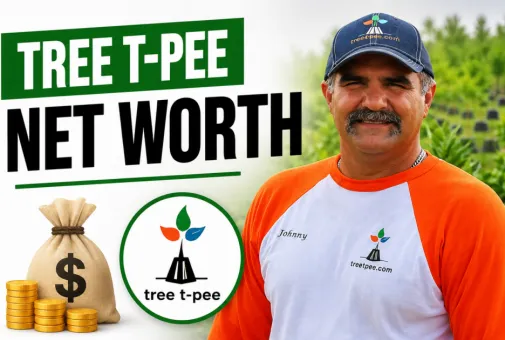
Tree T-PEE, officially styled as tree T-PEE, is an agricultural water-conservation product created by Johnny Georges through GSI Supply, Inc. The company became nationally known after Georges appeared on Shark Tank Season 5 in 2013 and secured a deal from billionaire entrepreneur John Paul DeJoria.
The product is a cone-shaped device placed around young trees. It helps direct water and fertilizer toward the roots, protects trees from wind and frost, and reduces waste in irrigation. The idea came from the citrus industry, where water costs, frost damage and crop survival can directly affect a farmer’s livelihood.
As of 2026, Tree T-PEE’s exact net worth is not publicly verified. Some online sources estimate the business at over $100 million, but that number should be treated carefully because no official financial filing confirms it. A more responsible estimate would place the company’s value in a broad private-business range, likely depending on current revenue, distribution, inventory, intellectual property, margins and agricultural demand.
Quick Facts About Tree T-PEE
| Fact | Details |
|---|---|
| Company / Product Name | tree T-PEE / Tree T-PEE |
| Founder | Johnny Georges |
| Parent Company | GSI Supply, Inc. |
| Founded | 2005 |
| Industry | Agriculture, irrigation, water conservation, tree protection |
| Famous For | Shark Tank Season 5 pitch and water-saving farming product |
| Shark Tank Ask | $150,000 for 20% equity |
| Shark Tank Deal | $150,000 for 20% from John Paul DeJoria |
| Shark Tank Valuation | $750,000 implied valuation |
| Product Material | Made in the U.S. from 100% recycled plastic |
| Primary Use | Water containment, fertilizer efficiency, frost protection and young tree growth support |
| Official Status | Official website remains active with product and ordering information |
| Estimated Net Worth | Private and unverified; online estimates range from mid-seven figures to $100M+ |
Tree T-PEE Net Worth: What Is the Company Worth in 2026?
The most searched question is simple: What is Tree T-PEE net worth today? The honest answer is that no exact public number exists. Tree T-PEE is not a publicly traded company, so it does not publish SEC filings, quarterly earnings reports, balance sheets or verified annual revenue figures.
Many websites repeat a $100 million valuation, but most do not show a primary source for that figure. That does not automatically mean the company is unsuccessful. It simply means readers should not treat the $100 million number as confirmed.
A smarter way to estimate Tree T-PEE’s value is to look at available signals: Shark Tank valuation, current product pricing, niche market demand, farmer adoption, water conservation relevance, intellectual property, manufacturing scale and possible distribution reach.
Realistic Valuation View
| Valuation Level | What It Means | How Reliable It Is |
|---|---|---|
| $750,000 | Implied valuation during the 2013 Shark Tank deal | Confirmed by the pitch structure |
| $5 million to $10 million | Conservative private-business estimate if annual sales remain moderate | Possible, but not officially confirmed |
| $10 million to $25 million | Possible if revenue, margins and distribution are stronger | Reasonable scenario, still unverified |
| $100 million+ | Common online claim repeated by many blogs | Unverified and should be treated carefully |
For a private agricultural product company, valuation depends heavily on revenue and profit. If a company earns $5 million in annual revenue, a $100 million valuation would require a very high revenue multiple unless the company has major patents, huge growth, strong margins or large strategic buyer interest. Without official numbers, the safest conclusion is: Tree T-PEE is a successful Shark Tank business, but its exact net worth remains private.
Who Founded Tree T-PEE?
Johnny Georges founded GSI Supply, Inc. in 2005. The official Tree T-PEE website says GSI was established on March 2, 2005, by John G. Georges, better known as Johnny.
Johnny’s background is deeply tied to Florida agriculture. He grew up around irrigation, citrus groves, pumps, motors and fieldwork. According to the company’s official story, he worked for his father for more than 20 years and helped install irrigation across tens of thousands of acres of citrus land.
That field experience matters. Tree T-PEE did not come from a boardroom brainstorm. It came from years of watching farmers lose water, fertilizer, energy and young trees to inefficient practices.
The Role of Rick Georges and the Citrus Industry
Tree T-PEE’s story starts with Johnny’s father, Rick Georges, a pioneer in citrus irrigation. The official company history credits Rick with inventing the micro-sprinkler, originally called the Geor-Jet, in 1970.
That innovation changed how water reached individual trees. Instead of using broad overhead irrigation, water could be directed more precisely. This reduced water use and helped increase heat around groves during frost conditions.
The early Tree T-PEE idea was also connected to frost protection. Farmers used a method called banking trees, where dirt was packed around young trees before freezing nights and removed later. It worked, but it required heavy labor. Rick Georges developed a cone concept to make frost protection easier. Johnny later improved the concept by focusing on water conservation, fertilizer efficiency and practical field use.
What Is Tree T-PEE and How Does It Work?
Tree T-PEE is a cone-shaped water and nutrient containment system designed for trees between one and five years old. The official product page says it is made in the United States from 100% recycled plastic.
The device is placed around the base of a young tree. When used with drip or micro-sprinkler irrigation, it keeps water and fertilizer inside the cone area instead of letting wind, runoff or overspray waste it. This helps direct resources toward the root zone.
Main Product Benefits
| Benefit | How Tree T-PEE Helps |
|---|---|
| Water Conservation | Contains irrigation water and directs it toward the roots |
| Fertilizer Savings | Keeps fertilizer near the tree instead of feeding weeds and grass |
| Frost Protection | Traps warmth and mist around young trees during cold nights |
| Wind Protection | Reduces wind diffusion that can blow water away from the tree |
| Growth Support | Helps maintain moisture around the root zone |
| Durability | Official FAQ says Tree T-PEEs have been known to last 20+ years |
The company claims the product can save approximately 90% water compared with traditional watering practices. Its FAQ also says farmers may use 75% less fertilizer because nutrients are concentrated where the tree needs them.
Tree T-PEE on Shark Tank
Johnny Georges appeared on Shark Tank in 2013 during Season 5. He asked for $150,000 in exchange for 20% equity, which implied a $750,000 business valuation at the time.
His pitch became memorable because it was not built around flashy branding or aggressive profit claims. Johnny focused on farmers, water savings and his father’s legacy. He explained that he made only about $1 profit per unit because he wanted farmers to afford the product.
Some Sharks questioned whether the product was priced too low. Kevin O’Leary was concerned about margins. But guest Shark John Paul DeJoria, co-founder of John Paul Mitchell Systems and Patrón Spirits, connected with Johnny’s mission and offered exactly what he asked for.
Shark Tank Deal Summary
| Pitch Detail | Information |
|---|---|
| Founder | Johnny Georges |
| Product | Tree T-PEE |
| Season | Shark Tank Season 5 |
| Ask | $150,000 for 20% |
| Investor | John Paul DeJoria |
| Deal | $150,000 for 20% |
| Implied Valuation | $750,000 |
| Original Selling Price Discussed | $4.50 per unit |
| Approximate Cost Discussed | $2.95 per unit |
Why John Paul DeJoria Invested
John Paul DeJoria is not only a billionaire entrepreneur. He is also known for supporting sustainability, philanthropy and mission-driven businesses. His background includes building John Paul Mitchell Systems and co-founding Patrón Spirits Company.
DeJoria saw two things in Tree T-PEE: a useful agricultural product and a founder with genuine commitment to farmers. Johnny was not trying to squeeze every possible dollar out of growers. He wanted to make the product affordable while still creating enough profit to survive.
That balance made the Shark Tank moment powerful. It showed that a business can be practical, profitable and purpose-driven at the same time.
What Was Tree T-PEE Worth Before Shark Tank?
Before Shark Tank, Tree T-PEE’s implied valuation was $750,000, based on Johnny’s ask of $150,000 for 20% equity. At that point, the company had already produced a large number of units and had farmers using the product, but it was still mostly known in agricultural circles rather than by the general public.
Johnny’s biggest challenge was not proving the product worked. It was changing farmer behavior. Many growers had used the same irrigation habits for decades. Asking them to adopt a new device required trust, demonstrations and patience.
The Shark Tank Effect on Tree T-PEE
After the Shark Tank episode aired, Tree T-PEE received national attention. The story connected with viewers because it had all the pieces of a strong business narrative: family legacy, environmental value, farmer support, emotional honesty and a simple product people could understand quickly.
Media coverage from Growing Produce reported that the deal gave Johnny and DeJoria a platform to push the product globally. The article noted that water conservation was a major issue in Florida and that Tree T-PEE could help growers reduce water use while protecting trees.
Shark Tank exposure likely increased brand awareness, inbound demand and investor confidence. However, long-term success still depended on manufacturing, distribution, farmer adoption and pricing.
Tree T-PEE Revenue: How Does the Company Make Money?
Tree T-PEE makes money primarily by selling units to farmers, orchard owners, growers, nurseries and possibly homeowners with young trees. The company’s official product page currently directs customers to call to order, which suggests a direct-sales or bulk-order model rather than a typical small e-commerce checkout.
The product is especially relevant for citrus, nut trees, fruit trees, avocado trees, olive trees, grapevines and other single-trunk trees using drip or micro-sprinkler irrigation.
Main Revenue Sources
- Direct product sales to farmers and growers
- Bulk agricultural orders for orchards and groves
- Distributor or retail partnerships where available
- International expansion into drought-prone farming regions
- Replacement and reuse cycles when growers plant new trees
- Specialized agricultural applications beyond citrus
Because Tree T-PEE is a physical product, revenue depends on unit volume, manufacturing cost, shipping cost, wholesale pricing and farmer demand. It is not a software company with near-zero marginal costs. Every unit must be made, stored and delivered.
Why the 0 Million Net Worth Claim Needs Context
Many competitor articles say Tree T-PEE is worth over $100 million. That number may be attractive for SEO, but it needs context. A private company’s value cannot be confirmed unless there is a sale, investment round, official disclosure, acquisition filing or audited financial data.
Tree T-PEE may be valuable, but a $100 million valuation would normally require strong revenue, strong margins, large-scale distribution or strategic importance. Without confirmed revenue, profit or acquisition interest, the number remains speculative.
A more trustworthy article should say this clearly: $100 million is a widely repeated estimate, not a verified valuation.
Tree T-PEE Product Price and Profit Margin
During the Shark Tank pitch, Johnny Georges discussed selling units at $4.50 with a cost around $2.95, leaving a small profit. He kept the price low because his target customers were farmers, and he wanted the product to be affordable.
Later online Shark Tank update sources reported that Tree T-PEE units were sold for around $9.95, often with minimum order quantities. The official website currently asks customers to call to order, so current pricing may depend on volume, location, shipping and order type.
This price history matters because margin improvement can change valuation. If the company sells more units at higher margins while keeping farmer adoption strong, the business becomes more financially attractive.
Tree T-PEE’s Agricultural Value
The biggest value of Tree T-PEE is not only money. It is agricultural efficiency. Water is one of the most important resources in farming, especially in regions facing drought, rising irrigation costs or tighter environmental rules.
Tree T-PEE helps solve a real field problem: water sprayed near a tree often spreads beyond the root zone. Wind can push it away. Fertilizer can feed weeds instead of the tree. Frost can damage young trees before they mature. A simple cone reduces those problems by controlling the environment around the young tree.
Practical Farming Benefits
- Less wasted irrigation water
- More targeted fertilizer use
- Reduced weed growth inside the cone area
- Better moisture retention around roots
- Extra frost protection during cold nights
- Potential support for stronger root development
- Reusable product life for multiple planting cycles
For farmers, these benefits can translate into lower input costs and better survival rates for young trees. That is why the product’s value proposition remains relevant long after Shark Tank.
Is Tree T-PEE Still in Business?
Yes, Tree T-PEE appears to still be in business. The official website remains active, lists product information, provides a phone number for ordering and displays updated website copyright information through 2026.
The official product page says customers can call to order. The company also keeps educational pages explaining how Tree T-PEE works, including containment, increased growth, wind diffusion and frost protection.
Some people question the business status because social media activity has not always been consistent. But social media silence does not prove a company is closed, especially in agriculture, where sales can happen directly through phone calls, distributor relationships and farmer networks.
Tree T-PEE Net Worth Growth Timeline
| Period | Business Stage | Estimated Value Impact |
|---|---|---|
| Before 2005 | Original frost-protection concept developed from Rick Georges’ field experience | Product idea and early farming application |
| 2005 | GSI Supply, Inc. established by Johnny Georges | Formal business foundation |
| 2005–2012 | Regional sales and farmer education | Slow growth, field validation |
| 2013 | Shark Tank pitch and John Paul DeJoria investment | $750,000 implied valuation |
| 2014–2017 | National attention and global expansion efforts | Major brand awareness increase |
| 2018–2026 | Ongoing niche agricultural sales and sustainability relevance | Private valuation unknown; online estimates vary widely |
Is Johnny Georges a Millionaire?
Johnny Georges may be a millionaire on paper if Tree T-PEE has meaningful equity value, but his personal net worth is not publicly verified. Many websites call him a millionaire because they assign a high valuation to Tree T-PEE, but company value and founder net worth are not the same thing.
A founder’s net worth depends on ownership percentage, company debt, distributions, salary, taxes, personal assets and whether the business could actually sell for the estimated amount. Since Tree T-PEE is private, Johnny Georges’ exact personal wealth remains unknown.
What is clear is that Johnny built a respected agricultural product and became one of Shark Tank’s most memorable founders because of his sincerity and farmer-first approach.
Tree T-PEE vs Traditional Irrigation
| Feature | Traditional Open Irrigation | Tree T-PEE System |
|---|---|---|
| Water Direction | Water can spread outside the root zone | Water is contained around the young tree |
| Wind Impact | Wind can blow spray away | Cone blocks wind diffusion |
| Fertilizer Use | Fertilizer may feed weeds and grass | Nutrients stay closer to the tree |
| Frost Protection | Requires other labor-heavy methods | Helps trap warmth and mist near the tree |
| Efficiency | More waste possible | Designed for targeted resource use |
Why Tree T-PEE Still Matters in 2026
Tree T-PEE remains relevant because water scarcity, drought, irrigation costs and sustainable agriculture are bigger issues than they were when the company started. Farmers need practical tools that reduce input waste without requiring expensive technology or complicated training.
Unlike many modern AgTech products, Tree T-PEE is simple. It does not require an app, subscription, sensor network or advanced software. That simplicity may be one of its strongest advantages. A farmer can understand the product by looking at it, installing it and seeing how water behaves around the tree.
In a world where agriculture often gets pushed toward complex systems, Tree T-PEE stands out because it solves a specific problem with a physical, reusable product.
Content Gaps Competitors Usually Miss
Most competitor articles repeat the same numbers without explaining whether they are verified. A stronger article should add context around valuation, product economics, farmer adoption and the difference between revenue, profit and net worth.
Important Missing Points
- The $100 million valuation is widely repeated but not officially confirmed.
- Tree T-PEE is a private company, so exact financials are not public.
- The Shark Tank valuation was $750,000, not $100 million.
- Product value comes from water savings, fertilizer savings and frost protection.
- Founder net worth is different from company valuation.
- Social media inactivity does not necessarily mean the company is closed.
- Water scarcity and sustainable farming make the product more relevant today.
FAQs About Tree T-PEE Net Worth
What is Tree T-PEE net worth in 2026?
Tree T-PEE’s exact net worth is not publicly verified. Some websites claim it is worth over $100 million, but that figure is not confirmed by official financial statements. A more careful estimate would describe the company as a successful private agricultural product business with an unknown valuation.
Is Tree T-PEE really worth $100 million?
The $100 million number is widely repeated online, but no primary source clearly verifies it. Because Tree T-PEE is privately held, readers should treat that figure as an estimate or claim, not a confirmed valuation.
Who owns Tree T-PEE?
Tree T-PEE was founded by Johnny Georges through GSI Supply, Inc. After Shark Tank, John Paul DeJoria became an investor by agreeing to a $150,000 deal for 20% equity.
How much did Tree T-PEE get on Shark Tank?
Johnny Georges secured $150,000 for 20% equity from guest Shark John Paul DeJoria during Shark Tank Season 5.
What was Tree T-PEE valued at on Shark Tank?
The Shark Tank deal implied a valuation of $750,000, based on Johnny Georges asking for $150,000 in exchange for 20% equity.
Is Tree T-PEE still in business?
Yes. Tree T-PEE appears to still be in business. Its official website remains active, lists product details and provides a phone number for orders.
What does Tree T-PEE do?
Tree T-PEE is a cone-shaped device placed around young trees to contain water and fertilizer, protect against wind diffusion, support root hydration and provide frost protection.
How much water does Tree T-PEE save?
The company says Tree T-PEE can save approximately 90% water compared with traditional watering practices by containing water around the tree’s base.
What is Tree T-PEE made of?
The official product page says Tree T-PEE is made in the United States from 100% recycled plastic.
Is Johnny Georges a millionaire?
Johnny Georges may have significant equity value through Tree T-PEE, but his exact personal net worth is not publicly confirmed.
Key Takeaways
- Tree T-PEE net worth is not officially confirmed because the company is private.
- The frequently repeated $100 million valuation is not backed by clear public financial filings.
- Tree T-PEE was valued at $750,000 during its Shark Tank pitch.
- Johnny Georges received $150,000 for 20% from John Paul DeJoria.
- The product helps conserve water, fertilizer and energy while protecting young trees.
- Tree T-PEE is still relevant because water conservation and sustainable farming are major agricultural priorities.
- The company appears active through its official website and ordering information.
Final Thoughts
Tree T-PEE is one of the best examples of a Shark Tank business built around practical value rather than hype. Johnny Georges did not pitch a luxury product or a trendy app. He pitched a tool for farmers: simple, durable, water-saving and rooted in real agricultural experience.
The company’s exact net worth in 2026 remains private. While $100 million is often repeated online, a trustworthy article should explain that the figure is unverified. What can be said with confidence is that Tree T-PEE grew from a regional farming product into a nationally recognized agricultural innovation after Shark Tank.
Its real value is not only in dollars. It is in water saved, young trees protected, fertilizer used more efficiently and farmers given a practical tool during a time when agriculture needs smarter resource management.
References & Sources
This article has been fact-checked and verified against multiple public sources, financial disclosures, SEC filings, Forbes reports, Celebrity Net Worth databases, and official records. All net worth estimates are based on publicly available information and financial analysis.