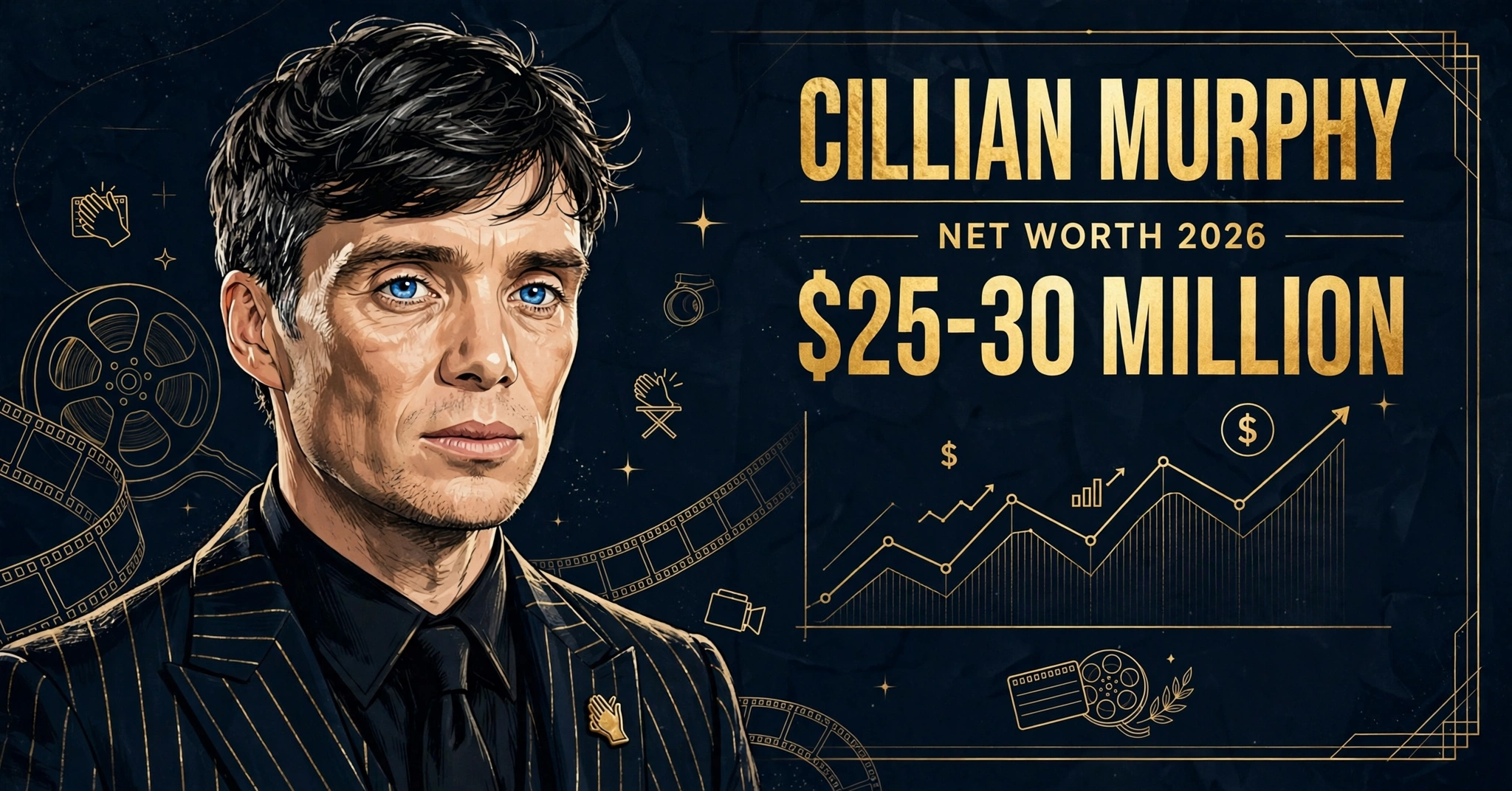
Cillian Murphy’s net worth in 2026 is estimated at $20–30M. We break down the $10M Oppenheimer payday, Peaky Blinders salary arc, The Immortal Man, Big Things Films and the Versace deal.
Last updated: October 1, 2026 · By Nathan Cole
Cillian Murphy’s net worth in 2026 is estimated between $20 million and $30 million. Celebrity Net Worth, the most-cited tracker, holds the figure at $20 million — a number that has barely budged even after Oppenheimer. A handful of outlets push it as high as $65 million. The evidence points closer to the low end, and the reason is unusual for an A-lister: Murphy built his fortune almost entirely from acting fees, with no franchise backend, no business empire, and — until recently — no endorsement deals at all.
Then came 2023. A reported $10 million paycheck for Oppenheimer, a film that grossed $952 million worldwide, and an Academy Award for Best Actor in March 2024 — the first ever won by an Irish-born performer. That single role reset his market value. March 2026 brought the next chapter: Peaky Blinders: The Immortal Man, which premiered in Birmingham on March 2 and landed on Netflix on March 20, with Murphy returning as Tommy Shelby and carrying a producer credit.
This profile breaks down every reported payday, the production-company economics most trackers ignore, and exactly why the published estimates disagree by tens of millions of dollars.
Quick Facts
| Net Worth (2026) | $20–30 million (estimated) |
| Full Name | Cillian Murphy |
| Born | May 25, 1976, Douglas, County Cork, Ireland (age 50) |
| Profession | Actor, producer |
| Nationality | Irish |
| Spouse | Yvonne McGuinness (married 2004) |
| Known For | Peaky Blinders, Oppenheimer, Inception, 28 Days Later |
| Wealth Sources | Film salaries, television salaries, producing fees, endorsements |
| Last Updated | October 1, 2026 |
How This Estimate Was Made
This figure is an independent estimate — Cillian Murphy has never disclosed his finances publicly. Our process: gather every credibly reported salary, deal, and asset; cross-check them across reputable outlets; allow for taxes, representation fees, and spending; and publish a range wherever sources disagree, with the reasoning shown in the article. Anything uncertain is labeled as an estimate, not a fact.
+
The Million Role That Changed Everything
Murphy was reportedly paid $10 million to play J. Robert Oppenheimer, per ComingSoon and MarketRealist — the largest single paycheck of his career, and the highest fee on the film. His co-stars took notably less: Variety reported Robert Downey Jr., Emily Blunt, and Matt Damon each earned around $4 million. Murphy out-earned all of them as the lead.
A minority of outlets cite a lower figure — Sportskeeda, via ClutchPoints, put his Oppenheimer fee at $5 million. The $10 million number is the one most outlets repeated, and it squares with the film’s $180 million budget and Murphy’s position as the sole lead. Either way, it dwarfed anything he had earned before.
The financial upside didn’t end with the base salary. Oppenheimer grossed $952 million worldwide against that $180 million budget, and Murphy won the Oscar in March 2024. Backend bonuses on a hit that size typically add meaningful money on top of base pay, though no outlet has published his exact participation. What is documented: his asking price for films rose sharply afterward, with outlets citing figures in the $5–8 million range per picture.
Peaky Blinders: From 0,000 to Million an Episode
Tommy Shelby was the role that made Murphy a global star — and one of the strangest salary arcs in television. Across 36 episodes from 2013 to 2022, his per-episode fee reportedly climbed from roughly $100,000 in the early seasons to around $2–2.2 million by the final run, according to figures aggregated from The Things and repeated by MarketRealist, FandomWire, and Animated Times. Murphy also held a co-executive producer credit on the series.
The early number reflects what the show was in 2013: a BBC Two gamble. By the later seasons it was a Netflix-fueled global hit, and the pay caught up. No official figures were ever released, so treat the arc as reported, not confirmed — but every outlet that covers it lands in the same band.
| Era | Reported per-episode fee | Source |
|---|---|---|
| Seasons 1–2 (2013–14) | ~$100,000–$350,000 | The Things, via ClutchPoints / MarketRealist |
| Seasons 3–4 (2016–17) | Seven figures (exact number unreported) | Animated Times, citing The Things |
| Seasons 5–6 (2019–22) | ~$2–2.2 million | The Things, via FandomWire / ComingSoon |
Cumulatively, the series likely delivered in the region of $15 million-plus across its run — one outlet, TrendCelebs, puts the total above $15 million. Streaming residuals from Netflix and the BBC keep paying after the fact, typically in the low hundreds of thousands per year for a catalog title of this size. Modest next to the headline fees, but it compounds.

The 2026 Slate: The Immortal Man, The Bone Temple, and the Sequel Series
March 2026 belonged to Tommy Shelby. Peaky Blinders: The Immortal Man premiered at Symphony Hall in Birmingham on March 2, opened in UK cinemas on March 6, and arrived on Netflix on March 20, 2026. The 112-minute film, directed by series veteran Tom Harper and written by creator Steven Knight, puts Murphy back in the flat cap alongside Rebecca Ferguson, Tim Roth, Barry Keoghan, and Stephen Graham — and carries his name as a producer.
January 2026 brought a second release: 28 Years Later: The Bone Temple, directed by Nia DaCosta. Murphy appears in a cameo at the film’s end and served as an executive producer on the first 28 Years Later, per Consequence and RadioTimes — a quiet piece of backend economics on a horror franchise he helped launch in 2002.
The longer play is television. Netflix and the BBC have given a Peaky Blinders sequel series a two-season order, set in 1953 — a decade after The Immortal Man’s 1940s setting — with Murphy executive-producing alongside Knight, per ScreenRant and CBR. EP fees on a two-season prestige order are meaningful money even before a frame is shot.

Big Things Films: The Production Company Play
Most net-worth trackers describe Murphy as an actor with no business interests. That stopped being true in 2023, when he launched Big Things Films with producer Alan Moloney. The company’s first project, Small Things Like These, opened the Berlin Film Festival in 2024 — Emily Watson won the Silver Bear — and was distributed by Lionsgate, co-produced with Ben Affleck and Matt Damon’s Artists Equity, per Collider and Pinkvilla.
The slate kept moving. Steve, a 2025 Netflix drama in which Murphy played a headteacher opposite Jay Lycurgo, carried his producer credit. The Immortal Man lists him as a producer too. Producer fees on mid-budget features typically run in the high six to low seven figures per project — and equity in a working production company is an asset class most Murphy profiles never mention.
This is the single biggest gap in competitor coverage. The top-ranking net-worth pages still write that Murphy has “no business ventures.” He has had one since 2023, with three released projects behind it.
The Versace Deal: His First-Ever Endorsement
For two decades Murphy took no endorsement money — a deliberate choice, consistent with a man who has no social media and moved his family back to Dublin to avoid the celebrity machine. That changed after the Oscar. In 2024 he became the face of Versace Icons, the Italian house’s essentials line, in a campaign that drew on the label’s bold 1990s men’s ads. He had hinted at the ambassadorship on Oscars night itself, wearing a custom-made Atelier Versace tux, and handpicked a Fontaines D.C. track — “Boys in the Better Land” — to score the spot, per NDA News IE.
Neither side disclosed the fee. Global luxury ambassadorships at this level are typically seven-figure annual deals, and Murphy’s post-Oscar heat put him in the top tier of that market. Competitor pages that claim he has “minimal” or “no” endorsement income are working from pre-2024 information.
What He Owns: A Dublin Home and a Dingle Cinema
Murphy’s property footprint is modest by Hollywood standards. The family home is in Monkstown, County Dublin, which Financial News values at around €1.7 million — a comfortable figure that reflects a man who chose Dublin over Los Angeles. There is no reported LA mansion, no portfolio of investment flats, no property empire.
The more interesting asset is cultural. In 2024 Murphy and his wife Yvonne McGuinness bought the Phoenix Cinema in Dingle, County Kerry — a small-town picture house they are restoring as a non-profit venture, per Irish Times-derived reporting. It is a bet on community cinema rather than a wealth play, and it fits the pattern: money goes toward things he cares about, not things that compound.
The Long Road: 1996 to Oppenheimer
Murphy’s career started on stage, not screen — his professional debut was Disco Pigs in 1996, and his 2011 one-man show Misterman won him an Irish Times Theatre Award and a Drama Desk Award. Before acting paid, he played in a band, The Sons of Mr. Green Genes, and turned down a record deal — widely reported as a refusal to play covers instead of originals. The music money never materialized. The acting money took 25 years.
The Nolan relationship did the heavy lifting. Batman Begins (2005), The Dark Knight (2008), Inception (2010), Dunkirk (2017) — Murphy was the director’s recurring utility player long before he was his leading man. Supporting roles in studio blockbusters pay well but not spectacularly; the widely reported pre-Oscar per-film band for Murphy was $1–3 million. Add 28 Days Later (2002), Red Eye (2005), Breakfast on Pluto (2005), and A Quiet Place Part II (2021), and you get a 25-year filmography of steady, unspectacular paydays — the slow compounding that got him to roughly $10 million before the Peaky Blinders money and Oppenheimer arrived.
| Film | Year | What we know about the money |
|---|---|---|
| 28 Days Later | 2002 | Breakout lead; indie budget ($8M) — fee unreported, necessarily modest |
| Batman Begins / The Dark Knight | 2005 / 2008 | Supporting role (Scarecrow); studio supporting fees, unreported |
| Inception | 2010 | Supporting (Robert Fischer); film grossed $839M — no backend reported for Murphy |
| Dunkirk | 2017 | Supporting (Shivering Soldier); unreported fee |
| A Quiet Place Part II | 2021 | Co-lead; unreported fee |
| Oppenheimer | 2023 | Reported $10M base — his largest single payday |
| Small Things Like These / Steve | 2024 / 2025 | Lead + producer fees (Big Things Films); unreported |
Why Estimates Range From Million to Million
The spread is one of the widest in the net-worth niche, and it comes down to methodology, not new information. Celebrity Net Worth’s $20 million is the conservative anchor — it counts reported earnings minus standard haircuts and has barely moved since before the Oscar. SocialLifeMagazine publishes $20–35 million, folding in Oppenheimer residuals, Peaky Blinders backend, Big Things Films, and the Versace deal.
Then the outliers. TrendCelebs lands at $30 million. CelebTrendNow claims $65 million, built on a post-Oscar per-film rate of $8–12 million applied generously across an assumed slate. That rate is not sourced to any outlet’s reporting — it appears to be the site’s own extrapolation. ILikeToDabble’s $50 million figure dates to a page last updated over a year and a half ago and reads as stale.
| Source | Figure | Basis | Our read |
|---|---|---|---|
| Celebrity Net Worth | $20M | Reported earnings minus standard deductions | Credible floor; slow to reflect 2024–26 income |
| SocialLifeMagazine | $20–35M | CNW base + residuals, backend, company, Versace | Best-argued range; matches our analysis |
| TrendCelebs | $30M | Income-source buildup ($10M Oppenheimer, $15M+ Peaky) | Reasonable ceiling |
| CelebTrendNow | $65M | Unsourced $8–12M/film rate extrapolated forward | Outlier; rate not tied to reported deals |
The Math Behind the Estimate
The following is illustrative — it shows how the reported numbers add up, not a bank statement. Take the reported headline earnings: roughly $15 million-plus from Peaky Blinders, $10 million from Oppenheimer, and perhaps $10–15 million from the pre-2023 film career. That is $35–40 million in gross career earnings before the Oscar.
Now apply the haircuts every working actor pays. Ireland’s top income tax rate runs at 40% plus USC and PRSI; UK and US work adds its own layers. A standard 10% goes to the agent, another 5–10% to managers and lawyers. Murphy lives well but not lavishly — no private jet, no reported supercar collection. After taxes, fees, and two decades of living costs, retaining $20–25 million from ~$40 million gross is exactly what you would expect. The post-Oscar income — Oppenheimer backend, Small Things Like These and Steve, the Versace deal, The Immortal Man — pushes the top of the range toward $30 million. Getting to $65 million would require either a franchise backend he never had or a per-film rate no outlet has actually reported him signing.
A Lifestyle That Doesn’t Spend Like a Movie Star
Murphy told The Guardian he feels embarrassed by his wealth — Financial News quotes his view that “actors are overpaid.” The spending record backs the modesty. He has no social media accounts, does no red-carpet brand circus beyond contractual duties, and moved his family from London back to Dublin for a quieter life. The two children, Malachy and Aran, were born in 2005 and 2007; he married artist Yvonne McGuinness in 2004.
This matters for the estimate in a specific way: low spending is a wealth compounder. An actor who banks $40 million gross and spends like a rock star keeps $15 million. One who lives in Monkstown and buys a community cinema keeps far more of it. Murphy’s frugality is the quiet variable that makes the $20–30 million range hold together.
Nolan, Knight, Boyle: The Collaborator Effect
Three relationships explain Murphy’s filmography — and his bank balance. Christopher Nolan cast him five times before handing him Oppenheimer; Steven Knight wrote Tommy Shelby specifically around him and keeps him as a producer on the franchise’s future; Danny Boyle gave him 28 Days Later and brought him back as an executive producer on the 28 Years Later films. Repeat collaborators are how character actors become wealthy without franchises: the trust converts into bigger roles, producer credits, and backend participation.
The Peaky Blinders sequel series may be the purest example. Murphy is not expected to star — the story jumps to 1953 with a new generation — but he executive-produces alongside Knight on a two-season Netflix/BBC order. That is franchise economics without franchise acting: fees and backend on a universe he helped build.
How His Peers’ Fortunes Compare
Murphy sits in the middle of his generation’s British-Irish leading men — richer than the indie purists, far behind the franchise players. The comparison explains his number better than any single figure does.
| Actor | Reported net worth | Why the gap |
|---|---|---|
| Cillian Murphy | $20–30M (est.) | Acting fees + producing; no franchise backend |
| Tom Hardy | ~$40M (reported) | Venom franchise paydays + producer roles |
| Idris Elba | ~$35M (reported) | Marvel + Fast & Furious supporting runs, DJ/producing sidelines |
| Robert Downey Jr. | ~$300M (reported) | Marvel backend — the machine Murphy never joined |
The pattern is clean: every actor above Murphy on this table touched a franchise backend. Murphy’s wealth is what a great actor earns without one. FandomWire notes he is not even the richest Peaky Blinders cast member — Tom Hardy, who played Alfie Solomons, sits ahead of him.
Sources & Reporting
Figures in this profile reflect reporting through September 2026. Key sources: Celebrity Net Worth (the $20 million baseline figure); Variety (the $4 million Oppenheimer fees for Downey, Blunt, and Damon); ComingSoon and MarketRealist (the reported $10 million Oppenheimer salary and the Peaky Blinders per-episode arc); The Things (the original $100K-to-$2.2M per-episode reporting, via multiple outlets); RadioTimes and Consequence (The Bone Temple cameo and executive-producer role, January 2026 release); ScreenRant and CBR (The Immortal Man’s March 2026 release dates and the 1953 sequel-series order); Collider and Pinkvilla (Big Things Films, Small Things Like These, Steve); NDA News IE (the Versace Icons campaign); Financial News (the Monkstown home valuation); Irish Times-derived reporting (the Phoenix Cinema purchase in Dingle). Where outlets disagree, the article explains why and publishes a range rather than picking a side.
Frequently Asked Questions
What is Cillian Murphy’s net worth in 2026?
Cillian Murphy’s net worth is estimated between $20 million and $30 million in 2026. Celebrity Net Worth holds the figure at $20 million, while other outlets range up to $35 million once Oppenheimer residuals, his Big Things Films production company, and the Versace deal are factored in. He has never disclosed his finances, so every published figure is an estimate.
How much did Cillian Murphy make for Oppenheimer?
Murphy was reportedly paid $10 million for Oppenheimer, per ComingSoon and MarketRealist — the largest single paycheck of his career and the highest fee on the film. A minority of outlets cite $5 million. For comparison, Variety reported that Robert Downey Jr., Emily Blunt, and Matt Damon each earned around $4 million for their supporting roles.
How much did Cillian Murphy earn per episode of Peaky Blinders?
His per-episode fee reportedly rose from around $100,000–$350,000 in the early seasons to roughly $2–2.2 million by seasons 5–6, according to figures from The Things repeated by multiple outlets. Across 36 episodes from 2013 to 2022, the series likely delivered $15 million-plus in total, and he also held a co-executive producer credit.
When did the Peaky Blinders movie come out?
Peaky Blinders: The Immortal Man premiered at Symphony Hall in Birmingham on March 2, 2026, opened in UK cinemas on March 6, 2026, and arrived on Netflix on March 20, 2026. The 112-minute film was directed by Tom Harper, written by Steven Knight, and stars Murphy as Tommy Shelby alongside Rebecca Ferguson, Tim Roth, Barry Keoghan, and Stephen Graham — with Murphy also credited as a producer.
Is Cillian Murphy in 28 Years Later: The Bone Temple?
Yes — he appears in a cameo at the end of the film, released in January 2026 and directed by Nia DaCosta. Murphy also served as an executive producer on 28 Years Later (2025), the franchise revival from Danny Boyle and Alex Garland that followed his 2002 breakout 28 Days Later.
Does Cillian Murphy have a production company?
Yes. He founded Big Things Films with producer Alan Moloney in 2023. Its projects include Small Things Like These (2024), which opened the Berlin Film Festival; the 2025 Netflix drama Steve; and Peaky Blinders: The Immortal Man (2026), on which Murphy carries a producer credit.
Who is Cillian Murphy’s wife?
Cillian Murphy has been married to Irish visual artist Yvonne McGuinness since 2004. They have two sons, Malachy (born 2005) and Aran (born 2007), and live in Monkstown, County Dublin, after moving back from London for a quieter family life. Together they bought the Phoenix Cinema in Dingle, County Kerry, as a non-profit restoration project.
Is Cillian Murphy the richest Peaky Blinders cast member?
No. Despite playing the lead, Murphy’s estimated $20–30 million fortune sits below co-star Tom Hardy — who played Alfie Solomons and is reported at around $40 million, largely from his Venom franchise paydays. Murphy’s wealth was built without any franchise backend, which is exactly why the gap exists.
WRITTEN BY
Nathan Cole
Nathan Cole is the editor of Guide Net Worth. He covers celebrity wealth the way a business desk covers earnings: reported figures first, estimates labeled as estimates, and no invented numbers. Every profile on this site passes through his desk before it publishes. About Guide Net Worth · Corrections: figures are updated when new reporting emerges — contact us via the About page if you spot an error.
References & Sources
This article has been fact-checked and verified against multiple public sources, financial disclosures, SEC filings, Forbes reports, Celebrity Net Worth databases, and official records. All net worth estimates are based on publicly available information and financial analysis.