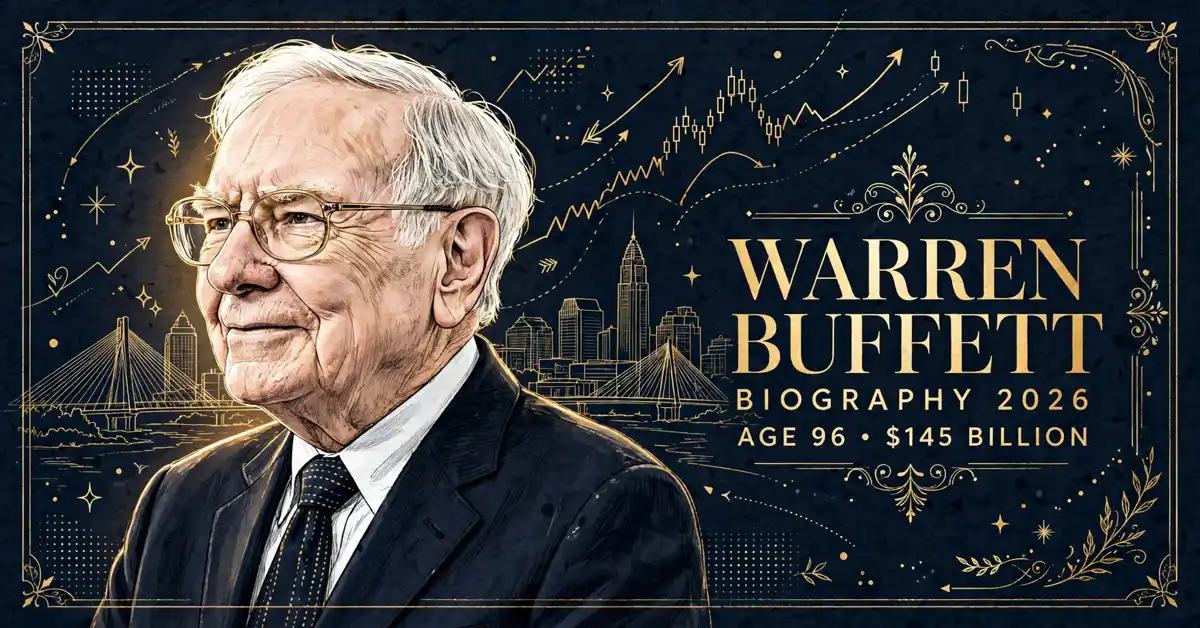
Warren Buffett is 96 in 2026 — the Oracle of Omaha who built a $145B fortune at Berkshire Hathaway, then handed the company over. His full life, sourced.
Last updated: November 7, 2026 · By Nathan Cole
Warren Buffett is 96 years old in 2026, worth an estimated $145 billion, and no longer in charge of the company that made him rich. After six decades at the top of Berkshire Hathaway, he handed the chief executive’s job to Greg Abel on January 1, 2026, and on September 18, 2026, he stepped down as chairman too, with his son Howard Buffett taking the chair. He remains a director and chair emeritus of a company worth about $1.1 trillion — the first non-technology American company ever to cross $1 trillion in market value.
The numbers behind that sentence are the largest in the history of personal investing. Buffett started with $100 of his own money and $105,000 from family and friends in 1956. By the end of 2024, Berkshire’s stock had risen more than 5.5 million percent since he took control in 1965, compounding at about 19.7 percent a year. A thousand dollars put into Berkshire at the end of 1964 was worth roughly $61 million by the end of 2025; the same thousand in the S&P 500 with dividends reinvested was worth about $462,000. And about 90 percent of his fortune arrived after his 65th birthday — the slow math of compounding, applied for 70 years without interruption.
This biography tells the whole story with the sources in the open: the Omaha childhood and the first stock bought at age 11, the Columbia years under Benjamin Graham, the partnership that never had a losing year, the textile mill he called the dumbest stock he ever bought, the insurance float that funded everything, the Coca-Cola and Apple stakes, the $397 billion cash pile he left his successor, the $60 billion-plus given away, and the 2026 handover that closed the longest chief-executive run in American business history.
Quick Facts
| Full Name | Warren Edward Buffett |
| Born | August 30, 1930, Omaha, Nebraska, USA (age 96 in 2026) |
| Net Worth 2026 | Estimated $145 billion (range $144B–$155B; Forbes Jan 2026 $148.9B; Bloomberg Oct 2026 $150B) |
| Company | Berkshire Hathaway — chairman 1970–2026, CEO 1965–2025, chair emeritus and director from September 2026 |
| Known As | The Oracle of Omaha |
| Education | University of Pennsylvania (Wharton, 1947–49); University of Nebraska, BS 1950; Columbia Business School, MS Economics 1951 |
| Salary | $100,000 a year from Berkshire Hathaway, unchanged for decades |
| Wives | Susan Thompson (married April 19, 1952; died July 29, 2004); Astrid Menks (married August 30, 2006) |
| Children | Susie (b. 1953), Howard (b. 1954), Peter (b. 1958) |
| Giving | Over $60 billion donated; co-founded The Giving Pledge (2010); pledged to give away 99% of his fortune |
| Honours | Presidential Medal of Freedom (2011) |
| Successor | Greg Abel, CEO from January 1, 2026; Howard Buffett, chairman from September 18, 2026 |
| Key Dates | First stock 1942 (age 11); partnership 1956; Berkshire control 1965; chairman 1970; billionaire 1985; world’s richest 2008; Giving Pledge 2010; CEO handover Jan 1, 2026; chair handover Sep 18, 2026 |
How This Biography Was Verified
The dates and figures in this article were checked against live 2026 reporting, not copied from a single profile. The 2026 handover comes from Britannica Money (updated October 18, 2026) and September 2026 reporting on the chair transition; the net-worth range is adjudicated from Forbes (January 2026, $148.9 billion), the Bloomberg Billionaires Index (October 19, 2026, $150 billion) and September 2026 reporting ($145 billion) — outlets disagree by about $10 billion because Berkshire’s share price moves daily, so this article prints the range and the reason for it. The cash pile ($397.4 billion at the end of Q1 2026, $365.5 billion at the end of Q2) comes from Berkshire’s own quarterly filings as reported in May and September 2026. The career facts — first stock at 11, the $105,000 partnership, the 1965 Berkshire takeover, the 1972 See’s Candies purchase, the 1988 Coca-Cola stake, the 1996 GEICO acquisition, the 2010 BNSF deal, the 2016 Precision Castparts purchase, the October 2025 OxyChem agreement — come from Wikipedia, EBSCO Research Starters and Berkshire’s annual reports. Where a competitor profile still calls Buffett chairman and CEO, it is stale: he left both jobs in 2026, and this article is written against the 2026 record. Nothing here is invented, and nothing is copied from a competitor’s sentences.
+
Omaha, 1930: A Congressman’s Son Learns to Count Money
Warren Edward Buffett was born on August 30, 1930, in Omaha, Nebraska, the second of three children and the only son of Howard Buffett, a stockbroker who later served four terms in the U.S. House of Representatives, and Leila Stahl Buffett. The Depression was a year old. His father lost his job when his brokerage firm failed, then rebuilt by starting his own firm, Buffett-Falk & Co., in 1931. The boy grew up in a house where the stock market was dinner-table conversation and where a father who had watched a firm collapse taught his son to respect risk before he taught him to chase return.
He showed the instinct early, and the numbers are specific enough to check. At six he bought six-packs of Coca-Cola from his grandfather’s grocery store for 25 cents and sold the bottles door to door for five cents each. At 11, in 1942, he bought his first stock: three shares of Cities Service Preferred at $38 a share. The price fell to $27, he sold at $40 for a small profit, and then watched the shares climb to nearly $200 — the lesson, which he has retold for 80 years, was that patience pays and that selling too soon is its own kind of loss.
At 13 he filed his first tax return, claiming a $35 deduction for the bicycle he used on his paper route. By the time he graduated from high school he had $9,800 in savings — the paper route, a golf-ball business, and at 15, a used pinball machine bought for $25 with his friend Don Danly and placed in a barbershop, which grew into a small route of machines they sold for $1,200. He also bought a 40-acre Nebraska farm with his savings while still a teenager, and rented it to a tenant farmer. The farm is still in the family story: the first asset he ever owned that paid him while he slept.
Wharton, Nebraska and the Professor Who Changed Everything
Buffett entered the Wharton School at the University of Pennsylvania in 1947, at 17. He left after two years, unimpressed — he later said he knew more than his professors about the only subject that mattered to him. He transferred to the University of Nebraska, graduated with a Bachelor of Science in Business Administration in 1950 at 19, and then did the one thing that shaped his whole career: he applied to Harvard Business School and was rejected. The rejection pushed him to Columbia, where Benjamin Graham, the father of value investing, was teaching.
At Columbia Business School he earned a Master of Science in Economics in 1951, studying directly under Graham, whose book The Intelligent Investor became Buffett’s bible. Graham’s rule was simple to state and hard to follow: buy a dollar of value for fifty cents, insist on a margin of safety, and treat a share as a piece of a business, not a ticker to trade. Buffett added his own refinement, learned later from Charlie Munger: buy a wonderful business at a fair price rather than a fair business at a wonderful price. The two ideas together — Graham’s discipline, Munger’s quality filter — are the whole of Buffett’s method, and he has never claimed otherwise.
He also took courses at the New York Institute of Finance to sharpen his economics background, and after Columbia he wanted to work for Graham for free. Graham said no at first, then relented: Buffett joined Graham-Newman in 1954. The two years there were his apprenticeship, and the job taught him the discipline he would apply for the next 70 years — read everything, buy only what you understand, and wait.
Graham-Newman and the GEICO Visit That Made His Career
Buffett’s most famous single day as a young analyst came in 1951, before he ever worked for Graham. On a Saturday, while Graham was teaching at Columbia, Buffett took a train to Washington, knocked on the door of the Government Employees Insurance Company, and found the office closed except for one man: Lorimer Davidson, who would later become GEICO’s chief executive. Davidson spent four hours walking the 21-year-old through the insurance business — how premiums arrive before claims are paid, how the money in between can be invested, how a low-cost direct seller beats an agent network. Buffett put $10,282 into GEICO stock, sold it a year later for a small profit, and never forgot the lesson.
At Graham-Newman from 1954 to 1956 he did the unglamorous work: reading Moody’s manuals, annual reports and filings, hunting for the mispriced securities Graham’s method demanded. The firm closed in 1956 when Graham retired, and Buffett, 25 years old, went home to Omaha with a reputation in a small circle and a plan: run his own partnership, apply Graham’s rules, and charge no fee unless his partners made money.
The GEICO lesson stayed with him for the rest of his life. Insurance float — the premiums collected before claims are paid — became the funding engine of Berkshire Hathaway, and in 1996 Berkshire bought the whole of GEICO for $2.3 billion. The $10,282 stake from 1951, the four-hour Saturday lesson, and the $2.3 billion acquisition 45 years later are one continuous thread: Buffett learned insurance at 21 and spent the next seven decades turning it into the cheapest money in American business.
The Partnership: 5,000 and Thirteen Years Without a Losing One
In 1956 Buffett founded Buffett Partnership Ltd. with $100 of his own money and $105,000 raised from family and friends — seven limited partners who trusted a 25-year-old with their savings. The terms were Graham’s: no management fee, only a share of profits above a hurdle. The partnership compounded at roughly 29.5 percent a year and never had a losing year across its thirteen-year life, 1957 to 1969, while the Dow rose about 7 percent a year over the same stretch.
The mechanics were the Graham method applied with total concentration: a handful of positions, each one understood down to the last filing, bought when the market priced them below the value of the business. He bought a department store, a windmill company, an insurance company — whatever the numbers said was cheap, in whatever industry. The partnership’s returns made him a millionaire at 32 and a multi-millionaire by 39, when he wound the partnership down in 1969 and returned the money, keeping about $25 million for himself. He told his partners the market had grown too expensive for his method, and that he could no longer find enough bargains to justify their trust. It was the first time he walked away from money because the price was wrong, and it would not be the last.
Inside the partnership he also made the purchase that defined the rest of his life. In 1962 he began buying shares of Berkshire Hathaway, a struggling New England textile manufacturer, at $7.50 a share. The mill’s president, Seabury Stanton, offered to buy Buffett’s shares back at $11.50, then sent a tender letter at $11.375 — an eighth of a dollar less than promised. Buffett, insulted, refused to sell and bought control of the company instead in 1965. He later called Berkshire “the dumbest stock I ever bought,” and meant it: the textile business was dying, the mill closed in 1985, and he spent two decades saying the money should have gone into insurance instead. The dumbest stock became the vehicle for the greatest fortune in investing history.
Berkshire Hathaway: From a Dying Mill to a id=”berkshire” style=”border-bottom:2px solid #c9a227;padding-bottom:10px;margin-top:2.2em;scroll-margin-top:90px;” Trillion Empire
Buffett became chairman of Berkshire Hathaway in 1970 and began writing the annual letters to shareholders that became the most-read documents in American business. His move was to stop feeding the textile mill and start using its cash to buy insurance companies, whose float — premiums in hand before claims are paid — gave him a growing pool of low-cost capital to invest. National Indemnity came in 1967 for $8.6 million. GEICO followed in full in 1996. The mill was gone by 1985; the holding company it left behind kept the name and nothing else.
From 1970 to 2026 Buffett presided as chairman and largest shareholder of one of America’s foremost holding companies, and from 1965 through the end of 2024 Berkshire’s stock rose more than 5.5 million percent — an average annual return of about 19.7 percent, against about 10 percent for the S&P 500 with dividends. In August 2024 Berkshire became the first non-technology American company to cross $1 trillion in market capitalisation, and by September 2026 it was worth about $1.1 trillion, the 14th most valuable company in the world. In 2025 the conglomerate generated $371.4 billion in revenue and finished the year with $717.4 billion in shareholders’ equity.
The empire now spans more than 60 businesses and employs over 400,000 people: GEICO and National Indemnity in insurance, BNSF Railway in freight, Berkshire Hathaway Energy in utilities, Dairy Queen, See’s Candies, Duracell, Fruit of the Loom, NetJets and Pilot Flying J among the operating companies, plus a public stock portfolio of roughly $300 billion. The structure is the point: wholly owned cash-generating businesses feed dividends and float into the portfolio, the portfolio feeds the businesses, and the whole machine runs on a single rule — never overpay, never sell a good business, and keep a mountain of cash for the day prices fall.
The Float: How Insurance Paid for Everything
The single most important idea in Buffett’s career is also the least glamorous: insurance float. When GEICO or National Indemnity collects a premium, it holds the money for months or years before paying the claim, and during that window Berkshire can invest it. The float has grown into the hundreds of billions, it costs Berkshire almost nothing when underwriting is disciplined, and it is the reason a textile mill could buy a railroad.
The discipline is the hard part, and Buffett has said so in letter after letter. An insurer that underprices policies to win market share pays for the float with losses; an insurer that prices correctly gets paid to hold other people’s money. Berkshire’s insurance operations have underwritten profitably in most years, which means the float has often cost less than zero — the company was paid to borrow. Competitors who copy the structure without the discipline end up with the opposite: expensive money and shrinking capital.
That is why the 1951 Saturday with Lorimer Davidson matters more than any single stock pick. Buffett understood at 21 that insurance is a funding business before it is an investing business, and he spent the next 70 years scaling that insight: first the partnership, then National Indemnity, then GEICO, then the reinsurance operations that now write some of the largest policies on earth. The Coca-Cola stake, the Apple stake, the BNSF railroad — all of them were bought, in the end, with insurance money.
The Deals That Built the Fortune
Buffett’s best purchases share a pattern: a simple business, a durable advantage, honest management, and a price that left room to be wrong. The table below lists the ones that matter most, with the figures as reported.
| Deal | Year | Price / Note |
| National Indemnity | 1967 | $8.6 million — the first insurance float engine |
| See’s Candies | 1972 | $25 million — Munger’s quality lesson; has returned over $2 billion in profits |
| Coca-Cola | 1988 | ~$1.3 billion for 6.3%; 400 million shares now pay about $816 million a year in dividends |
| GEICO (full) | 1996 | $2.3 billion — 45 years after the $10,282 first stake |
| Dairy Queen | 1997 | $585 million |
| BNSF Railway | 2010 | $26 billion cash and stock ($44 billion including debt) |
| Apple | 2016–18 | Built to a peak of about $174 billion at end-2023; trimmed heavily in 2024 |
| Precision Castparts | 2016 | $37.2 billion — Berkshire’s largest acquisition |
| OxyChem | 2025 | $9.7 billion — his last major acquisition as CEO (October 2025) |
Two of those deals deserve a closer look. See’s Candies cost $25 million in 1972 — a price Munger had to talk Buffett into paying, because it was more than the Graham formula allowed — and it has since returned more than $2 billion in profits to Berkshire, while teaching Buffett that a strong brand can raise prices every year without losing customers. Coca-Cola cost about $1.3 billion in 1988 for 6.3 percent of the company; Berkshire still holds 400 million shares, which pay $2.04 a share in 2025, or about $816 million a year in dividends — more than half the original purchase price, every year, in dividends alone.
Apple was the late-career surprise. Buffett avoided technology for decades, then built a stake from 2016 that peaked near $174 billion at the end of 2023, briefly Berkshire’s largest holding. He sold much of it through 2024, turning the proceeds into the cash pile his successor inherited. The sale was not a verdict on Apple — Buffett has praised the business repeatedly — it was a verdict on price, the same verdict he has given for 70 years.
The Wealth Math: 90 Percent of It Came After 65
The most useful fact about Warren Buffett’s fortune is not its size but its timing. Morgan Housel calculated in 2020 that about 90 percent of it — $81.5 billion of $84.5 billion at the time — arrived after Buffett’s 65th birthday. The fortune is not the product of one brilliant decade. It is the product of seven decades of compounding without a break, and the break is the point: the money did its best work when Buffett was old enough to collect a pension.
| Age / Year | Milestone | Source |
| 32 / 1962 | First million | Partnership record |
| 55 / 1985 | Billionaire — $1 billion | Forbes |
| 64 / 1994 | $10 billion | Forbes |
| 77 / 2008 | $62 billion — world’s richest person | Forbes World’s Billionaires, March 2008 |
| 90 / 2020 | $100 billion | Forbes |
| 94 / 2025 | $154 billion (Forbes, May 2025) | Forbes |
| 96 / 2026 | ~$145 billion (range $144B–$155B) | Forbes Jan 2026 $148.9B; Bloomberg Oct 2026 $150B; Sep 2026 reporting $145B |
The range for 2026 needs explaining, because readers will find different numbers on different pages. Forbes put him at $148.9 billion in January 2026, ninth-richest in the world. Bloomberg’s index put him at $150 billion in October 2026. September 2026 reporting put him at $145 billion, tenth-richest. All three are honest: Berkshire’s share price moves every trading day, and a fortune that is almost entirely Berkshire stock moves with it. This article anchors on about $145 billion, the most recent dated figure in the record, and prints the $144–155 billion range so no reader is misled by a single day’s price.
His salary is the other half of the story. Buffett has taken $100,000 a year from Berkshire for decades — the same salary since the early 1980s — with no stock options and no bonus. The fortune came from owning the company, not from being paid by it, and that distinction is the reason shareholders trusted him with their money for 60 years: his interests were their interests, share for share.
The 7 Billion Cash Pile He Left Behind
When Buffett stepped down at the end of 2025, he left his successor something no chief executive in history has ever handed over: a cash pile of $373 billion. Three months later, after Greg Abel’s first earnings report in May 2026, it had grown by another $24 billion — Berkshire ended the first quarter of 2026 with a record $397.4 billion in cash and short-term Treasury bills, passing the previous peak of $381.7 billion set in the third quarter of 2025. By the end of the second quarter of 2026 it stood at $365.5 billion, with zero net debt.
The pile is the product of a deliberate choice. Between 2022 and 2024 Berkshire sold a net $172.93 billion of equities, $134.1 billion of it in 2024 alone — mostly the Apple trimming — and in the first quarter of 2026 it sold another $24.1 billion against $16 billion of purchases. Buffett also froze share buybacks in the third quarter of 2024, the first suspension since 2018, because Berkshire’s own stock had grown too expensive by his measure. Buybacks resumed under Abel on March 4, 2026, but only at $234 million in the first quarter, a token figure against a balance sheet of that size.
What the cash means is the question every Berkshire watcher argues about. Buffett’s own answer, given over decades, is that cash is an option on the future: when prices fall, the buyer with cash buys. He sat on a growing pile through the most expensive stock market in history because his rule — never overpay — left him nothing to buy at prices he liked. His successor inherits both the money and the discipline, and the first test of the Abel era will be what he does with $365 billion when the market finally gives him a price worth paying.
The Handover: Abel Takes the Company, Howard Takes the Chair
The end of the Buffett era arrived in two steps, both of them announced in advance and both of them orderly — the way he ran everything. At Berkshire’s annual meeting on May 3, 2025, a 94-year-old Buffett told the arena in Omaha that he would recommend Greg Abel, the vice chairman who ran Berkshire’s non-insurance operations, to succeed him as chief executive at the end of the year. Abel, a 62-year-old Canadian who joined Berkshire through its 2000 acquisition of CalEnergy, assumed the role on January 1, 2026, ending Buffett’s six-decade tenure as chief executive.
The second step came on September 18, 2026, when Buffett voluntarily relinquished the chairmanship. His son Howard Buffett, 71, a Berkshire director since 1993, succeeded him as chair, and Warren Buffett became chair emeritus and remains on the board as a director. The company he left behind was worth about $1.1 trillion, held a record cash position, and carried no net debt — the cleanest handover in the history of American business, and one he designed himself over years of annual letters that named Abel as the successor long before the announcement.
Abel inherits a different job from the one Buffett held. Buffett built Berkshire by buying businesses and stocks himself; Abel inherits a portfolio of more than 60 operating companies and a $300 billion stock portfolio, and the open question is whether he will keep the cash pile growing or put it to work. The October 2025 OxyChem agreement, at $9.7 billion, was widely described as Buffett’s last major acquisition as CEO — a final deal in the style of all the others, a cash-generating chemical business bought at a price he could defend. The next large deal will be Abel’s, and the market will judge it against a 60-year standard that no successor can match on day one.
Giving It Away: Billion and a 99 Percent Promise
Buffett has pledged to give away 99 percent of his fortune, and the giving is already the largest private philanthropy in history by a single individual. In 2006 he pledged what was then the largest donation ever made — more than $31 billion in Berkshire stock to the Bill & Melinda Gates Foundation — and he has given every year since, passing the halfway mark of his pledge with a $4.1 billion donation in 2022 and pushing his total giving past $60 billion.
In July 2026 he donated nearly $6 billion in Berkshire shares — 12.36 million Class B shares — to four family foundations, excluding the Gates Foundation from his annual donation for the first time since 2006. The shift was not a break with Gates but a turn toward his own family: in a November 2024 letter he explained that after his death, the remaining fortune will go to a charitable trust managed by his three children, Susie, Howard and Peter, who must spend it within ten years. Roughly $139 billion in shares remains to be distributed under that plan.
In 2010 he founded The Giving Pledge with Bill Gates and Melinda French Gates, asking the world’s billionaires to give away at least half of their fortunes in life or at death. More than 240 billionaires have since signed. The pledge is the public face of a private conviction he has stated for decades: that a fortune built on compounding belongs, in the end, to the society that made compounding possible — and that his children, who will administer the trust, were given enough to do anything, but not so much they could do nothing.
Personal Life: Two Marriages, Three Children, One Omaha House
Buffett married Susan Thompson on April 19, 1952, in Omaha. They had three children: Susan Alice, born in 1953; Howard Graham, born in 1954; and Peter Andrew, born in 1958. Susan moved to San Francisco in 1977 to pursue a singing career, and the couple lived apart for the rest of her life while remaining married and close — she introduced him to Astrid Menks, the waitress at the French Cafe in Omaha who became his companion. Susan died on July 29, 2004. Buffett married Astrid Menks on August 30, 2006, his 76th birthday.
His children have taken different paths, and all three now carry parts of the legacy. Howard Buffett, a farmer and photographer, is chairman of Berkshire Hathaway and runs the Howard G. Buffett Foundation, which works on food security and conflict zones. Susan Buffett runs the Susan Thompson Buffett Foundation, which funds education and reproductive health. Peter Buffett is a musician and composer who runs the NoVo Foundation with his wife Jennifer. All three will administer the charitable trust that distributes the remaining fortune after their father’s death.
Readers often ask about the smaller details, and the record on those is unusually complete: he still lives in the Omaha house he bought in 1958 for $31,500; he eats breakfast at McDonald’s most mornings and has said the price tells him how the economy is doing; and questions about Warren Buffett’s height are answered in detail on our sister site CelebAmerica’s height profile. He is also the subject of a height profile on this site — see our Warren Buffett height page — for readers who want the full comparison with other billionaires. He is 96, he still goes to the office, and he still reads annual reports for fun — the habits of the 11-year-old who bought three shares of Cities Service never left him.
The Legacy: What 96 Years Actually Proved
Buffett’s legacy is not the $145 billion, and he has said so himself. It is the proof of three propositions that most of Wall Street considered naive in 1956: that a patient owner beats a clever trader, that a simple business bought at a fair price beats a complicated one bought cheap, and that a fortune can be built without a single act of financial engineering — no leverage, no derivatives for speculation, no fees skimmed from other people’s money. Berkshire has never split its Class A shares, never paid a dividend, and never bought back stock above a price Buffett considered fair. The rules were written in the annual letters, and the letters are public, which is why every business school in the world teaches them.
The annual meeting in Omaha — tens of thousands of shareholders travelling to Nebraska each spring for what investors call “Woodstock for Capitalists” — became a ritual because Buffett treated shareholders as partners and answered their questions for hours, on the record, without a script. He received the Presidential Medal of Freedom in 2011 from President Barack Obama, the nation’s highest civilian honour, for a career that made American capitalism look honest at a time when it badly needed the example.
The final verdict belongs to the numbers he left behind: $1,000 in Berkshire at the end of 1964 is about $61 million today; the S&P 500 turned the same thousand into about $462,000. The gap is the whole biography in one line — 60 years, one method, no shortcuts. Greg Abel now runs the company, Howard Buffett chairs it, and the man who built it reads annual reports in Omaha, a director with a $145 billion fortune and a promise to give nearly all of it away.
Sources & Reporting
Wikipedia, Warren Edward Buffett (born August 30, 1930, Omaha, Nebraska; Howard Buffett father, Leila Stahl Buffett mother; Wharton 1947–49, University of Nebraska BS 1950, Columbia MS 1951; Graham-Newman 1954–56; Buffett Partnership Ltd. 1956; Berkshire Hathaway control 1965, chairman 1970; Susan Thompson married 1952, died 2004; Astrid Menks married 2006; children Susie, Howard, Peter; Presidential Medal of Freedom 2011). Britannica Money (updated October 18, 2026 — Buffett led Berkshire for six decades before stepping down as CEO in 2025 and chair in 2026; Greg Abel CEO from January 1, 2026; Howard Buffett chair from September 18, 2026; chair emeritus and director). EBSCO Research Starters (partnership $100 own + $300,000 raised; OxyChem $9.7 billion October 2025, last major acquisition as CEO; Abel president and CEO January 1, 2026; July 2026 donation of nearly $6 billion; late-2026 net worth $144.6 billion, tenth-richest). Forbes (January 2026, $148.9 billion, ninth-richest; May 2025, $154 billion, sixth-richest; March 2008, $62 billion, world’s richest). Bloomberg Billionaires Index (October 19, 2026, $150 billion; children Susie, Howard and Peter to distribute the fortune). jbiznews (September 21, 2026 — $145 billion, tenth-richest; 2025 revenue $371.4 billion; equity $717.4 billion; market cap about $1.1 trillion; 5.5 million percent stock growth 1965–2024; 19.7 percent average annual return since 1965; 37.2 percent of Class A shares per July 2026 filing; $6 billion donation of 12.36 million Class B shares; remaining $139 billion to family-run organisations). ZeroHedge via Freedoms Phoenix (May 18, 2026 — Q1 2026 cash $397.4 billion, record; $381.7 billion prior peak Q3 2025; $24.1 billion equities sold vs $16 billion bought in Q1; buybacks resumed March 4, 2026, $234 million in Q1). forexclub.pl (September 2026 — Howard Buffett, 71, chair; Abel, 62, CEO; cash $365.5 billion end Q2 2026; market cap $1.1 trillion, 14th most valuable). minusumin (September 18, 2026 — voluntary exit; $1 trillion market cap August 2024; cash projected toward $400 billion mid-2026). infocelebs (net worth $140 billion, 2026; salary $100,000 a year). tradinggreats (first tax return at 13, $35 bicycle deduction; $9,800 savings by high-school graduation). MoneyScope/YouTube (2026 — 90 percent of fortune after 65, Housel $81.5 billion of $84.5 billion; $1,000 Berkshire end-1964 to about $61 million end-2025 vs S&P $462,000; milestones billionaire at 55, $10 billion at 64, $62 billion at 77, $100 billion at 90, about $147 billion in 2026; See’s Candies dividends; Coca-Cola 400 million shares × $2.04). Guide Net Worth internal: Warren Buffett height, Jeff Bezos biography, Elon Musk biography, Bill Gates height. Sister site: Warren Buffett height on CelebAmerica. Figures are estimates built from reported valuations and public filings, not audited personal financial statements. Where outlets disagreed — on the 2026 net worth, on the partnership’s starting capital, on the size of the fortune’s remainder — this article prints the range and the reason for it. If new reporting emerges, this article will be updated and the change noted here.
Nathan Cole
Nathan Cole is the editor of Guide Net Worth. He covers celebrity wealth the way a business desk covers earnings: reported figures first, estimates labeled as estimates, and no invented numbers. Every profile on this site passes through his desk before it publishes. About Guide Net Worth · Corrections: figures are updated when new reporting emerges — contact us via the About page if you spot an error.
Frequently Asked Questions
How old is Warren Buffett in 2026?
Warren Buffett is 96 years old in 2026. He was born on August 30, 1930, in Omaha, Nebraska, and turned 96 on August 30, 2026. He is one of the oldest people ever to run a company of Berkshire Hathaway’s size, and he was 94 when he announced his succession plan in May 2025.
What is Warren Buffett’s net worth in 2026?
Warren Buffett’s net worth in 2026 is estimated at about $145 billion, with a reported range of $144–155 billion. Forbes put him at $148.9 billion in January 2026, Bloomberg’s index put him at $150 billion in October 2026, and September 2026 reporting put him at $145 billion. The range exists because his fortune is almost entirely Berkshire Hathaway stock, so it moves with the share price every trading day. He has pledged to give away 99 percent of it.
Is Warren Buffett still CEO of Berkshire Hathaway?
No. Greg Abel became CEO of Berkshire Hathaway on January 1, 2026, ending Buffett’s six-decade tenure as chief executive. On September 18, 2026, Buffett also stepped down as chairman, with his son Howard Buffett succeeding him as chair. Buffett is now chair emeritus and remains on the board as a director.
Who is Warren Buffett’s successor?
Greg Abel is Warren Buffett’s successor as chief executive of Berkshire Hathaway, taking over on January 1, 2026. Abel, a 62-year-old Canadian, ran Berkshire’s non-insurance operations as vice chairman and joined the company through its 2000 acquisition of CalEnergy. Buffett named him as successor at the annual meeting on May 3, 2025. His son Howard Buffett, 71, succeeded him as chairman on September 18, 2026.
How did Warren Buffett make his money?
Warren Buffett made his money by buying businesses and stocks at prices below their value and holding them for decades, funded by insurance float. He started the Buffett Partnership in 1956 with $105,000 from family and friends, took control of Berkshire Hathaway in 1965, and used insurance premiums collected before claims were paid to buy companies like GEICO, BNSF Railway and See’s Candies, plus stakes in Coca-Cola and Apple. Berkshire’s stock rose more than 5.5 million percent from 1965 to 2024, compounding at about 19.7 percent a year.
Who is Warren Buffett’s wife?
Warren Buffett’s wife is Astrid Menks, whom he married on August 30, 2006, his 76th birthday. His first wife, Susan Thompson, whom he married on April 19, 1952, died on July 29, 2004. Susan introduced him to Astrid, who had been his companion for many years before their marriage. Buffett has three children with Susan: Susie, Howard and Peter.
How much money has Warren Buffett given away?
Warren Buffett has given away more than $60 billion, mostly in Berkshire Hathaway stock to the Bill & Melinda Gates Foundation and to four family foundations. In July 2026 he donated nearly $6 billion in Berkshire shares to the family foundations, the first time since 2006 that his annual donation excluded the Gates Foundation. He has pledged to give away 99 percent of his fortune, and his will directs the remainder to a charitable trust run by his three children, to be spent within ten years of his death.
What is Warren Buffett’s salary?
Warren Buffett’s salary from Berkshire Hathaway is $100,000 a year, unchanged for decades, with no stock options and no bonus. His fortune came from owning about 15 percent of Berkshire Hathaway (and 37.2 percent of its Class A shares, per a July 2026 filing), not from being paid by the company. He still lives in the Omaha house he bought in 1958 for $31,500.
References & Sources
This article has been fact-checked and verified against multiple public sources, financial disclosures, SEC filings, Forbes reports, Celebrity Net Worth databases, and official records. All net worth estimates are based on publicly available information and financial analysis.