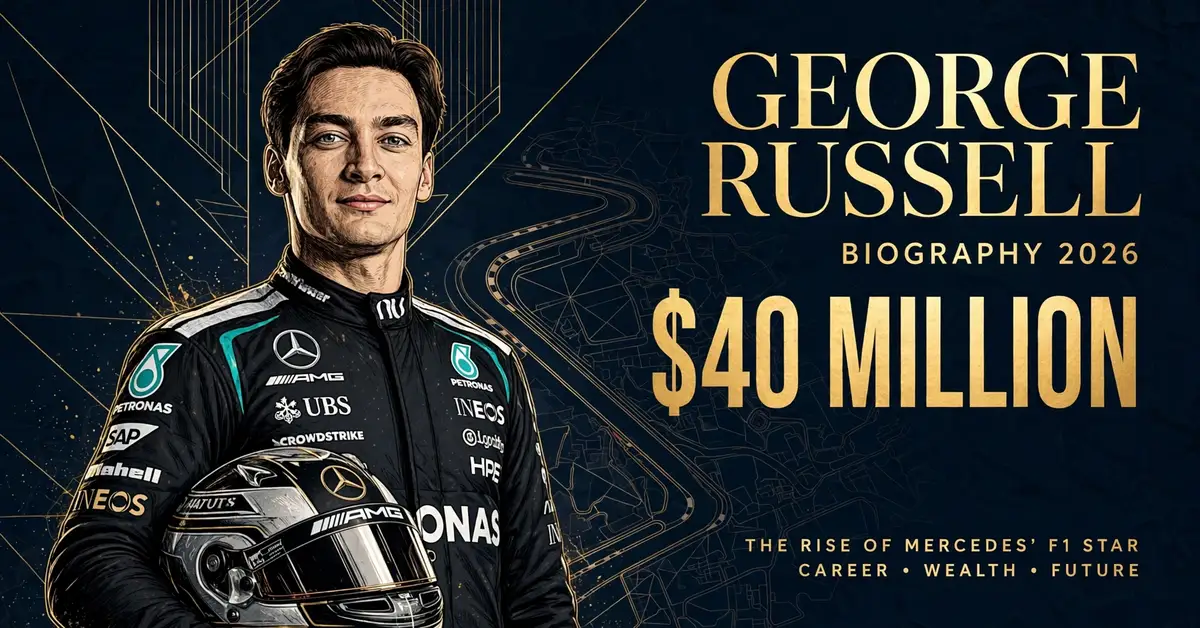
George Russell, 28, is Mercedes’ F1 star with 8 wins and a $40M fortune. From a seed merchant’s son in King’s Lynn to the 2026 title fight — his full story.
Last updated: November 21, 2026 · By Nathan Cole
George Russell is 28 years old, drives for Mercedes in Formula One, and is worth an estimated $40 million. He was born George William Russell on February 15, 1998, in King’s Lynn, Norfolk, the youngest son of a seed merchant who sold his business to pay for his son’s karting. Eight seasons into his Formula One career he has eight Grand Prix wins, 12 pole positions and 32 podiums — and in 2026 he came closer to a world championship than ever before, winning three races and finishing third in the standings while his 20-year-old teammate, Kimi Antonelli, took the title.
The 2026 season is the heart of this story, because it is the year Russell finally had the car, the contract and the form all at once — and still watched the championship go to the other side of the garage. He opened the new regulation era by winning in Australia from pole, led the championship for the first time in his life, and delivered his first career Grand Slam at the Azerbaijan Grand Prix. Then Antonelli, the teenager Mercedes had promoted straight from Formula 2, clinched the title in Mexico City while Russell finished sixth after a penalty. It was the cruellest possible ending to his best season, and the most interesting chapter of his career.
This biography covers the whole arc: the Fenland childhood and the karting years his father bankrolled, the junior titles won one after another, the three lean seasons at Williams, the Mercedes promotion and the Hamilton test, the winless year and the disqualification, the career-best 2025 season, the 2026 title fight, the contract saga that saw Toto Wolff openly court Max Verstappen, and the money — a salary that climbed from $3 million to $34 million in four years. Every figure carries a named source and a date, and where sources disagree, both sides are shown.
Quick Facts
| Full Name | George William Russell |
| Born | February 15, 1998, King’s Lynn, Norfolk, England |
| Age (2026) | 28 — turns 29 on February 15, 2027 |
| Height | 182 cm (6 ft 0 in) |
| Team | Mercedes-AMG Petronas (since 2022); car number 63 |
| F1 Debut | Australian Grand Prix, 2019 (Williams) |
| Career Stats | 172 starts, 8 wins, 12 poles, 13 fastest laps, 32 podiums, 1,295 points (as of 2026 São Paulo GP) |
| Championships | 0 — best finish 3rd in 2026 (teammate Antonelli champion) |
| Salary (2026) | $34 million base (F1Salaries); ~£30 million per British newspapers |
| Net Worth (2026) | $34M–$40M range (Guide Net Worth $34M; PlanetF1 ~$40M, Aug 2026) |
How This Biography Was Verified
The career facts come from Wikipedia’s George Russell profile, updated six days before this article and current through the 2026 São Paulo Grand Prix, cross-checked against Formula Daily, PaddockLedger, F1Everything and Expokinetic. The 2026 season details — the Australian, Austrian and Azerbaijan wins, the Grand Slam, the 262 points and third place — are taken from F1Salaries’ November 8, 2026 update and the Wikipedia season record. The contract and salary figures come from F1Salaries ($34 million base, $50 million potential income, $120.5 million career earnings), Autosport (the 2027 option exercised after the Spanish Grand Prix) and the British newspaper reporting of a £30 million salary. The net-worth range is honest: Guide Net Worth’s own profile anchors $34 million, while PlanetF1’s August 2026 estimate, carried by NetWorth.com, puts him at about $40 million.
One conflict in the sources is flagged rather than hidden. Two trackers list Russell’s 2025 wins as Bahrain, Monaco and Mexico; Wikipedia, F1Everything and Formula Daily — which counts two wins for the season — list Canada and Singapore. This profile follows the Wikipedia/F1Everything version, because it matches the two-win count that three sources agree on, and notes the disagreement here. Where the sources agree, the article states the fact plainly. Where they do not, both sides are shown.
+
Who Is George Russell?
George Russell is a British racing driver who competes in Formula One for Mercedes, and in 2026 he is the team’s senior driver — the man who leads the garage, sets the direction of the car, and carries the number 63. He is 28 years old, eight seasons into a Formula One career that began at the back of the grid with Williams and has carried him to eight Grand Prix wins, 12 pole positions and 32 podiums. He has never won a world championship. In 2026 he came as close as he has ever come, and the title went to his teammate instead.
The simplest way to understand Russell is through the junior record. Before he reached Formula One he won everything he entered in order: the BRDC Formula 4 championship in 2014, the GP3 Series in 2017, and the FIA Formula 2 championship in 2018 as a rookie. Three titles in four years, each one in his first attempt at the level. Drivers who do that do not usually spend three years at the back of the grid, but Russell did — because Mercedes, which had signed him to its junior programme in 2017, placed him at Williams to learn the sport while the team rebuilt itself. The apprenticeship was long, and it is the reason the biography reads the way it does: a driver who arrived fully formed and then had to wait for the car to catch up.
He is also, by 2026, one of the best-paid drivers in the sport. His Mercedes salary is a $34 million base, level with Charles Leclerc for the third-highest pay in Formula One, behind only Max Verstappen and Lewis Hamilton. Four years earlier his first Mercedes base was $3 million. The climb from $3 million to $34 million is the financial shape of the career, and it is the reason the biography is also a money story. The full breakdown of the fortune is in George Russell’s net worth in 2026 on this site, and the year-by-year age picture is in George Russell’s age in 2026.
The King’s Lynn Beginning: A Seed Merchant’s Son
George William Russell was born on February 15, 1998, in King’s Lynn, Norfolk, to father Steve and mother Alison. He was the youngest of three children, and he grew up in Tydd St Giles, Wisbech and Castle Rising — the flat Fenland country of eastern England, a long way from the circuits of Europe. His father ran a seeds and pulses business. His older brother Benjy was a competitive karter who won the 2007 Super 1 National Kart Championship in the Rotax Max class. George first climbed into a kart at seven years old, following Benjy, and the number he still races under — 63 — comes from a kart his brother had once rented.
The sacrifice behind the career is the detail that explains everything else. Steve Russell sold his business to fund his youngest son’s karting career. Karting at the level Russell was racing is not a hobby; it is a six-figure annual commitment before a driver is old enough for secondary school, and the family paid for it by giving up the business that supported them. That is the context for the methodical, almost managerial way Russell has run his career ever since — the homeschooling, the junior titles in sequence, the patience at Williams. He was not a rich kid buying a seat. He was a family investment, and he has raced like a man who knows what the investment cost.
He attended Wisbech Grammar School, then shifted to homeschooling so he could devote more time to racing. The karting results came fast: he won the CIK-FIA European Championship in the KF3 junior class in 2011 and again in 2012, becoming the first driver to defend that title. His karting contemporaries included Charles Leclerc and Alex Albon — the same generation that now fills the Formula One grid, and the same faces he would race against for the next fifteen years. Leclerc, now at Ferrari, is one of the drivers whose height fans compare with Russell’s, and how tall Charles Leclerc is is a measure of how closely the two have been tracked since those karting days.
The Junior Ladder: F4, GP3 and F2 in Four Years
Russell’s climb through the junior formulas was the fastest of his generation, and it was done without a wasted season. He finished third in the 2016 FIA Formula 3 European Championship, then won the GP3 Series in 2017, then won the FIA Formula 2 championship in 2018 as a rookie. Each title came in his first year at the level. The pattern is the point: Russell does not spend a season learning a category. He arrives, wins it, and moves on.
Mercedes had been watching the whole way. The team signed him to its young driver programme at the start of 2017, before the GP3 title, and the relationship has now run for nearly a decade — 2026 marks his tenth year with Mercedes in one form or another. The junior programme is where the bond was built: Mercedes paid for the ladder, placed him at Williams for his debut, and promoted him to the works team when the seat opened. It is also where the loyalty was earned. When Toto Wolff spent 2025 openly courting Max Verstappen, and Russell’s own future hung in the balance for months, the driver who had been with the team since he was 19 did not walk away. He waited, and the team kept him.
The F2 title in 2018 is the one that matters most, because it is the championship that decides who gets a Formula One seat. Russell won it against a field that included Lando Norris and Alex Albon — both now Grand Prix winners themselves — and he won it as a rookie, which is the mark of a driver who belongs at the next level immediately. Norris, who finished second to Russell in that F2 season, went on to win the 2025 world championship with McLaren, and Lando Norris’ biography runs on a parallel track to this one: two karting rivals, two F2 rivals, two different routes to the front of the grid.
Williams 2019–2021: The Lean Years
Russell made his Formula One debut at the 2019 Australian Grand Prix with Williams, partnering Robert Kubica. The team was at the back of the grid, and it stayed there for three seasons. Over those three years Russell scored points only once. The single points finish is the most famous drive of his early career, and it is worth telling in full because it is the drive that made his reputation.
At the 2021 Belgian Grand Prix, in torrential rain at Spa-Francorchamps, Russell qualified second — ahead of Lewis Hamilton’s Mercedes — in a Williams that had no business being on the front row. The race itself barely happened: the rain was so heavy that the cars ran two laps behind the safety car before the race was stopped, and the result was taken from qualifying order. Russell finished second, 1.8 seconds behind the winner, and the points were awarded at half value. It was a fluke of the weather and a masterpiece of a qualifying lap at the same time, and everyone in the paddock understood what it meant. A driver who can put a backmarker car second on the grid in the rain is a driver who belongs in a fast car.
That performance, combined with the 2018 F2 championship, earned him the promotion to Mercedes for 2022, replacing Valtteri Bottas. The three Williams years had taught him something the junior titles could not: how to lead a team that is losing, how to extract a result from a car that does not deserve one, and how to wait. He had spent three seasons qualifying last and finishing last, and he had never once looked like a driver who had given up. Mercedes had been watching that too.
Mercedes 2022: The Hamilton Test
Russell joined Mercedes in 2022 alongside Lewis Hamilton, the seven-time world champion, and the first season was the test that defined him. Mercedes had stumbled into the new ground-effect regulations without a competitive car, and the team spent the year fighting porpoising and a lack of pace. In that difficult car, in his first season with the team, Russell outscored Hamilton. He took his first pole position in Hungary, and his maiden Grand Prix victory at the São Paulo Grand Prix — the same circuit where, a year earlier, he had scored his only Williams points.
Outscoring a seven-time champion in your first season with a team is the kind of result that changes a career, and it is the reason Russell was never again treated as a junior driver. Hamilton, now at Ferrari, remains the benchmark every Mercedes driver is measured against, and how tall Lewis Hamilton is is one of the smaller ways fans compare the two men — the real comparison is the one Russell won in 2022, on points, in the same car. The São Paulo win was also the first victory for Mercedes in a season the team had expected to dominate, and it came from the new driver, not the champion.
The win carried a second meaning. Russell had waited three years at Williams for a car that could win, and then won in his first season in one. The patience of the lean years had paid off in the most direct way possible. He was 24 years old, a Grand Prix winner, and the future of the most successful team of the hybrid era. What nobody knew then was how long the wait for the next step would be.
2023 and 2024: The Long Way Back
The 2023 season was a winless one. Russell finished eighth in the championship, the car was still short of Red Bull’s pace, and the year ended without a victory. Mercedes still handed him a two-year contract extension, a vote of confidence that said the team believed in the driver even when the results were not there. The extension covered 2024 and 2025, and it is the deal that carried him through the rebuild.
The wins came back in 2024: Austria and Las Vegas. The Austrian win was a gift of sorts — it came after the leaders collided — but the Las Vegas win was earned, a controlled drive under the lights that reminded the paddock what Russell could do with a car underneath him. The same season also produced the strangest result of his career. At the Belgian Grand Prix, Russell won the race on the road, only to be disqualified afterward because his car was found to be underweight. He became the first driver in 30 years to be disqualified from a race win, and the victory went to his teammate Hamilton. It was the kind of luck that has followed Russell at intervals throughout his career — the brilliance and the misfortune arriving in the same weekend.
By the end of 2024 the picture was clear. Hamilton was leaving for Ferrari, and Russell, at 26, was about to become the senior driver at Mercedes for the first time. The team was rebuilding around him, and the next two seasons would decide whether he was a Grand Prix winner or a world champion. The 2025 season answered the first half of that question.
2025: The Career-Best Season
With Hamilton gone to Ferrari, 2025 was Russell’s first year as the senior figure at Mercedes, partnered by rookie Andrea Kimi Antonelli — an 18-year-old Italian promoted straight from Formula 2, the youngest driver on the grid. Russell responded with the best season of his career: two wins, nine podiums, 319 points, and fourth in the championship. He won in Canada and Singapore, scored his maiden hat-trick of pole, win and fastest lap in Canada, and finished 169 points ahead of Antonelli. Mercedes returned to second in the Constructors’ Championship, and Russell had comfortably out-scored the rookie over the campaign.
The season also contained the moment that set up everything that followed. After his Singapore win, Mercedes announced that Russell had re-signed for the 2026 season — and the team later extended the deal to 2027. The announcement came in October 2025, after months in which his future had been the subject of open speculation, and it confirmed what the results had already said: Russell was the leader of the team, and the team was his.
The 2025 season is also the baseline against which 2026 must be judged. Russell entered 2026 as one of the pre-season title favourites, under a major regulation change, with his Mercedes contract carrying performance benchmarks that would decide whether it vested for 2027. He was 28 years old, in his eighth Formula One season, and he had never led a championship. That was about to change.
2026: The Title Fight That Got Away
The new regulation cycle introduced for 2026 changed everything, and Mercedes emerged as the fastest team. Russell opened the season by taking pole at the Australian Grand Prix — three-tenths of a second over Antonelli, eight-tenths over third-placed Isack Hadjar — and converting it into victory, heading a Mercedes one-two and leading the championship for the first time in his life. He added a win in the China sprint race, and at the Austrian Grand Prix he converted pole into his second win of the season, holding off a recovering Max Verstappen by around 1.6 seconds, with Antonelli third for a Mercedes one-three.
The peak came at the Azerbaijan Grand Prix, where Russell achieved his first career Grand Slam — pole position, race win, fastest lap, and leading every lap. It was the most complete weekend of his career, and it put him firmly in the title fight. But the fight was not his alone. Antonelli, the rookie who had finished 169 points behind him in 2025, had grown into the season, and by the autumn the teenager was the one setting the pace. Antonelli clinched the Drivers’ Championship at the Mexico City Grand Prix on November 1, 2026, where Russell finished sixth after a penalty. Mercedes secured its first Constructors’ Championship since 2021, with both drivers’ contributions, but the drivers’ title — the one Russell had chased for eight seasons — went to the other side of the garage.

As of the 2026 São Paulo Grand Prix, the last entry before this article was written, Russell has 8 race wins, 12 pole positions, 13 fastest laps and 32 podiums, with 262 points and third place in the championship after a fourth-place finish in São Paulo. A technical problem ended his race at Sepang, and engine failures and other setbacks cost him points through the season — the kind of misfortune that has shadowed him before, from the Belgium disqualification to the Williams years. The season is not over at the time of writing, and the final rounds will decide whether third place holds. What is already settled is the shape of the year: his best season, his first championship lead, his first Grand Slam — and a title won by his teammate.
The Contract Saga: Verstappen, £30 Million and 2027
The contract story is the subplot that ran through the whole of 2025, and it explains why the 2026 season carried so much weight for Russell. His renewal was held up while Toto Wolff openly courted Max Verstappen, and only after the Dutchman committed to Red Bull was the Mercedes line-up confirmed. On October 15, 2025, Mercedes announced extensions for Russell and Antonelli. British newspapers reported Russell’s salary at about £30 million a year, making him the third-highest-paid driver in Formula One after Verstappen and Hamilton. F1Salaries puts the 2026 base at $34 million, level with Charles Leclerc, with a potential income of $50 million once bonuses are added.
Russell has said the deal carries performance clauses tied to 2027, and the structure was a one-year deal for 2026 with an option for 2027 rather than a fresh long-term contract. After the Spanish Grand Prix in Barcelona in June 2026, Mercedes exercised the option in his contract, securing the partnership through 2027 — the same mechanism that extended Hamilton’s Ferrari deal. Wolff said in June 2026 that Mercedes wants to keep the same line-up for 2027, and Russell has said he will “100%” race for the team next year. The “temporary” label that one former champion attached to him — the claim that he could be replaced even if he won the championship — has not survived the season: he is confirmed, he is paid, and he is the senior driver.
The salary progression is the financial spine of the biography. His first Mercedes base in 2022 was $3 million. By 2024–2025 Forbes estimated his earnings at $15 million a year in base pay, jumping to $23 million in total earnings in 2024. The October 2025 deal more than doubled his base to $34 million, and across 23 races that works out to about $1.48 million per Grand Prix, or roughly $93,000 a day. F1Salaries puts his career earnings at $120.5 million. The driver whose father sold a seeds business to fund his karting now earns in a day what that business might have made in a year.
Russell vs Antonelli: The Teammate Who Became Champion
The central rivalry of Russell’s career is not with another team. It is with the teenager in the other Mercedes. Kimi Antonelli arrived in 2025 as an 18-year-old rookie, promoted straight from Formula 2, and Russell out-scored him by 169 points in their first season together. A year later Antonelli was the world champion, and Russell was third. It is the fastest reversal of a teammate battle in recent Formula One history, and it is the fact that will define how both men are remembered.
The numbers make the reversal stark. Antonelli’s net worth, on Guide Net Worth’s profile, sits at $18 million — less than half of Russell’s $34 million to $40 million, because Antonelli has had one season of top pay and Russell has had eight. Read Kimi Antonelli’s net worth in 2026 and the gap is the story of two careers at different stages: the veteran who built his fortune over eight seasons, and the rookie who won the title in his second. Russell is 28, Antonelli is 20, and the two men will race together again in 2027, with the same car and the same team and the championship now belonging to the younger one.
There is no public bad blood between them, and that is itself notable. Russell has spent his career being patient — three years at Williams, a year waiting for a contract while his boss courted another driver — and the patience is now being tested in its hardest form: watching a teammate eight years younger win the title he has chased since he was seven years old. The 2027 season will be the answer to the only question that matters now, which is whether the veteran or the champion leads the team.
Russell vs Norris: The Karting Generation Grows Up
The wider generation tells the same story from a different angle. Russell, Lando Norris, Alex Albon and Charles Leclerc all raced karts together as children, all climbed the junior ladder in the same years, and all now race at the front of the grid. Norris beat Russell to the 2025 world championship with McLaren — the title Russell watched from fourth place — and the two men have been measuring themselves against each other since they were teenagers. Norris finished second to Russell in the 2018 Formula 2 championship, and the roles have reversed twice since: Norris the champion in 2025, Russell the title contender in 2026.
The generation is the strongest Formula One has had in years, and Russell sits in the middle of it — not the youngest, not the most decorated, but the most methodical. Norris has the 2025 title. Antonelli has the 2026 title. Verstappen, the oldest of the group at 29, has four. Russell has eight wins and no title, and the gap between his talent and his trophy cabinet is the tension that drives the biography. He has beaten every one of them on a given weekend. He has not yet beaten all of them across a season.
The Money: Million and What It Buys
George Russell’s net worth in 2026 sits in a $34 million to $40 million range. Guide Net Worth’s own profile anchors the bottom of it at $34 million, while PlanetF1’s August 2026 estimate, carried by NetWorth.com, puts him at about $40 million. The range is honest: a driver’s fortune is mostly salary, and the salary has moved so fast — from $3 million in 2022 to $34 million in 2026 — that any single number is a snapshot of a moving target.
| Year | Base Salary | Note |
|---|---|---|
| 2022 | $3 million | First Mercedes season; outscored Hamilton |
| 2024–2025 | ~$15 million | Forbes estimate; $23 million total earnings in 2024 |
| 2026 | $34 million | F1Salaries base; ~£30 million per British newspapers |
| 2027 | $34 million (expected) | Option exercised June 2026; no new salary published |
The $34 million base is the headline, but the full package is bigger. F1Salaries values the potential income at $50 million with bonuses, and puts career earnings at $120.5 million. The bonuses are tied to results — wins, podiums, championship position — which means the 2026 season, with three wins and third in the championship, will have paid at the top of the range. Endorsements add to it, though Russell’s portfolio is quieter than the headline names: he is a Mercedes driver first and a brand second, and the team is the sponsor that matters.
Put beside his peers, the fortune is mid-table for a front-running driver, and the table below shows why. Oscar Piastri’s net worth sits at $30 million on Guide Net Worth’s profile, Alex Albon’s net worth at $20 million, and Antonelli’s at $18 million. Russell, at $34 million to $40 million, is ahead of all three — the reward for eight seasons, three teams’ worth of patience, and a salary that tripled in two years. The full fortune breakdown, with the salary history and the endorsement picture, is in George Russell’s net worth in 2026 on this site.
Life Off the Track: Monaco, Carmen and Number 63
Russell lives in Monaco, like most of the grid, and has been with his partner Carmen Montero Mundt since 2020. He keeps the private side of his life quiet in the way he keeps most things quiet: the public Russell is the methodical professional, the driver who stopped using the 2025 racing simulator in November 2024 and spent the winter focused entirely on the new 2026 car and regulations, while others were still thinking about the season just finished. The preparation is the personality.
Two details from the off-track life have become part of the brand. The first is the number 63, borrowed from a kart his brother Benjy once rented, carried through every category from karting to Formula One. The second is the helmet: the 2026 design is an electric turquoise-blue shell with a gloss-black sponsor crown, a neon pink-purple top flash and a blue chrome visor — the most distinctive lid on the grid, and the one fans pick out of a pack at a glance. At 182 cm, he is one of the taller drivers on the grid, and readers who want the full measurement picture can read how tall George Russell is on our sister site CelebAmerica. How tall Max Verstappen is — the driver Wolff courted while Russell waited for his contract — is the comparison fans make most often, and the two men are near-identical in height.
There is also the question of what comes next, and it is the question the biography cannot yet answer. Russell is 28, confirmed at Mercedes through 2027, third in the championship, and racing against a 20-year-old teammate who has already won the title. The 2027 season is the next chapter, and it will be run in the same team, with the same car philosophy, and with the championship now belonging to the younger man. Russell has said he will “100%” race for Mercedes next year. The rest is still to be written.
George Russell’s Fortune Compared With His Generation
The money table is the whole generation in miniature. Russell’s $34 million to $40 million sits above his karting contemporaries and below the champions, and the gap is the difference between winning races and winning titles. The table below uses only figures from Guide Net Worth’s own profiles and the November 2026 reporting, so the comparison is apples to apples.
| Driver | Team (2026) | Net Worth (2026) |
|---|---|---|
| George Russell | Mercedes | $34M–$40M |
| Oscar Piastri | McLaren | $30M |
| Alex Albon | Williams | $20M |
| Kimi Antonelli | Mercedes | $18M |
The table carries a warning for anyone who reads net worth as a ranking of talent. Antonelli, the 2026 world champion, is worth less than half of Russell’s fortune, because he has had two seasons of Formula One pay and Russell has had eight. Piastri, a race winner at McLaren, sits $10 million behind Russell for the same reason. The fortune measures time served as much as it measures speed, and Russell has served the longest. Readers can browse the rest of the Formula One coverage in the Celebrity Net Worth archive, where this biography sits alongside the drivers of every generation.
George Russell Biography FAQs
How old is George Russell in 2026?
George Russell is 28 years old in 2026. He was born on February 15, 1998, in King’s Lynn, Norfolk, England, and he turns 29 on February 15, 2027. He is in his eighth Formula One season and his fifth with Mercedes.
What is George Russell’s net worth in 2026?
George Russell’s net worth in 2026 sits in a $34 million to $40 million range. Guide Net Worth’s own profile anchors $34 million, while PlanetF1’s August 2026 estimate, carried by NetWorth.com, puts him at about $40 million. His Mercedes salary is a $34 million base, level with Charles Leclerc for the third-highest pay in Formula One.
What is George Russell’s salary in 2026?
George Russell’s 2026 salary is a $34 million base from Mercedes, according to F1Salaries, updated November 8, 2026. British newspapers report it at about £30 million a year. With bonuses his potential income reaches $50 million, and his career earnings are estimated at $120.5 million. His first Mercedes base in 2022 was $3 million.
How many races has George Russell won?
George Russell has won 8 Grands Prix as of the 2026 São Paulo Grand Prix: São Paulo 2022, Austria and Las Vegas 2024, Canada and Singapore 2025, and Australia, Austria and Azerbaijan in 2026. He also has 12 pole positions, 13 fastest laps and 32 podiums from 172 starts. His first career Grand Slam — pole, win, fastest lap, leading every lap — came at the 2026 Azerbaijan Grand Prix.
Has George Russell won a world championship?
No. George Russell has never won the Formula One Drivers’ Championship. His best finish is third, in 2026, when his Mercedes teammate Kimi Antonelli won the title. Antonelli clinched it at the Mexico City Grand Prix on November 1, 2026, while Russell finished sixth after a penalty. Russell did win the junior titles — BRDC F4 in 2014, GP3 in 2017 and Formula 2 in 2018.
Who is George Russell’s girlfriend?
George Russell has been with his partner Carmen Montero Mundt since 2020. He keeps his private life quiet, and the two live in Monaco, where most of the Formula One grid is based. No engagement has been confirmed in the reporting used for this profile.
Why does George Russell race with number 63?
George Russell races with number 63 because it was the number on a kart his older brother Benjy once rented. Benjy was a competitive karter who won the 2007 Super 1 National Kart Championship, and George followed him into karting at seven years old. He has carried 63 through every category since, from karting to Formula One.
How long is George Russell’s Mercedes contract?
George Russell is contracted to Mercedes through the end of 2027. The deal was announced on October 15, 2025 as a one-year contract for 2026 with performance clauses tied to 2027, and Mercedes exercised the 2027 option after the Spanish Grand Prix in Barcelona in June 2026. Team principal Toto Wolff has said Mercedes wants to keep Russell and Kimi Antonelli together for 2027, and Russell has said he will “100%” race for the team next year.
Sources & Reporting
Biography and career: Wikipedia, “George Russell (racing driver)”, updated November 2026 (born February 15, 1998, King’s Lynn; 172 starts, 8 wins, 12 poles, 13 fastest laps, 32 podiums, 1,295 points as of the 2026 São Paulo Grand Prix; 2026 wins Australia, Austria, Azerbaijan; Grand Slam at Azerbaijan; Antonelli champion; Mercedes Constructors’ first since 2021); Formula Daily (2025 season: two wins, nine podiums, 319 points, fourth; age 28, eighth season); PaddockLedger (family, karting, Williams years, Spa 2021); F1Everything (career record; 2025 wins Canada and Singapore; contract extension to 2027); Expokinetic (Mercedes junior since 2017; 2026 helmet; contract and Verstappen context). Salary and contract: F1Salaries, updated November 8, 2026 ($34 million base, $50 million potential income, $120.5 million career earnings, 262 points, third in championship); NetWorth.com (net worth ~$40 million per PlanetF1, August 2026; £30 million salary per British newspapers; Antonelli title clinched Mexico City GP, November 1, 2026); Autosport, June 2026 (2027 option exercised after the Spanish Grand Prix; Hamilton option parallel); SportBible, March 2026 (“temporary” claim; 1+1 arrangement). Net worth: Guide Net Worth, “George Russell Net Worth 2026: The $34M Mercedes Payday” ($34M anchor); PlanetF1 via NetWorth.com (~$40M, August 2026) — range $34M–$40M. Peers: Kimi Antonelli $18M, Oscar Piastri $30M, Alex Albon $20M (Guide Net Worth profiles); Lando Norris biography (Guide Net Worth). Cross-site check: CelebAmerica has a live George Russell height post (different angle — linked); NetWorthCraft has no George Russell post. Internal links: George Russell net worth and age (same-person), Kimi Antonelli net worth, Lando Norris biography, Oscar Piastri net worth, Alex Albon net worth, Lewis Hamilton height, Max Verstappen height, Charles Leclerc height, and the Celebrity Net Worth category archive on Guide Net Worth. Reporting window: November 2026. Where sources disagreed — the 2025 wins (Canada and Singapore per Wikipedia/F1Everything/Formula Daily’s two-win count, against Bahrain, Monaco and Mexico per two trackers) and the $34 million against $40 million net-worth figures — both sides are shown with their sources and dates, and no figure is presented as confirmed where no primary source confirms it.
Nathan Cole
Nathan Cole is the editor of Guide Net Worth. He covers celebrity wealth the way a business desk covers earnings: reported figures first, estimates labeled as estimates, and no invented numbers. Every profile on this site passes through his desk before it publishes. About Guide Net Worth · Corrections: figures are updated when new reporting emerges — contact us via the About page if you spot an error.
References & Sources
This article has been fact-checked and verified against multiple public sources, financial disclosures, SEC filings, Forbes reports, Celebrity Net Worth databases, and official records. All net worth estimates are based on publicly available information and financial analysis.