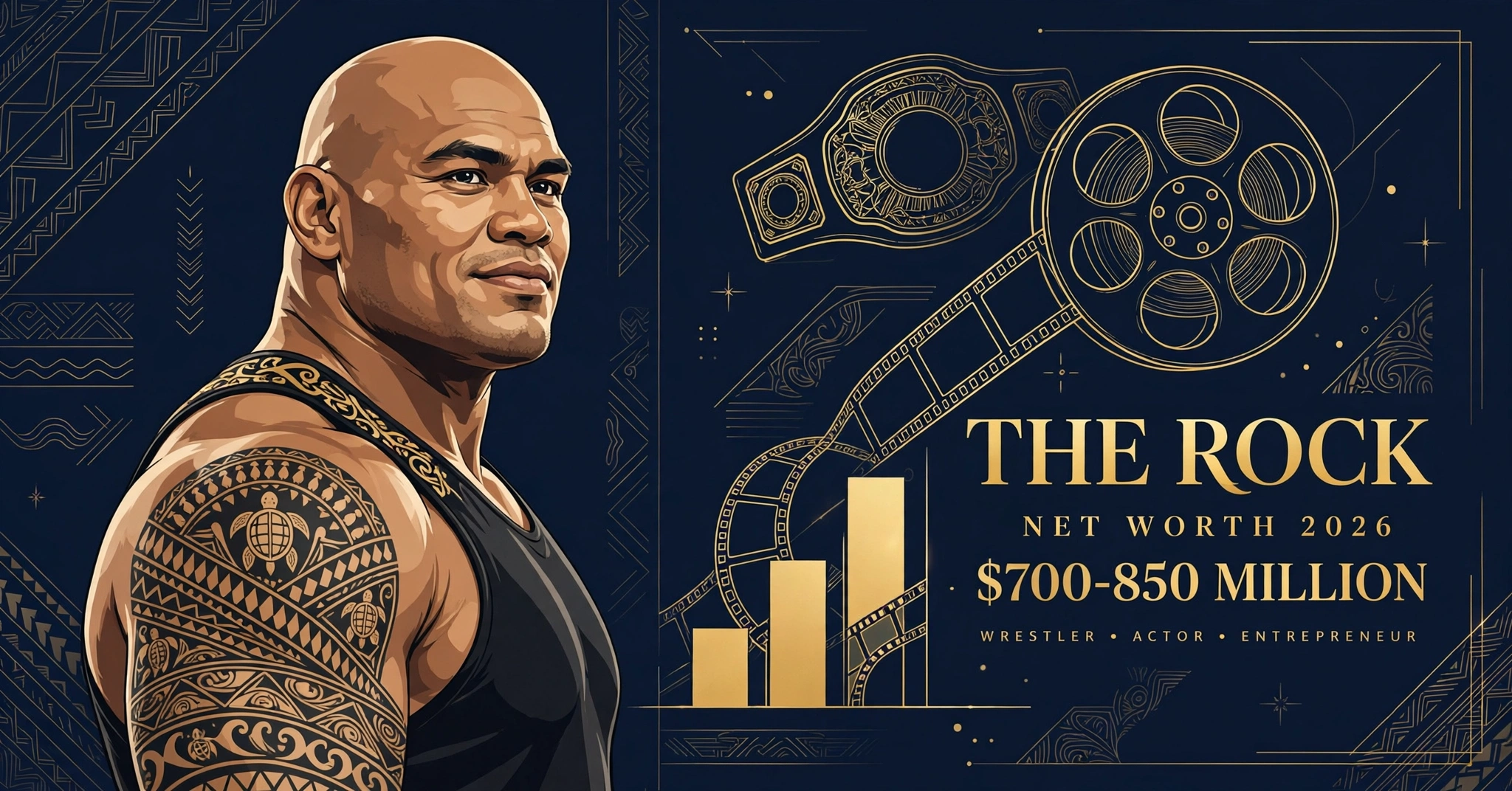
The Rock’s net worth is estimated at $700–850M in 2026. Inside: the record $50M Red One payday, Teremana’s paper value, ~$70M in TKO stock, and the 2026 Under Armour split.
Last updated: October 1, 2026 · By Nathan Cole
Dwayne “The Rock” Johnson’s net worth is estimated at $700–850 million in 2026, anchored around $800 million. That number puts him within sight of billionaire status — but the honest version comes with a caveat most net-worth pages skip: roughly half of that figure is paper value in businesses that have never been formally valued, not cash in a bank.
What follows is the full accounting: the record-breaking $50 million Red One payday, the $4 million pay cut he took for art’s sake, a tequila stake that may outweigh every movie check combined, $70 million in wrestling-company stock, and the August 2026 breakup with Under Armour that nobody’s net-worth page has caught up with yet.
Quick Facts
| Net Worth (2026) | $700–850 million (estimated; ~$800M consensus) |
| Full Name | Dwayne Douglas Johnson (“The Rock”) |
| Born | May 2, 1972 (age 54) |
| Profession | Actor, producer, businessman, former professional wrestler |
| Nationality | American (Samoan heritage) |
| Wealth Sources | Film salaries & backend, Teremana Tequila equity, TKO Group stock, Seven Bucks Productions, UFL, ZOA Energy, endorsements |
| Last Updated | October 1, 2026 |
How This Estimate Was Made
This figure is an independent estimate — Dwayne Johnson has never disclosed his finances publicly. Our process: gather every credibly reported salary, deal, and asset; cross-check them across reputable outlets; allow for taxes, representation fees, and spending; and publish a range wherever sources disagree, with the reasoning shown in the article. Anything uncertain is labeled as an estimate, not a fact.
+
Why Estimates Range From 0 Million to 0 Million
Ask ten outlets what The Rock is worth and you’ll get one answer — $800 million — repeated so often it starts to sound audited. It isn’t. Celebrity Net Worth lists ~$800M, and nearly every other tracker copies it. But the methodology underneath matters more than the number.
Two different questions produce two different fortunes. “What could everything be worth if you marked it to market?” gives you ~$800M, because it counts his Teremana equity at a multi-billion-dollar paper valuation. “What can actually be proven — banked salaries, liquid stock, documented deals?” gives you a much smaller number, because Teremana has never been sold and never had a formal valuation. The table below shows the honest spread.
| Source / method | Estimate | What it counts |
|---|---|---|
| Celebrity Net Worth | ~$800M | Film pay + business equity at paper value |
| Other trackers | $800–850M | Same mark-to-market method |
| Earnings-based (Forbes-style) | Well under $800M | Verifiable pretax earnings + liquid assets only |
| Reported film salaries, career total | ~$393.55M | Upfront fees through 2024, before backend (per Plisio’s tally) |
The word doing all the work is liquid. A banked salary is liquid. Shares of TKO Group trading on the NYSE are liquid. A minority stake in a private tequila company that has never been appraised is not — it’s valuable, probably, but nobody knows the price until someone writes a check. That single distinction is why a careful tracker lands at $800M while a cautious one refuses to. We publish $700–850M and show our work below.
The Million Payday That Broke Hollywood’s Salary Record
In 2023, Amazon MGM Studios paid Johnson $50 million upfront to star in the Christmas action-comedy Red One opposite Chris Evans. Puck journalist Matthew Belloni reported the figure, and it stands as the largest upfront acting fee ever paid for a single role — ahead of Robert Downey Jr.’s $40M Marvel paydays and Will Smith’s $40M for King Richard.
The mechanics matter. Streaming films carry no box-office backend, so studios buy out the backend with a bigger upfront check. Johnson’s usual deal is ~$20M plus points on profits; with no profits to share on a Prime Video release, Amazon simply paid the whole number at signing. On top of that, Johnson can reportedly earn up to $4M per film for promotional obligations tied to his social-media reach — he commands one of the largest followings on the planet, and studios pay for access to it.
Film by Film: How the Salaries Stacked Up
Johnson’s per-film fee climbed for two decades without a down year — until he chose one. The progression, drawn from contemporary reporting:
| Film (year) | Reported salary | Note |
|---|---|---|
| The Scorpion King (2002) | $5.5M | Guinness record: largest salary for a first-time leading man |
| The Rundown (2003) | $12.5M | Doubled his quote in one year |
| Walking Tall (2004) | $15M | — |
| Fast & Furious franchise (2011+) | $15–20M+ per film | Rose with each sequel from Fast Five on |
| Jumanji: Welcome to the Jungle (2017) | ~$20M + backend | Film grossed $962M worldwide |
| Skyscraper (2018) / Hobbs & Shaw (2019) | $20M each | The $20M floor era |
| Jumanji: The Next Level / Red Notice | $23.5M each | 2019–2021 peak studio rate |
| Jungle Cruise (2021) | $22M | Co-star Emily Blunt reportedly earned $9M |
| Black Adam (2022) | $22.5M | Passion project; underperformed theatrically |
| Red One (2024) | $50M | Record upfront fee (Puck’s Matthew Belloni) |
| The Smashing Machine (2025) | $4M | Deliberate pay cut (Deadline) |
| Moana live-action (2026) | ~$30M | Per Variety; also a producer |
Television paid too: HBO’s Ballers earned him $650,000 per episode, roughly $6.5M per 10-episode season. And the annual totals tell the arc — $43M in 2013, $65M in 2015, $125M between June 2017 and June 2018, and $88M in 2024 per Forbes, which named him the world’s highest-paid actor in 2019, 2020, 2021, and 2023. His films have grossed more than $14 billion worldwide.
The Million Pay Cut: Art Over Paychecks
For A24’s The Smashing Machine (October 2025), Johnson accepted $4M to play MMA pioneer Mark Kerr — about an 80% discount from his studio rate. Deadline’s Anthony D’Alessandro reported the figure, adding that Johnson gave a portion of his reduced fee to co-star Emily Blunt and to Kerr himself.
The film earned strong reviews (71% on Rotten Tomatoes) and a 15-minute standing ovation at its Venice premiere, but audiences stayed away: a $5.9M domestic opening weekend was the lowest of Johnson’s career, and the worldwide total stalled near $21M against a $50M production budget. A24 softened the blow by pre-selling international rights for ~$35M and keeping marketing near $15M. The episode is a useful data point for the net-worth math — it shows a star wealthy enough to leave $16M+ on the table for a role he wanted.
Moana’s Million Salary — and Disney’s 0 Million Problem
Johnson reprised Maui in Disney’s live-action Moana (July 2026) for a reported ~$30M, per Variety — and served as a producer, which typically adds a separate fee. The film, budgeted at $250M plus ~$120M in marketing, opened to just $43M domestically against projections of $80–105M. Early estimates put Disney’s eventual loss at $100–125M.
None of that touches Johnson’s fee — his deal was signed long before release, which is precisely why upfront-heavy deal structures favor the star over the studio. Critics were cool on the remake, but audiences gave it 90% on Rotten Tomatoes, and the producer credit keeps him attached to any downstream revenue.
Teremana: The Tequila Stake That Outweighs the Movies
The single most misunderstood line item in The Rock’s fortune is Teremana Tequila. Here’s what actually happened: Johnson co-founded the brand with Dany Garcia (plus Ken Austin and Jenna Fagnan) and launched it in March 2020. It sold 300,000 cases in its first year, and in 2023 it moved a million cases in twelve months — the fastest a premium spirits brand had ever hit that mark, according to company statements.
Two corrections to stories still circulating on net-worth pages:
- Teremana was never sold. Reports of a 2024 “sale” are wrong. What happened: Mast-Jägermeister — which had been Teremana’s exclusive distributor since launch — bought a stake in the brand for an undisclosed sum, per the Spirited Drinks trade publication. The brand continues to operate under the Siete Bucks Spirits umbrella, and Johnson remains its public face.
- There is no formal valuation. The $2–3.5B figures floating around are extrapolations from the Casamigos precedent (Diageo paid up to $1B in 2017), not announced numbers. Johnson’s exact ownership percentage is undisclosed; estimates of 30–40% are unconfirmed.
Do the speculative math anyway, because this is how the $800M estimates are built: a 35% stake in a $3B brand is ~$1B on paper. That one position could exceed every movie paycheck he’s ever collected — which is exactly why the number sits in the “paper value” column of the disagreement table above, and why we label it an estimate rather than a fact.

The TKO Board Seat: Million in Wrestling Stock
In January 2024, Johnson joined the board of TKO Group Holdings — the NYSE-listed parent of WWE and UFC — receiving $30M in restricted stock vesting through 2025. As part of the deal he also regained full ownership of his “The Rock” trademark and stage name, a rights package with long-term licensing value.
Since then, TKO’s share price has climbed, and the stake has grown with it. Wrestling Observer’s Dave Meltzer reported an additional 8,047 shares (~$1.52M) issued to Johnson, bringing the total position to roughly $69.74 million — commonly rounded to ~$70M, on roughly 354,000 shares with TKO trading near $180. Pages still quoting the original “$30M stock grant” are a year behind: the position has more than doubled on paper.

Project Rock Walks Away From Under Armour (August 2026)
On August 14, 2026, Johnson and Under Armour ended their decade-long Project Rock partnership — one of the most successful athlete-apparel lines in the industry, whose shoe drops routinely sold out. The split was described as mutual: Johnson and Dany Garcia retake full ownership of the Project Rock trademark and name, while Under Armour distributes remaining inventory through October 2026.
The business significance: Project Rock is no longer a licensing line inside someone else’s company — it’s an independent brand Johnson fully controls, with a decade of sell-through data behind it. Most net-worth pages still describe the Under Armour partnership as active; it isn’t.
ZOA Energy and the Rest of the Portfolio
Launched in March 2021, ZOA Energy is Johnson’s energy-drink brand, co-founded with Dany Garcia, Dave Rienzi, and Juggernaut Capital’s John Shulman. Molson Coors handled distribution at launch — a serious distribution muscle for a celebrity beverage. The brand refreshed its look and formula in 2023 and is stocked at Costco, Walmart, Amazon, and grocery chains nationwide. No sale or outside investment has been reported, so its value sits in the private-equity column: real, growing, and unpriced.
Beyond that, the portfolio includes the Brahma Bull trademark, the $64M-minimum-salary UFL (below), producer fees from Seven Bucks, and endorsement income that has run into eight figures annually at its peak — including his long-ago Apple Siri ad and Ford campaigns.
The UFL’s 2026 Season Is Done — What’s Next
Johnson, Dany Garcia, and RedBird Capital bought the XFL for $15 million out of bankruptcy in 2020. The league merged with the USFL in 2024 to form the United Football League (UFL), and the 2026 season just completed: eight teams, March 28 to June 13, with the Louisville Kings beating the DC Defenders 27–20 in the first-ever “United Bowl” championship on June 13 at Audi Field, aired on ABC.
In September 2026 the league announced an expansion franchise landing in Rhode Island for the 2027 spring season, and new investment has arrived from Mike Repole’s Impact Capital alongside FOX and ESPN commitments. The league remains a work in progress financially — spring football has never been profitable in America — but as an asset it’s a long option on a media property, and player payrolls ($64,000 minimum for 2026) are modest next to Johnson’s film income.
Seven Bucks: The Company Behind the Camera
Seven Bucks Productions, founded in 2012 with Dany Garcia, is the engine room of the fortune. Named for the $7 Johnson had in his pocket when he was cut from the CFL in 1995, the company produces or co-produces most of his films — which means producer fees and a share of backend profits flow to the same people on both sides of the table. It also produced HBO’s Ballers, Young Rock, and DC’s Shazam! films.
This is the quiet compounding mechanism: when your own company produces your movies, the “studio” and the “talent” are splitting money that would otherwise leave the building. Garcia, his ex-wife and lifelong business partner, runs the business side — a partnership that has survived their divorce and outlasted most Hollywood marriages.
Taxes, Agents, and the Money That Doesn’t Stay
A $393.55M career salary tally is gross, not net. The illustrative math most trackers skip: roughly 10% to the agent, another 10–15% to manager, lawyer, and business manager, then ~40% in taxes on what’s left. On that basis, $393.55M in reported upfront fees becomes something like $190–210M actually retained — before spending a dollar. That framing is approximate, but it explains the gap between “he earned $400M from movies” and “he isn’t a billionaire from movies.” The billion-dollar math only works once the businesses are marked to market.
From to 0 Million: The Timeline
| Year | Milestone |
|---|---|
| 1995 | $7 in his pocket, cut from the CFL’s Calgary Stampeders |
| 1996 | WWE debut as “Rocky Maivia”; becomes The Rock |
| 2002 | $5.5M for The Scorpion King — Guinness record for a debut lead |
| 2012 | Seven Bucks Productions founded with Dany Garcia |
| 2016 | Project Rock x Under Armour launches |
| 2020 | Teremana launches (300K cases in year one); buys the XFL for $15M |
| 2021 | ZOA Energy launches with Molson Coors distribution |
| 2024 | $50M for Red One (record); TKO board seat with $30M in stock |
| 2025 | $4M pay cut for The Smashing Machine |
| 2026 | ~$30M for live-action Moana; Under Armour split; UFL season complete |
Sources & Reporting
This estimate was built from reporting published between 2019 and September 2026. Key contributions: Puck (Matthew Belloni) on the $50M Red One fee; Deadline (Anthony D’Alessandro) on the $4M Smashing Machine salary; Variety on the ~$30M Moana payday; Dave Meltzer / Wrestling Observer on the ~$70M TKO position; WWD, Hypebeast, and Sports Illustrated on the August 2026 Under Armour split; Spirited Drinks on the Mast-Jägermeister/Teremana stake; Forbes annual earnings lists (2013–2024); Box Office Mojo on grosses; Finnhub for the TKO share price (September 2026). Valuation methodology notes draw on Plisio’s career-salary tally and Bouncemojo’s audit caveats. Net-worth figures are estimates, not audited financials — where outlets disagreed, this article says so in the text.
Frequently Asked Questions
What is The Rock’s net worth in 2026?
Dwayne “The Rock” Johnson’s net worth is estimated at $700–850 million in 2026, with most trackers converging around $800 million. The range reflects a real disagreement: roughly half the figure is paper value in private businesses (mainly Teremana Tequila) that have never been formally valued, rather than cash or liquid stock.
Is The Rock a billionaire?
No — not yet. At an estimated $700–850 million, he is within striking distance but not across the line. The most plausible path to billionaire status would be a formal valuation event for Teremana Tequila, where his undisclosed stake is marked to a multi-billion-dollar paper value.
How much does The Rock make per movie?
His studio rate has run $20–23.5 million per film since the late 2010s, plus backend on theatrical releases and up to $4 million in social-media promotional fees. Streaming deals pay more upfront instead: Amazon paid him a record $50 million for Red One. He took a deliberate cut to $4 million for A24’s The Smashing Machine.
How much did Dwayne Johnson make from Red One?
$50 million upfront, per Puck’s Matthew Belloni — the largest upfront acting fee ever paid for a single role. Because Red One released on Prime Video, there was no box-office backend; Amazon bought out the backend with the bigger upfront check.
Does The Rock own Teremana Tequila?
He co-founded it and remains an owner — it was never sold. Mast-Jägermeister, the brand’s distributor since launch, bought an undisclosed stake (not the whole company) for an undisclosed sum. Johnson’s exact ownership percentage and the brand’s valuation have never been publicly confirmed, so the often-cited “$2–3.5 billion valuation” is speculation, not fact.
What companies does The Rock own?
Seven Bucks Productions (film/TV, co-founded 2012 with Dany Garcia), a co-ownership stake in Teremana Tequila, ZOA Energy (co-founded 2021), co-ownership of the UFL spring football league, and the Project Rock brand (fully his since the August 2026 split with Under Armour). He also sits on the board of TKO Group Holdings with ~$70 million in stock.
How much is The Rock’s TKO stock worth?
Roughly $70 million at current prices — about 354,000 shares with TKO trading near $180. He received $30 million in restricted stock when he joined the TKO board in January 2024, and the position has more than doubled on paper since.
Who is richer, The Rock or Kevin Hart?
The Rock, by a wide margin. Johnson is estimated at $700–850 million versus Hart’s roughly $450 million per celebrity-wealth trackers — Hart’s fortune rests on comedy tours, film fees, and his HartBeat media company, while Johnson’s includes far larger acting fees and the Teremana equity.
Written by Nathan Cole
Nathan Cole is the editor of GuideNetWorth, covering celebrity finances with reported figures and documented sources rather than copy-paste estimates. Figures in this article were compiled from trade-press reporting and market data through September 2026.
Found an error? We correct the record. Contact us and cite your source — verified corrections are published with an update note.
References & Sources
This article has been fact-checked and verified against multiple public sources, financial disclosures, SEC filings, Forbes reports, Celebrity Net Worth databases, and official records. All net worth estimates are based on publicly available information and financial analysis.