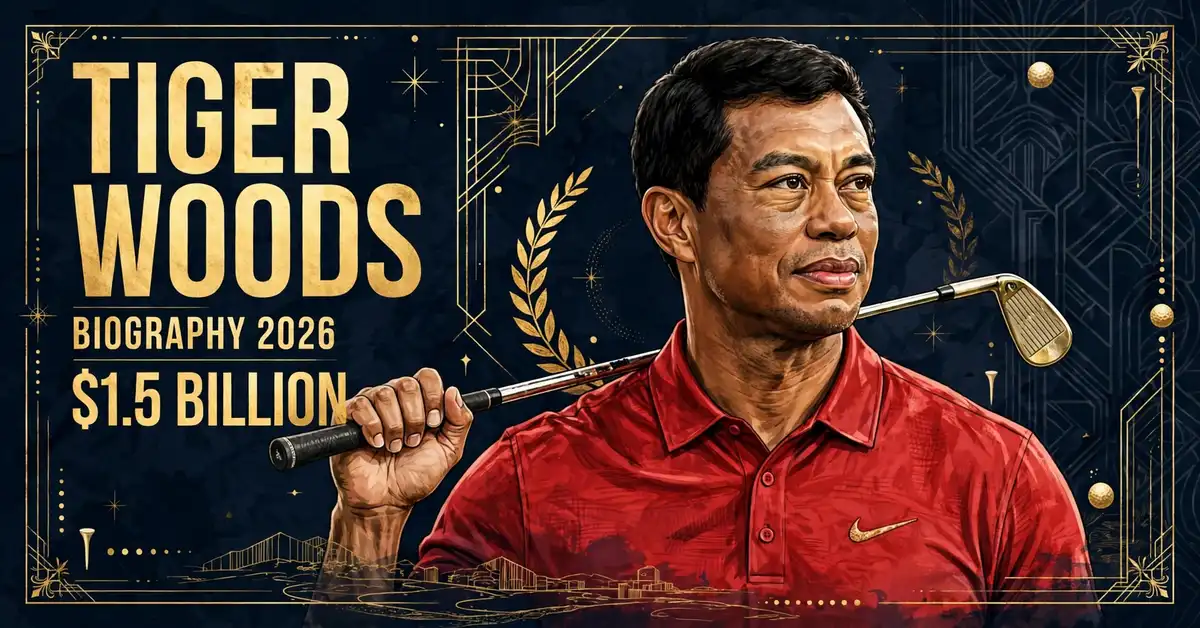
Tiger Woods biography 2026: 15 majors, 82 PGA Tour wins and a $1.5 billion fortune at 50. From child prodigy to billionaire — crashes, comebacks and courtroom.
Last updated: November 20, 2026 · By Nathan Cole
Tiger Woods is 50 years old, a 15-time major champion, and — by every serious measure — the richest golfer who ever lived. His net worth in 2026 is estimated at $1.3–$1.5 billion: Forbes puts the figure at $1.5 billion on its real-time billionaires list, as of April 2026, while Celebrity Net Worth and TheRichest both publish $1.3 billion. Born Eldrick Tont Woods on December 30, 1975, in Cypress, California, he turned professional at 20, won the Masters by 12 shots at 21, held all four major titles at the same time, and spent a record 683 weeks as world No. 1. He has earned nearly $2 billion before tax across his career, according to Forbes, and he did it in a sport where the previous generation’s stars retired as millionaires.
The second half of the story is why the biography still gets read. Woods lost almost everything in public — his marriage, his sponsors, his health, his reputation — and then won the Masters again at 43, an age when golfers are supposed to be ceremonial. Then his body broke again: a car crash in February 2021 that shattered his right leg, a sixth back surgery in September 2024, a ruptured Achilles tendon in March 2025. He returned to competitive play in March 2026 in a TGL event, and three days later he was in another car crash, arrested, and facing charges that ended in a plea deal in September. He turned 50 in December 2025, and he is expected to play the TGL opener on December 27, 2026.
This is the full story with dated sources: the child prodigy years, the Stanford turn to professional golf, the 1997 Masters, the Tiger Slam, the decade of dominance, the 2009 fall, the broken body, the 2019 comeback, the 2021 crash, the 2026 crash and plea deal, the billion-dollar fortune and how it was built, the family, and what comes next at 50.
Quick Facts
| Full Name | Eldrick Tont Woods |
| Born | December 30, 1975, Cypress, California, USA |
| Age (2026) | 50 — turned 50 on December 30, 2025 |
| Height | 6 ft 1 in (1.85 m) |
| Nationality | American |
| Profession | Professional golfer |
| Turned Pro | 1996 (age 20, after Stanford) |
| Major Championships | 15 — 2nd all time (Jack Nicklaus, 18) |
| PGA Tour Wins | 82 — tied with Sam Snead for the most ever |
| Weeks at World No. 1 | 683 — the record |
| Career Prize Money | $120.9 million |
| Net Worth (2026) | $1.3–$1.5 billion (Forbes: $1.5B, Apr 2026; Celebrity Net Worth / TheRichest: $1.3B) |
| Children | Sam Alexis (b. 2007), Charlie Axel (b. 2009) |
| Partner | Vanessa Trump (relationship confirmed March 2025) |
| Last Updated | November 20, 2026 |
How This Biography Was Researched
This biography was researched from live reporting and public records in November 2026. Money figures are estimates from named outlets, not audited statements, and where they conflict this article publishes the range and says which source anchors it. The net worth anchor is $1.5 billion (Forbes, real-time billionaires list, April 2026), with Celebrity Net Worth and TheRichest publishing $1.3 billion. Career records — 15 majors, 82 PGA Tour wins, 683 weeks at No. 1 — come from the PGA Tour and the World Golf Hall of Fame. The 2026 crash and plea deal are reported from Britannica’s October 26, 2026 update, Wikipedia, and ESPN’s September–October 2026 court reporting. Where a date or figure is disputed, this article says so rather than picking the cleaner version.
+
The Child Prodigy
Eldrick Tont Woods was born on December 30, 1975, in Cypress, California, a suburb of Los Angeles, the only child of Earl Woods and Kultida Woods. His father was African American, a retired US Army lieutenant colonel who had served two tours in Vietnam. His mother was from Thailand. The nickname came from his father: Earl had served alongside a Vietnamese soldier called Tiger, and he gave his son the name before the boy could walk. The boy was putting a golf ball before he could properly speak, and at the age of two he appeared on the Mike Douglas Show, putting against the comedian Bob Hope on national television.
Earl Woods ran his son’s childhood like a training program, and he said so openly. The boy practised for hours a day, played junior tournaments across California, and by his teens was winning everything in front of him: three consecutive US Junior Amateur titles and three consecutive US Amateur titles, a run no golfer before or since has matched. He attended Western High School in Anaheim and then Stanford University, where he won the NCAA individual championship in 1996. He left Stanford after two years. The amateur career had nothing left to teach him, and the professional game was waiting with a reported $40 million Nike contract and a Titleist deal already signed.
The detail that explains the rest of his life is how early the pressure started. Woods has been famous since he was two years old, coached since he was three, and expected to change his sport since he was a teenager. Everything that followed — the dominance, the fall, the comebacks — happened to a man who had never lived a private life, and who had been told since childhood that he was a project as much as a golfer. His father died on May 3, 2006, and his mother, Kultida, died on February 4, 2025. Both deaths marked turning points in his career, and both are covered in the sections below.

Stanford and the Turn to Professional Golf
Woods turned professional in August 1996, at 20, with a press conference that has become part of golf folklore. “Hello, world,” he said, and the sport has quoted him ever since. His first event as a professional was the Greater Milwaukee Open, where he finished tied for 60th and earned $2,544 — a figure that looks absurd now, beside the $120.9 million in career prize money that followed, but it is a useful reminder that even Woods started with a pay cheque smaller than a month’s rent.
The Nike deal he signed that summer was reported at $40 million over five years, an unheard-of sum for a golfer who had not yet won a professional tournament. Titleist signed him too. The money was a bet on what he would become, and it was settled within eight months: Woods won his first PGA Tour event at the Las Vegas Invitational in October 1996, in a playoff, and by the spring of 1997 he was the most famous athlete in America. The endorsement model he built — a single global brand, a single equipment maker, a face that sold to audiences golf had never reached — became the template every golfer since has followed, and it is the foundation of the billion-dollar fortune covered in the money section below.
The 1997 Masters: Twelve Shots
On April 13, 1997, Tiger Woods won the Masters Tournament by 12 shots. He was 21 years old, playing in his first Masters as a professional, and he finished at 18-under par, the lowest score in the tournament’s history at the time. He became the first golfer of either African American or Asian descent to win the Masters, one of the most prestigious events in the sport, at a club that had admitted its first Black member only seven years earlier. The final round was watched by more people than any golf broadcast before it, and the images from that Sunday — the red shirt, the fist pump on the 18th green, the hug with his father — are still the most replayed in the sport’s history.
The margin matters because it announced something the sport had never seen: a player who separated from the field rather than merely beating it. Woods hit the ball further than anyone, putted better than anyone, and did it with a physical presence — 6 ft 1 in, powerfully built, an athlete where his rivals were sportsmen — that made the gap look permanent. How tall he is, and how that frame shaped his game, is covered in detail in Tiger Woods’ height profile on this site. The 1997 Masters also set the commercial terms of his career: after that week, his appearance fee, his endorsement value and his prize money all moved onto a scale no golfer had occupied before.
The Tiger Slam and the Decade of Dominance
Between the 2000 US Open and the 2001 Masters, Tiger Woods did something no golfer had done in the modern era: he held all four major championship titles at the same time. The run started at Pebble Beach in June 2000, where he won the US Open by 15 shots, the largest margin in a major in 138 years. He won the Open Championship at St Andrews by eight shots the following month, then the PGA Championship in a playoff against Bob May, then the 2001 Masters. The achievement became known as the Tiger Slam, because it was not a calendar-year Grand Slam — the four titles were won across two seasons — and it remains the closest any golfer has come to holding all four at once since Bobby Jones.
The numbers from the decade that followed are the reason his name still anchors every debate about the greatest golfer ever. He spent 683 weeks as world No. 1, a record, including a continuous run of 281 weeks from June 2005 to October 2010. He won 14 majors by the end of 2008. He won the 2006 Open Championship at Hoylake and the 2006 PGA Championship weeks after his father’s death, playing with a grief he barely discussed. And he won the 2008 US Open at Torrey Pines on a torn anterior cruciate ligament and two stress fractures in his left leg, beating Rocco Mediate in a 19-hole Monday playoff, then disappeared for eight months for reconstructive knee surgery. That tournament is still the purest evidence of what made him different: most golfers would not have teed it up; he won it on one leg.
His closest rival across those years was Phil Mickelson’s net worth story in reverse: Mickelson won five majors in Woods’ shadow and spent his career as the second name in the sport, while Woods collected the wins, the ranking weeks and the money. By 2009, Woods had earned more than $100 million in prize money alone and was, according to Forbes, the first athlete in history to pass $1 billion in career earnings. He was 33, and the sport assumed the records would keep falling for another decade. They did not, and the reason is the next section.
The Fall: 2009 and the Lost Years
On November 27, 2009, Woods was involved in an early-morning one-car accident outside his home in Orlando, Florida. The crash itself was minor — his SUV hit a fire hydrant and a tree — but what followed was not. Within days, reports of infidelity surfaced, then more, and the most controlled image in sport collapsed in a fortnight. Accenture ended its sponsorship within weeks. AT&T followed. Gatorade ended its Tiger-branded drink line. Nike, his biggest partner, stayed. Woods took an indefinite break from golf in December 2009, issued a public apology in February 2010, and divorced Elin Nordegren in August 2010.
The golf never recovered its old shape. He returned at the 2010 Masters and finished fourth, which only showed how far the standard had fallen: fourth was now a good result. He changed swing coaches, changed putters, changed his body. He won five times in 2013 and returned to No. 1, but the majors did not come — his last before the fall had been the 2008 US Open, and the gap stretched to eleven years. The injuries piled up through the same period: back problems that required four surgeries between 2014 and 2017, a chipping collapse in 2015 so severe that he looked, for the first time in his life, like a golfer who had forgotten how to play the shortest shots in the game.
The lowest point came on May 29, 2017, when he was arrested near his home in Jupiter, Florida, and charged with driving under the influence. He said later that the arrest was caused by a reaction to prescribed pain medication, not alcohol, and in October 2017 he pleaded guilty to reckless driving and entered a diversion program. A month before the arrest, in April 2017, he had undergone back-fusion surgery, his fourth back operation, and the doctors had told him he might never play competitive golf again. He was 41, and the obituaries for his career were being written in earnest.
The 2019 Masters: The Comeback
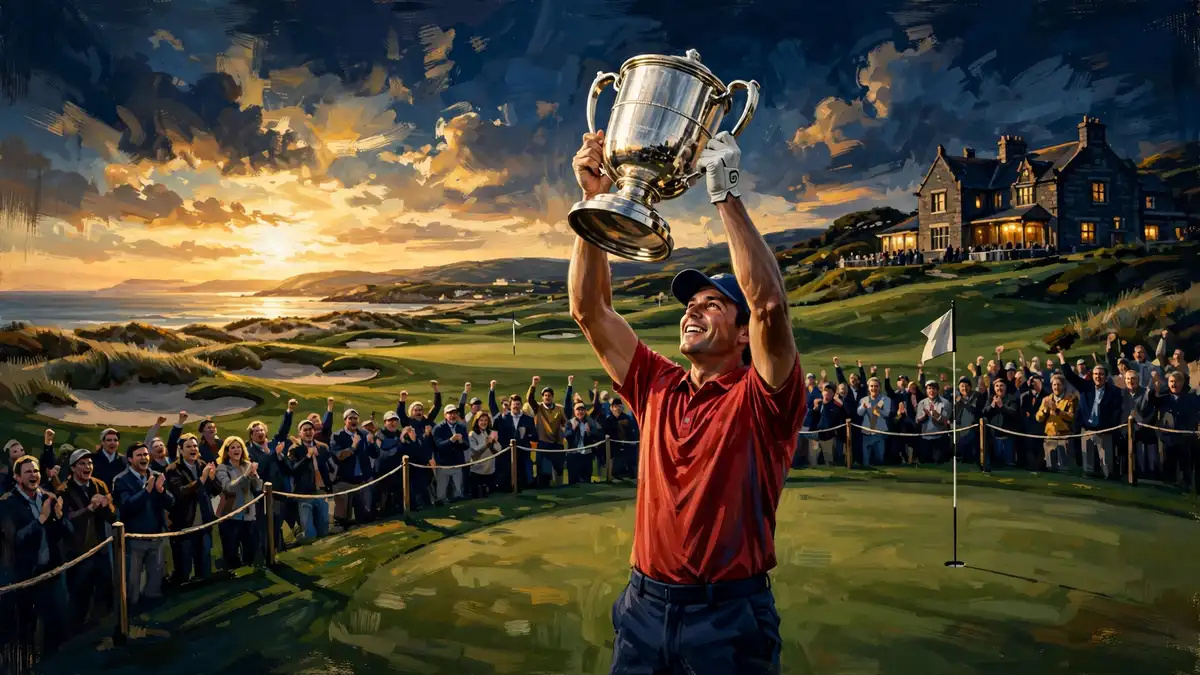
On April 14, 2019, Tiger Woods won the Masters for the fifth time. He was 43 years old. It was his first major championship in eleven years, and his first green jacket in fourteen. He won by one shot over Dustin Johnson, Brooks Koepka and Xander Schauffele, and the roar on the 18th green was the loudest Augusta National had heard since 1997. The victory completed the strangest arc in modern sport: the most dominant athlete of his generation, written off as finished, winning the tournament that had made him famous, in front of a crowd that included his two children, who had never seen him win a major.
The comeback had been building for a year. He returned to the PGA Tour in January 2018, played a full season, and won the Tour Championship in September 2018 — his 80th PGA Tour victory, and his first win in five years. The fused back held. The putting stroke returned. And in October 2019, six months after the Masters, he won the Zozo Championship in Japan, his 82nd PGA Tour victory, tying Sam Snead’s record — a record that had stood for 54 years. He was inducted into the World Golf Hall of Fame in 2022, and in 2019 he received the Presidential Medal of Freedom from President Donald Trump.
The 2019 win also reset his commercial value. Sponsors who had left in 2009 were replaced by new ones, and the Nike relationship, which had survived the scandal, was now attached to a redemption story rather than a dominance story. The comeback is the reason his fortune kept growing after his playing prime ended: the brand was no longer about winning every week, it was about the man who had come back from everything.
The 2021 Crash and the Long Road Back
On February 23, 2021, Woods was involved in a single-car collision in Rancho Palos Verdes, California. His SUV rolled into a ditch, and he suffered compound fractures to his right leg and a shattered ankle. Emergency surgery rebuilt the leg with rods, screws and pins, and the doctors’ first question was not whether he would play golf again but whether he would walk normally. He told Golf Digest in November 2021 that his full-time professional career was over, though he intended to play a limited schedule.
He returned to the PGA Tour at the 2022 Masters, fourteen months after the crash, and made the cut. He withdrew during the third round of the 2023 Masters, and underwent ankle fusion surgery that April. The schedule after that was spare: a few events a year, the majors where his body allowed, and a growing role off the course. In September 2024 he had his sixth back surgery. In March 2025 he ruptured his left Achilles tendon while training. His mother, Kultida, died on February 4, 2025, weeks before the Achilles injury. By the spring of 2025, the question was no longer whether he could win again — it was whether he would play competitive golf at all.
2026: TGL, Another Crash and a Plea Deal
Woods returned to competitive play on March 24, 2026, in a TGL event — the indoor team league he co-founded with Rory McIlroy’s net worth profile subject, his fellow billionaire golfer and TMRW Sports partner. Three days later, he crashed his SUV into another vehicle near his home in Jupiter, Florida, and was arrested and charged with driving under the influence and refusal to submit to a lawful test. He pleaded not guilty, released a statement saying he would take time away from professional golf to seek treatment and focus on his health, and in September 2026 he reached a plea deal in which he pleaded no contest to charges of reckless driving and refusal to submit to a lawful test, agreeing to pay fines and accept a licence suspension. The reporting comes from Britannica’s October 26, 2026 update, Wikipedia, and ESPN’s September 2026 court coverage.
The episode is the third car crash of his public life, and it lands differently from the first two. In 2009 the crash exposed a private life; in 2021 it nearly cost him his leg; in 2026 it cost him a season and, for the first time, produced a criminal plea. What it did not cost him was his place in the sport’s future: ESPN reported on October 27, 2026 that Woods is expected to play the TGL opener on December 27, 2026. The league he built is now the stage he performs on, and the format — indoor, team-based, short matches — is designed for a 50-year-old body that can no longer walk 72 holes over four days in the heat.
How old he is, and what 50 means for a golfer whose career has already spanned three decades, is covered in detail in Tiger Woods’ age profile on this site. The short version is that he has now been famous for longer than most golfers’ entire careers, and he is still the name that sells tickets.
The Billionaire: How the Money Was Made
The money is the part of the biography that separates Woods from every golfer before him. Forbes certified him as a billionaire in 2022, and its real-time billionaires list put his net worth at $1.5 billion as of April 2026. Celebrity Net Worth and TheRichest publish a lower figure, $1.3 billion. Forbes also reports that he has earned nearly $2 billion before tax across his career, and that his 2026 annual earnings were about $46 million. The full money story — the estimate range, the $800 million offer he turned down, and the deal-by-deal breakdown — is told in Tiger Woods’ net worth profile on our sister site NetWorthCraft, and the same-person figure is covered in detail in Tiger Woods’ net worth on this site.
The prize money is the smallest part of it. His career prize money stands at $120.9 million — the most any golfer had earned on the course until recently, and still a record for a single career built before the LIV era inflated purses. The rest came from endorsements, and the structure of those deals changed the sport’s economics. The Nike relationship ran for 27 years, from the $40 million deal he signed as a 20-year-old in 1996 until the split in January 2024. He launched his own apparel brand, Sun Day Red, the following month. Titleist, American Express, Accenture, AT&T, Gillette, Tag Heuer and Gatorade all paid him at his peak, and the Accenture and AT&T deals ended in the weeks after the 2009 scandal showed how much of his value was tied to his image.
The business second act is where the billion was completed. TGR Ventures, his holding company, runs golf course design — he has designed courses in Mexico, the Bahamas and the United States — along with restaurants, including The Woods in Jupiter, Florida, and a growing events business. He co-founded TMRW Sports with Rory McIlroy, the company behind TGL, the indoor league that is now his competitive home. And he turned down a reported $800 million offer to join LIV Golf, the Saudi-backed breakaway tour, a decision that cost him the largest single pay cheque in the sport’s history and kept him on the PGA Tour’s side of the game’s civil war. Jon Rahm’s net worth profile shows the other side of that choice: Rahm took the LIV money, a reported $100 million walkaway from the PGA Tour, and Woods’ refusal is the reason the two men now sit on opposite sides of the richest argument golf has ever had.
The comparison with the current No. 1 shows how the money has moved. Scottie Scheffler’s biography records a $110 million fortune built in a few seasons of dominance — and Scheffler is the player who now holds the ranking Woods held for 683 weeks. Woods earned his billion across three decades, through endorsements that no longer exist in their old form, and he did it while winning 82 times. Scheffler’s fortune is bigger, faster, and built on prize money that Woods never had access to. The difference is the era, not the player.
Family: Elin, Sam, Charlie and Vanessa Trump
Woods married the Swedish model Elin Nordegren on October 5, 2004. Their daughter, Sam Alexis, was born in 2007, and their son, Charlie Axel, was born in 2009. Charlie has become a public figure in his own right, playing junior golf with a swing that looks uncannily like his father’s and appearing beside him at the PNC Championship, the parent-child event where the two have played together since 2020. The marriage ended in divorce in August 2010, in the aftermath of the 2009 scandal, and the settlement was reported at the time as one of the largest in sports history — the figure most often cited was $100 million, though neither party has ever confirmed it.
He was in a relationship with the Olympic skier Lindsey Vonn from 2013 to 2015, a pairing of two of the most famous athletes on earth that ended, by both accounts, because of the pressure of two public lives. In March 2025 he confirmed a relationship with Vanessa Trump, the former wife of Donald Trump Jr., in a post on his own social media. Wikipedia lists the relationship as running from 2024 to the present. He has kept the details private, and this article will not add to them: the relationship is reported because it is public, not because it is anyone’s business beyond that.
The family thread that runs through the whole biography is his father. Earl Woods built the golfer, coached him, managed him, and died in 2006, weeks before Woods won the Open Championship at Hoylake in what he later called the most emotional win of his life. His mother, Kultida, was the quieter presence — the one who kept the family grounded while her husband and son became famous — and her death in February 2025 closed the last direct link to the childhood that made him. He is 50 now, with two teenage children, and the next chapter of the family story is theirs as much as his.
TGR Foundation and the Second Act
The part of Woods’ life that gets the least attention is the part he has spent the most time on since his playing career slowed: the TGR Foundation, the education charity he founded in 1996, the year he turned professional. The foundation runs learning labs and college-access programs for students from under-resourced communities, and in September 2026 it marked the first anniversary of its Philadelphia learning lab, developed with the Cobbs Creek Foundation. The foundation is the longest-running project of his adult life — older than any of his business ventures, and the one he has funded most consistently.
The second act around it is a portfolio, not a single business. Golf course design, where his firm has built courses that carry his name and his design philosophy. The Woods Jupiter, his restaurant and sports bar near his home. Sun Day Red, the apparel brand he launched after the Nike split. TMRW Sports and TGL, the league he co-founded with McIlroy that now employs some of the best players in the world, including his close friend Justin Thomas’ net worth profile subject, his Jupiter neighbour and regular playing partner. The through-line is control: after thirty years of being managed, sponsored and scheduled by other people, Woods now owns the stage he performs on, and the league is designed around what his body can still do.
Woods vs. the Field: The Records
The argument about whether Woods is the greatest golfer ever comes down to two numbers and one absence. The numbers: 15 major championships, second only to Jack Nicklaus’s 18, and 82 PGA Tour wins, tied with Sam Snead for the most ever. The absence: the three majors he never won after 2008, the years the injuries and the scandal took. Nicklaus won his 18th major at 46; Woods won his 15th at 43, and the 2026 season suggests the 16th is not coming on the PGA Tour. The records table below sets the case out plainly, and readers can draw their own conclusion. Browse more profiles in our Celebrity Net Worth category to see how the rest of the sport’s fortunes compare.
| Record | Woods | Next best |
|---|---|---|
| Major championships | 15 | Jack Nicklaus, 18 |
| PGA Tour wins | 82 | Sam Snead, 82 (tied) |
| Weeks at world No. 1 | 683 | Greg Norman, 331 |
| Masters titles | 5 | Jack Nicklaus, 6 |
| Consecutive cuts made | 142 | Byron Nelson, 113 |
| Career prize money | $120.9 million | Phil Mickelson, ~$96 million |
| Career earnings (Forbes, pretax) | ~$2 billion | No golfer is close |
The number that best captures the dominance is not in the table: 142 consecutive cuts made, from 1998 to 2005, seven years without missing a weekend. Byron Nelson’s 113, set in the 1940s, had stood for half a century. Woods broke it by 29, and no active player is within a hundred of it. It is the record that says the most about what he was: a player who never had a bad week for seven years.
What Comes Next at 50
Woods turned 50 on December 30, 2025, which makes him eligible for the PGA Tour Champions, the senior circuit, whenever he chooses. He has not said he will play it. What he has said, through ESPN’s October 27, 2026 report, is that he is expected to play the TGL opener on December 27, 2026 — the league he built, in the format his body can still handle, in front of the audience that still pays to watch him. The TGL season is the most likely shape of his competitive future: short matches, team golf, no four-day walks in the heat, and a stage he owns a share of.
The business future is clearer than the playing future. Sun Day Red is a year old and growing. The course-design business has a pipeline. TGR Ventures keeps expanding, and the foundation keeps opening labs. The fortune, at $1.3–1.5 billion, no longer depends on whether he wins another tournament — it depends on whether the businesses hold their value, and they were built to outlast his playing career by design.
What is harder to say is what the legacy becomes. If the 2026 plea deal is the last public chapter, the biography ends on a sour note that the 2019 comeback had seemed to erase. If he plays the TGL opener in December and competes into his fifties, the story gets a coda. Either way, the record is fixed: 15 majors, 82 wins, 683 weeks at No. 1, and a fortune no golfer had imagined before him. The rest is commentary.
Sources & Reporting
This biography was researched from live reporting and public records in November 2026. Money figures are estimates from named outlets, not audited statements, and where they conflict this article publishes the range and says which source anchors it.
Britannica — the career narrative and the 2026 crash and plea deal, last updated October 26, 2026. Wikipedia — the career record, the February 2021 crash, the 2026 crash and plea deal, and the family detail, last updated November 2026. Forbes — the $1.5 billion net worth figure (real-time billionaires list, April 2026), nearly $2 billion in pretax career earnings, billionaire certification in 2022, and about $46 million in 2026 annual earnings. Celebrity Net Worth / TheRichest — the $1.3 billion figure. ESPN — the October 27, 2026 report that Woods is expected to play the TGL opener on December 27, 2026, and September 2026 court reporting on the plea change. PGA Tour — 82 wins, $120.9 million in career prize money, 683 weeks at No. 1. World Golf Hall of Fame — induction in 2022 and the amateur record. Regional Report — the career overview, July 17, 2026. CelebAmerica — the Tiger Woods biography, November 10, 2026, including the 2026 crash section and the Forbes earnings figure. Reporting window: November 2026. Figures are updated when new reporting emerges — contact us via the About page if you spot an error.
Frequently Asked Questions
How old is Tiger Woods?
Tiger Woods is 50 years old in 2026. He was born Eldrick Tont Woods on December 30, 1975, in Cypress, California, and he turned 50 on December 30, 2025. He turned professional in 1996 at the age of 20.
How many major championships has Tiger Woods won?
Tiger Woods has won 15 major championships, the second-most in history behind Jack Nicklaus with 18. His majors are the Masters in 1997, 2001, 2002, 2005 and 2019; the US Open in 2000, 2002 and 2008; the Open Championship in 2000, 2005 and 2006; and the PGA Championship in 1999, 2000, 2006 and 2007. He held all four major titles at the same time across 2000 and 2001, the achievement known as the Tiger Slam.
What is Tiger Woods’ net worth in 2026?
Tiger Woods’ net worth in 2026 is estimated at $1.3–$1.5 billion. Forbes puts the figure at $1.5 billion on its real-time billionaires list, as of April 2026, while Celebrity Net Worth and TheRichest both publish $1.3 billion. Forbes reports he has earned nearly $2 billion before tax across his career, and his 2026 annual earnings were about $46 million. His career prize money stands at $120.9 million.
Is Tiger Woods still playing golf?
Yes, on a limited schedule. Tiger Woods returned to competitive play on March 24, 2026, in a TGL event, and ESPN reported on October 27, 2026 that he is expected to play the TGL opener on December 27, 2026. He no longer plays a full PGA Tour schedule: his last full season was 2018, and since the February 2021 car crash he has played only a handful of events a year, mostly the majors when his body allows.
What happened in Tiger Woods’ 2021 car crash?
On February 23, 2021, Tiger Woods was involved in a single-car collision in Rancho Palos Verdes, California. His SUV rolled into a ditch, and he suffered compound fractures to his right leg and a shattered ankle. Emergency surgery rebuilt the leg, and he said in November 2021 that his full-time professional career was over, though he intended to play a limited schedule. He returned to the PGA Tour at the 2022 Masters, fourteen months after the crash.
What happened to Tiger Woods in 2026?
Tiger Woods returned to competitive play on March 24, 2026, in a TGL event, the indoor league he co-founded. Three days later he crashed his SUV near his home in Jupiter, Florida, and was arrested and charged with driving under the influence and refusal to submit to a lawful test. He pleaded not guilty, then reached a plea deal in September 2026, pleading no contest to reckless driving and refusal, and agreeing to pay fines and accept a licence suspension. He is expected to play the TGL opener on December 27, 2026.
Who is Tiger Woods’ partner?
Tiger Woods confirmed a relationship with Vanessa Trump in March 2025. He was previously married to Elin Nordegren, from 2004 to 2010, with whom he has two children, Sam Alexis (born 2007) and Charlie Axel (born 2009), and he was in a relationship with the Olympic skier Lindsey Vonn from 2013 to 2015.
How many PGA Tour wins does Tiger Woods have?
Tiger Woods has 82 PGA Tour wins, tied with Sam Snead for the most in history. His 82nd win came at the Zozo Championship in Japan in October 2019, tying a record that had stood for 54 years. He also spent a record 683 weeks as world No. 1 and made 142 consecutive cuts between 1998 and 2005.
Nathan Cole
Nathan Cole is the editor of Guide Net Worth. He covers celebrity wealth the way a business desk covers earnings: reported figures first, estimates labeled as estimates, and no invented numbers. Every profile on this site passes through his desk before it publishes. About Guide Net Worth · Corrections: figures are updated when new reporting emerges — contact us via the About page if you spot an error.
References & Sources
This article has been fact-checked and verified against multiple public sources, financial disclosures, SEC filings, Forbes reports, Celebrity Net Worth databases, and official records. All net worth estimates are based on publicly available information and financial analysis.