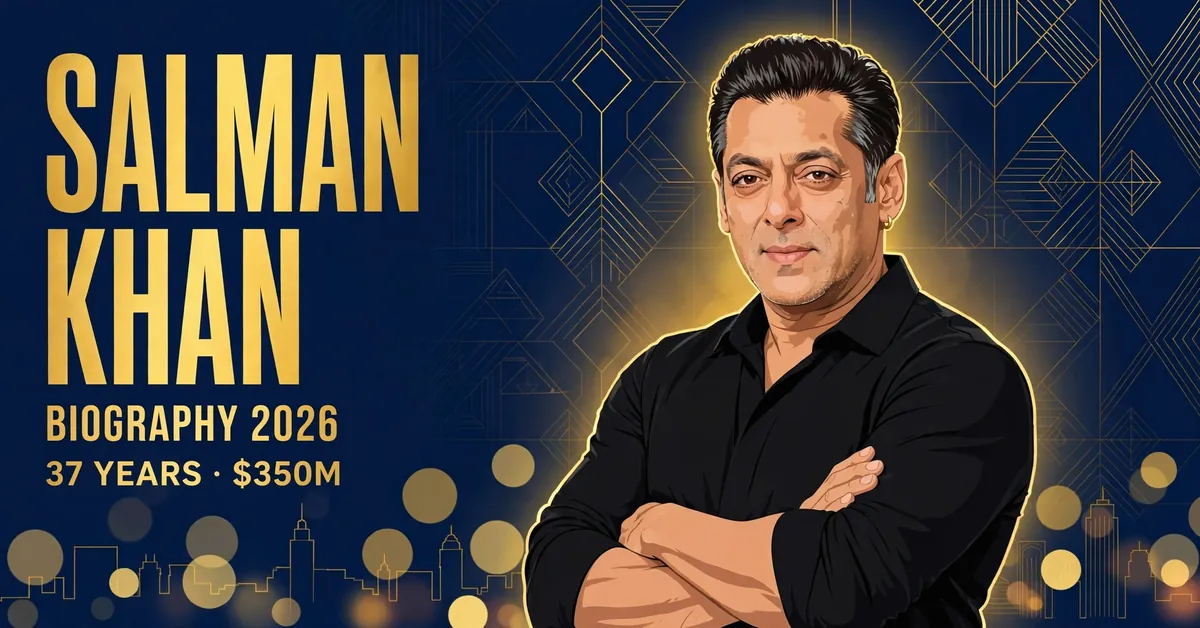
Salman Khan biography 2026: the 60-year-old superstar’s 37-year arc from Maine Pyar Kiya to Battle of Galwan — and the $350M fortune behind it, explained.
Last updated: November 18, 2026 · By Nathan Cole
Salman Khan is 60 years old in 2026, and he has spent 37 of those years as one of Hindi cinema’s biggest stars. Born Abdul Rashid Salim Salman Khan on December 27, 1965, in Indore, he turns 61 on December 27, 2026 — and he is still headlining films, still hosting Bigg Boss, and still the name that fills theatres on Eid. His estimated net worth in 2026 sits at around $350 million (roughly ₹2,900–3,225 crore), inside a published range of $300 million to $375 million. That fortune rests on more than 80 films, sixteen seasons of television’s biggest reality show, a production house, a clothing label and a charity that predates most of his rivals’ businesses.
The arc has three acts, and they do not look like each other. The first made him Prem, the romantic hero of Maine Pyar Kiya and Hum Aapke Hain Koun..!, the biggest star of the 1990s. The second nearly ended the career: a long stretch of flops, two criminal cases, and a stretch when the industry wrote him off. The third began with Wanted in 2009 and never really stopped — Dabangg, Ek Tha Tiger, Bajrangi Bhaijaan, Sultan — a run that made him the most bankable name in Hindi cinema for a decade. This biography traces the full arc: the screenwriter’s son who arrived in Mumbai with no acting plan, the overnight star, the wilderness years, the second act, the television host, the producer and charity founder, and the war film carrying his 2026.
Every figure in this article carries its source. Where the sources disagree — and on his net worth they disagree by $75 million — the disagreement is on the page, not hidden behind a single confident number.
Quick Facts
| Full Name | Abdul Rashid Salim Salman Khan |
| Born | December 27, 1965, Indore, Madhya Pradesh, India |
| Age in 2026 | 60 years old; turns 61 on December 27, 2026 |
| Height | Commonly listed at 5 ft 8 in (174 cm); no verified measurement published |
| Occupation | Actor, film producer, television presenter |
| Years Active | 1988–present (37 years) |
| Debut | Biwi Ho To Aisi (1988, supporting role) |
| Breakthrough | Maine Pyar Kiya (1989) |
| Television | Host of Bigg Boss since season 4 (2010) through season 19 (2025) |
| Estimated Net Worth | Around $350 million (₹2,900–3,225 crore), inside a $300M–$375M published range |
| Latest Film | Sikandar (Eid, March 2025) |
| Next Film | Battle of Galwan (retitled Maatrubhumi), planned for a 2026 release |
| Marital Status | Never married |
| Parents | Salim Khan (screenwriter) and Sushila Charak (Salma Khan) |
How This Estimate Was Made
No audited figure for Salman Khan’s wealth exists — every number here is a media estimate built from reported fees, property and business interests. This article anchors on around $350 million because the most complete 2026 reporting clusters there: TechnoSports put him at $350 million in April 2026, a January 2026 Siasat Daily report put the figure at ₹3,225 crore, and Guide Net Worth’s own age profile of the star reached the same anchor in October 2026. The published range, $300 million to $375 million, is the span of credible 2026 estimates: Alux’s November 2026 ranking put him at $320 million, the 2026 M3M Hurun India Rich List gave ₹3,000 crore (about $313–360 million depending on the exchange rate used), and the outer ends come from BeforeGood ($300 million) and TechToFacts ($375 million). Forbes’ much-quoted $37.7 million figure from 2018 is one year’s estimated pretax earnings, not wealth, and it is never added into the total. Where a figure in this article is a trade-reported box-office gross rather than a net-worth estimate, it is labelled as one.
+
Early Life and Family: The Screenwriter’s Eldest Son
Salman Khan was born in Indore on December 27, 1965, the eldest child of Salim Khan and Sushila Charak. His father was already on his way to becoming one of the most famous names in Hindi cinema: as half of the Salim–Javed writing partnership, Salim Khan wrote Sholay, Deewaar and Don, the films that defined the angry-young-man era. His mother, a Maharashtrian Hindu who took the name Salma after marriage, married Salim on November 18, 1964. Salman grew up, in his own telling, in both faiths — a detail he has repeated across interviews for decades, and one that still comes up whenever his background is discussed.
The family moved to Mumbai, and the household filled out around him: brothers Arbaaz and Sohail, sisters Alvira and Arpita, and his stepmother Helen, the former actress and dancer his father married later. The Khan household was film business from the inside — writers, actors and producers at the dinner table — but Salman has said repeatedly that he had no plan to act. The ancestry adds another layer his biographer Jasim Khan documented: the family traces its roots to the Akuzai sub-tribe of the Yusufzai Pashtuns from Malakand, in what is now Pakistan, with great-grandparents who immigrated to Indore in the mid-1800s.
That upbringing explains two things that run through the whole career. First, the ease with the industry’s machinery — he never had to learn how a film set works, because he grew up adjacent to one. Second, the loyalty to family that later became a business model: his brothers produce with him, his father produces his films, and the family name sits on the production banner. The eldest son of a famous screenwriter could have coasted on the surname. The record shows he did the opposite for his first decade — he worked, and then he worked harder when the work stopped coming.
School, College and the Long Way Round to Acting
Salman attended St. Stanislaus High School in Bandra, Mumbai, then went on to Elphinstone College. He dropped out after his second year. There is no film-school chapter in this story and no theatre apprenticeship of the kind his contemporaries sometimes claim. He has said he drifted into acting through friends and family connections rather than through any plan — a version of events that fits the record, since his first screen appearance came without a star launch, a famous director or a publicity campaign.
The dropout detail matters because it marks the difference between Salman and the other two Khans. Shah Rukh Khan came through Delhi theatre and television; Aamir Khan came through a film family too, but with a famous uncle-producer launch in Qayamat Se Qayamat Tak. Salman arrived with neither a craft pedigree nor a launch vehicle. What he had was a face, a physique and a surname — and for the first few years, that was almost enough, and then suddenly it was not.
The Debut: Biwi Ho To Aisi and the Overnight Star of Maine Pyar Kiya
Salman Khan’s first released acting credit was a supporting role in Biwi Ho To Aisi in 1988, a family drama headlined by Rekha. He played the younger brother. It was a small part in a successful film, the kind of debut that usually leads nowhere. A year later, everything changed. Sooraj Barjatya cast him as Prem in Maine Pyar Kiya (1989), opposite Bhagyashree, and the film became one of the biggest romantic hits Hindi cinema had seen. Salman won the Filmfare Award for Best Male Debut, and the character’s name stuck to him for the rest of his career — he would play Prem again and again, across directors and decades, until the name became shorthand for his romantic-hero image.
The speed of the rise is worth pausing on. In twelve months he went from an uncredited-feeling supporting player to the lead of a film that ran for months and made him, at 23, one of the most wanted young actors in the industry. The 1990s opened with him at the top of the call sheets. The films that followed — Baaghi (1990), Sanam Bewafa (1991), Saajan (1991) — kept him there, and the industry began treating him as a fixture rather than a discovery.

The 1990s: Prem, the Blockbusters and the First Slump
The 1990s made Salman Khan a superstar and then, in the second half of the decade, tested whether he would stay one. Hum Aapke Hain Koun..! (1994), again with Barjatya, became one of the highest-grossing Indian films of its era and fixed his image as the good-hearted family hero. Karan Arjun (1995), with Shah Rukh Khan, paired the two biggest young stars of the decade and became a blockbuster. Hum Dil De Chuke Sanam (1999), directed by Sanjay Leela Bhansali, gave him a prestige hit and a performance critics took seriously. By the end of the decade he had starred in the year’s highest-grossing Hindi film more often than any actor of his generation — a record Wikipedia notes he still holds, with ten individual years to his name.
The slump arrived anyway. The late 1990s and early 2000s brought a run of forgettable films, and the industry’s patience thinned. His personal life supplied the other half of the decade’s coverage: the relationship with Aishwarya Rai, which ended in 2002 amid intense tabloid attention, and the first of the legal cases that would shadow him for twenty years. The 1990s ended with Salman famous, rich and, for the first time, vulnerable — a star whose films no longer opened on his name alone.
The 2000s: Reinvention, Tere Naam and the Wilderness Years
If the 1990s were the rise, the 2000s were the long middle — a decade of reinvention that worked in flashes and failed in stretches. Tere Naam (2003) gave him one of his most remembered performances, playing a volatile, heartbroken young man with his hair grown long; the hairstyle became a fad across India, and the film’s music ran for months. Mujhse Shaadi Karogi (2004) and No Entry (2005) showed he could still carry a comedy hit. But the decade’s ledger is dominated by misses — films that opened, sank and were forgotten within a season.
The wilderness years matter to this biography because they explain the second act. Salman spent most of the 2000s as a star in search of a formula, cycling through genres and directors while his contemporaries consolidated. Aamir Khan rebuilt himself as the perfectionist with one film a year. Shah Rukh Khan became the global brand. Salman, meanwhile, was the actor the trade still called a superstar while quietly noting that his last clean solo hit was years behind him. The turnaround, when it came in 2009, did not look like a comeback plan. It looked like a Telugu remake.
Wanted and Dabangg: The Second Act That Rewrote the Rules
Wanted (2009), directed by Prabhu Deva, was a remake of the Telugu hit Pokiri, and it gave Salman something he had not had in years: a mass-action hero with a swagger the audience could quote. The film grossed around ₹90 crore worldwide — modest by today’s standards, large enough in 2009 to change the conversation. A year later Dabangg (2010) did what Wanted had promised. As Chulbul Pandey, the corrupt-but-lovable cop with the sunglasses and the catchphrases, Salman created the defining character of his second career. The film grossed more than ₹200 crore worldwide, spawned a franchise, and reset his price, his image and his audience in a single stroke.
The formula that followed was deliberate and repeated: a larger-than-life hero, an Eid release, a single-screen audience first and the multiplexes second. Ready (2011), Bodyguard (2011) and Ek Tha Tiger (2012) all followed it, and all of them worked. The actor who had spent the 2000s chasing hits had found a machine for making them. Critics complained the films were interchangeable. The box office answered for a decade.
Ek Tha Tiger, Bajrangi Bhaijaan and Sultan: The Peak Years
The peak ran from 2012 to 2017, and it was the most productive stretch of his career. Ek Tha Tiger (2012) grossed more than ₹300 crore worldwide and launched the YRF Spy Universe’s most durable franchise — a series that would still be running in 2023. Kick (2014) crossed ₹400 crore. Then came the two films that define the peak. Bajrangi Bhaijaan (2015), in which he played a simple-hearted devotee escorting a lost Pakistani girl home, grossed more than ₹900 crore worldwide and won him a National Film Award as a producer — the second of his career, after Chillar Party in 2011. Sultan (2016), in which he played an ageing wrestler fighting his way back, grossed more than ₹600 crore and gave him a performance with real weight behind the muscles.
The numbers from this period are the reason his net-worth estimates sit where they do. A star who headlines a ₹900-crore film and a ₹600-crore film in consecutive years commands the highest fees in the industry — and the reporting from this period puts his per-film fee in the ₹100–150 crore band, among the highest any Hindi film actor charges. The endorsements followed the box office: Thums Up, Revital, and a string of brands that paid for the mass-market reach his Eid releases guaranteed. The peak also built the businesses. Salman Khan Films, founded in 2011, produced Bajrangi Bhaijaan and the Dabangg sequels. Being Human, the clothing label whose profits fund his foundation, turned his name into a retail brand. The fortune was no longer just fees. It was equity.
Tiger 3, Sikandar and the 2025–26 Reset
The peak did not last forever, and the last three years have been the hardest test of the second act. Tiger 3 (2023), released on Diwali, grossed around ₹465 crore worldwide — a strong number that still fell short of the franchise’s own expectations. Kisi Ka Bhai Kisi Ki Jaan (2023) managed around ₹180 crore and was received as a disappointment. Then came Sikandar, released on Eid in March 2025 and directed by A. R. Murugadoss, co-starring Rashmika Mandanna. Trade reports called it a box-office flop, and the coverage through 2025 treated it as the film that finally broke the Eid formula — the first time in the second act that an Eid release failed to rescue the year.
The reset, so far, is not a retreat. He made a cameo in Aryan Khan’s directorial debut, the Netflix series The Ba***ds of Bollywood, in September 2025 — a small appearance that carried outsized coverage because it linked the industry’s biggest star to its most-watched debutant. And he spent the second half of 2025 shooting his next film in Ladakh while hosting Bigg Boss 19 at weekends, a schedule that tells its own story about how he works at 60: two jobs at once, both in public, neither scaled back.
Battle of Galwan: The War Film Carrying 2026
Salman Khan’s answer to the Sikandar setback is a war film. In July 2025 he announced Battle of Galwan, directed by Apoorva Lakhia and based on the 2020 Galwan Valley clash between Indian and Chinese troops, drawing on the book India’s Most Fearless by Shiv Aroor and Rahul Singh. He plays Colonel B. Santosh Babu, the commanding officer of the 16 Bihar regiment who was killed in the clash. Chitrangada Singh co-stars, and the film is produced by his mother Salma Khan under the Salman Khan Films banner.
The production has been unusually public. A 45-day schedule in Leh, Ladakh, wrapped in late 2025, with the director sharing behind-the-scenes footage; Salman returned to Mumbai with minor injuries from the shoot and went straight back to hosting Bigg Boss 19‘s Weekend Ka Vaar episodes. In March 2026 the film was retitled Maatrubhumi, and trade reports pointed to an April 17, 2026 release — though the date has already moved before, and other reports have floated a June 2026 window instead. The film also carries a complication that has nothing to do with its release date: the Dabangg director Abhinav Kashyap publicly attacked the casting in October 2025, a feud that played out on the Bigg Boss stage itself when Salman responded there. Whatever the release date, the film is a bet that the patriotic action drama — the genre Bajrangi Bhaijaan and Sultan proved he owns — still works for him at 60.
Bigg Boss: Sixteen Seasons as Host
Salman Khan has hosted Bigg Boss since season 4 in 2010, and the show is now as much a part of his biography as any film. Sixteen seasons in, he is the longest-serving host of a reality show in Indian television, and the Weekend Ka Vaar episodes — where he confronts, scolds and occasionally defends the contestants — have become a weekly fixture of their own. Season 19 ran for 106 days from August 24, 2025, and ended with Gaurav Khanna declared the winner, Farrhana Bhatt as first runner-up and Pranit More in third place. At the finale, Salman confirmed what the audience wanted to hear: he will be back for season 20.
The hosting job does three things for him that films no longer reliably do. It keeps him in front of a mass audience every weekend for four months a year. It pays a per-season fee that trade reports place among the highest on Indian television. And it gives him a platform no film can: a live, unscripted stage where the country’s most famous star talks directly to the country’s most-watched contestants, in front of cameras, every week. The controversies that used to follow his films now follow his weekends instead — the October 2025 exchange with Abhinav Kashyap happened on that stage — but the show’s ratings have never punished him for it.

The Money: A 0 Million Fortune, Built Four Ways
Salman Khan’s estimated net worth in 2026 is around $350 million, inside a published range of $300 million to $375 million. The full line-by-line breakdown — including the Hurun debut, the per-film fees and the businesses — is worked out in Salman Khan’s net worth in 2026. What follows here is the shape of the fortune: four streams, built over 37 years, that explain why the number is that large and why it moves so slowly.
The first stream is film fees. At the peak, his per-film fee was reported in the ₹100–150 crore band, among the highest in Hindi cinema. Even in a weaker year, a single film fee is a fortune by any normal measure. The second stream is television: sixteen seasons of Bigg Boss at a per-season fee the trade places among the highest on Indian television. The third is business: Salman Khan Films, which produces his own films and takes the producer’s share of the gross, and the Being Human clothing label. The fourth is the asset base — most visibly the property portfolio in Mumbai, including the Galaxy Apartments home in Bandra he has lived in for decades rather than trading up to a bungalow, and the farmhouse in Panvel.
Two cautions keep the number honest. First, the 2026 Hurun India Rich List debut — ₹3,000 crore, roughly $313 million at the September 2026 exchange rate — is a wealth estimate built from assets and business valuations, not a bank balance, and the rupee-dollar conversion moves the dollar figure by tens of millions depending on the rate used. Second, Forbes’ $37.7 million figure from 2018, which still circulates on aggregator sites, was one year’s estimated pretax earnings. It is not wealth, and it should never be averaged into a net-worth total. The $350 million anchor is the figure the most complete 2026 reporting keeps landing on — and the range around it is the honest answer.
| Fortune stream | What it is | 2026 position |
|---|---|---|
| Film fees | Per-film fee, 80+ films | Reported ₹100–150 crore per film at the peak |
| Television | Bigg Boss hosting, 16 seasons | Among the highest per-season fees on Indian TV |
| Production | Salman Khan Films (founded 2011) | Producer’s share of Bajrangi Bhaijaan, Dabangg franchise |
| Brand & charity business | Being Human clothing label; endorsements | Profits fund the Being Human Foundation |
| Assets | Mumbai property, Panvel farmhouse | Galaxy Apartments, Bandra — home for decades |
Being Human and Salman Khan Films: Business Beyond the Camera
The Being Human Foundation is the part of Salman Khan’s biography that predates the business language around it. He set it up as a charitable trust in 2007, focused on education and healthcare, and it has run health camps and supported children’s education ever since. The clothing label came later: Being Human apparel, sold in stores across India, with its profits funding the foundation’s work. It is the rare celebrity brand that was built backwards — the charity first, the commerce second — and it is the reason his name appears on T-shirts in small towns that have never seen one of his films in a multiplex.
Salman Khan Films, founded in 2011, is the more conventional business. It produces his films — Bajrangi Bhaijaan, the Dabangg sequels, Battle of Galwan — and it produces films for others, including the launchpad for his brother-in-law Atul Agnihotri’s projects and the occasional small film with no Khan on screen at all. The two businesses together explain a detail that puzzles people who only follow the box office: even in a year when his film flops, the money does not stop, because the producer’s share, the television fee and the brand income arrive on their own schedules.
Personal Life: Family, Galaxy Apartments and the Unmarried Question
Salman Khan has never married, and at 60 that fact is one of the most-asked questions about him. His past relationships — most famously with Aishwarya Rai in the late 1990s and with Katrina Kaif through the 2000s — were covered in exhaustive, often intrusive detail, and both ended years ago. He has been linked to others since, most recently to Iulia Vantur, but he has never confirmed a marriage, an engagement or a partner in the present tense, and this article does not invent one. The question comes up in every biography because the answer is genuinely unusual for a star of his stature and generation: the most eligible bachelor in Hindi cinema, still unmarried at 60.
His daily life is famously unglamorous for a man of his wealth. He lives in a flat in Galaxy Apartments in Bandra — a modest building by Bollywood standards — rather than in a bungalow or a penthouse, and he has lived there for decades. The Panvel farmhouse, where he spends weekends and where much of the family gathers, is the second home. He is close to his parents, who live with him, and to his siblings: Arbaaz and Sohail both act and produce, Alvira runs the Being Human Foundation’s work, and Arpita’s wedding in 2014 was one of the most covered family events in the industry’s recent history. The family is the constant in a career that has swung from the top of the charts to the edge of collapse and back.
Legal History: The Cases, the Verdicts and Where They Stand
No honest biography of Salman Khan skips the legal history, and no honest version simplifies it. There are two cases, with different facts and different outcomes, and they are often confused with each other. The first is the 2002 hit-and-run case: on the night of September 28, 2002, his car ran over five people sleeping on a pavement in Bandra, killing one. A trial court convicted him of culpable homicide in May 2015 and sentenced him to five years. Seven months later, in December 2015, the Bombay High Court acquitted him, overturning the conviction. The second is the blackbuck poaching case, from October 1998, during the shoot of Hum Saath-Saath Hain near Jodhpur: a trial court convicted him on April 5, 2018, and sentenced him to five years in prison. He was granted bail on April 7, 2018, and the appeals have continued since — the Rajasthan High Court record dated July 13, 2026 lists connected appeals involving Salman Khan and the State, and adjourns the matters.
The cases shaped the career in concrete ways. Films were delayed, endorsements were paused, and the 2000s slump coincided with the years the cases dominated coverage. They also shaped the public image: the same audience that filled theatres for Dabangg debated the verdicts at home. This article states the outcomes as the courts recorded them — a conviction overturned on appeal in one case, a conviction under appeal in the other — and leaves the rest to the record.
Age and Height: The Numbers People Keep Googling
Salman Khan is 60 years old in 2026. He was born on December 27, 1965, which means he turns 61 on December 27, 2026. The full milestone-by-milestone account — his age at every career turn, from the 23-year-old of Maine Pyar Kiya to the 60-year-old of Battle of Galwan — is set out in Salman Khan’s age in 2026. The confusion online usually comes from pages written before a birthday and never updated: a profile that says 59 was written in 2025, and a profile that says 60 was written after December 27, 2025. The birth date itself is not disputed anywhere.
His height is a different kind of question, because no verified measurement has ever been published. Most listings put him at 5 ft 8 in (174 cm), and that is the figure this article uses — with the caveat that it is a reported listing, not a measurement. The full source-by-source working-through — where the listings agree, where they split, and why some profiles still carry taller figures — is on our sister site in Salman Khan’s height, worked through source by source. The short version: he is listed shorter than his two fellow Khans, and the films have never cared.
Legacy: What 37 Years Actually Bought
Thirty-seven years in, the legacy is easier to count than to summarise. More than 80 films. The year’s highest-grossing Hindi film in ten individual years — a record no other actor holds. Two National Film Awards as a producer, two Filmfare Awards as an actor. A television hosting run, sixteen seasons and counting, that no Indian star has matched. A charity that predates the brand built on it, and a production house that turned his name into a business. And a fortune of around $350 million that, for all the disagreement about the exact figure, places him second among Bollywood’s male stars — behind Shah Rukh Khan’s biography, whose Hurun 2026 figure of roughly $1.2 billion puts him in a category of his own, and ahead of most of his generation.
The comparisons sharpen the picture. Aamir Khan’s biography is the story of the perfectionist who made fewer films and chose them more carefully; his net worth, at around $220 million per Guide Net Worth, is smaller, and his hit rate is higher. Akshay Kumar’s $315 million Khiladi empire was built on volume — four films a year where Salman made one — and the two men now sit within $35 million of each other. Katrina Kaif’s ₹224 crore fortune was built partly in his films: Ek Tha Tiger, Tiger Zinda Hai and Bharat were her biggest hits too. The Khans’ era is often described as ending. The 2026 release calendar says otherwise: all three Khans have major films out in the same year, and Salman’s is a war film about a real colonel who died in 2020. If it works, the third act gets a fourth. If it does not, the 37 years still stand on their own.
| Star | 2026 net worth | Built on |
|---|---|---|
| Shah Rukh Khan | ~$1.2 billion (Hurun 2026) | Red Chillies, Knight Riders, global stardom |
| Salman Khan | ~$350 million | 80+ films, Bigg Boss, production, Being Human |
| Akshay Kumar | ~$315 million | Volume — up to four films a year |
| Aamir Khan | ~$220 million | One film a year, profit-share deals |
Frequently Asked Questions About Salman Khan
Who is Salman Khan?
Salman Khan is an Indian actor, film producer and television presenter who works primarily in Hindi cinema. Born Abdul Rashid Salim Salman Khan on December 27, 1965, in Indore, he has acted in more than 80 films across 37 years, hosted Bigg Boss since 2010, and founded the Being Human Foundation and Salman Khan Films. He is one of the three Khans who have dominated Bollywood since the 1990s, alongside Shah Rukh Khan and Aamir Khan.
How old is Salman Khan in 2026?
Salman Khan is 60 years old in 2026. He was born on December 27, 1965, in Indore, Madhya Pradesh, and turns 61 on December 27, 2026. Some older profiles still list him as 59 because they were written before his 60th birthday in December 2025; the birth date itself is not disputed anywhere.
What is Salman Khan’s net worth in 2026?
Salman Khan’s net worth in 2026 is estimated at around $350 million (roughly ₹2,900–3,225 crore), inside a published range of $300 million to $375 million. The anchor comes from TechnoSports (April 2026) and a January 2026 Siasat Daily report of ₹3,225 crore; Alux put him at $320 million in November 2026 and the 2026 Hurun India Rich List gave ₹3,000 crore. Forbes’ $37.7 million figure from 2018 was one year’s earnings, not wealth.
What was Salman Khan’s first film?
Salman Khan’s first released acting credit was a supporting role in Biwi Ho To Aisi (1988), a family drama headlined by Rekha. His breakthrough came a year later with Maine Pyar Kiya (1989), in which he played Prem opposite Bhagyashree; the film made him an overnight star and won him the Filmfare Award for Best Male Debut.
Is Salman Khan married?
No, Salman Khan has never married. His past relationships with Aishwarya Rai and Katrina Kaif were widely reported and ended years ago. He lives with his parents in Galaxy Apartments in Bandra, Mumbai, and has never confirmed a marriage, an engagement or a current partner.
How tall is Salman Khan?
Salman Khan is commonly listed at 5 ft 8 in (174 cm). No verified measurement has ever been published, so the figure is a reported listing rather than a confirmed measurement, and some profiles carry taller figures. He is listed shorter than Shah Rukh Khan and Aamir Khan, though the films have never made an issue of it.
What is Salman Khan’s latest film?
Salman Khan’s latest film is Sikandar, released on Eid in March 2025 and directed by A. R. Murugadoss, co-starring Rashmika Mandanna. Trade reports called it a box-office disappointment. His next film is Battle of Galwan, directed by Apoorva Lakhia, in which he plays Colonel B. Santosh Babu; trade reports point to an April 17, 2026 release, though the date has moved before.
How many Bigg Boss seasons has Salman Khan hosted?
Salman Khan has hosted Bigg Boss since season 4 in 2010, through season 19, which ran for 106 days from August 24, 2025 and was won by Gaurav Khanna. That is sixteen seasons as host, making him the longest-serving host of a reality show in Indian television. At the season 19 finale he confirmed he will return to host season 20.
Sources & Reporting
This article was researched on 18 November 2026 from live reporting: Wikipedia (updated November 2026) for the December 27, 1965 birth date, the Indore birthplace, the 80-plus filmography, the two National Film Awards as producer and two Filmfare Awards as actor, the 2002 hit-and-run conviction and December 2015 Bombay High Court acquittal, and the April 2018 blackbuck conviction and bail; TheDesis (November 2026) for the family background, the Being Human Foundation’s 2007 establishment, the Salman Khan Films 2011 foundation, the Battle of Galwan retitling to Maatrubhumi and the Rajasthan High Court record of July 13, 2026; BookMyShow for the St. Stanislaus schooling and the Elphinstone College dropout; TechnoSports (April 2026) and HolaReads (August 18, 2026) for the $350 million anchor and the ₹3,225 crore figure, via Guide Net Worth’s own age profile of the star (October 31, 2026); Alux (November 2026) for the $320 million estimate and the ₹100–150 crore per-film fee band; the 2026 M3M Hurun India Rich List, as reported by The Indian Express, NDTV, IndiaWeekly and Trak.in (September 24, 2026), for the ₹3,000 crore debut and Shah Rukh Khan’s ₹10,000 crore figure; obnews.co (November 2026) for the Bigg Boss 19 finale, Gaurav Khanna’s win, the 106-day run and the Bigg Boss 20 confirmation, and for the Battle of Galwan Ladakh schedule and post-production status; bollyy.com (March 2026) for the April 17, 2026 release report; and Guide Net Worth’s own published anchors for the peer comparison — Aamir Khan $220 million, Akshay Kumar $315 million and Katrina Kaif ₹224 crore. Where sources disagreed — the $300 million to $375 million net-worth spread, the moving Battle of Galwan release date, the height listings — the article names the disagreement instead of picking a number silently. Corrections are welcome via the About page.
Nathan Cole
Nathan Cole is the editor of Guide Net Worth. He covers celebrity wealth the way a business desk covers earnings: reported figures first, estimates labeled as estimates, no invented numbers. Every profile passes through his desk before it publishes. About Guide Net Worth · Corrections: figures are updated when new reporting emerges — contact us via the About page if you spot an error.
References & Sources
This article has been fact-checked and verified against multiple public sources, financial disclosures, SEC filings, Forbes reports, Celebrity Net Worth databases, and official records. All net worth estimates are based on publicly available information and financial analysis.