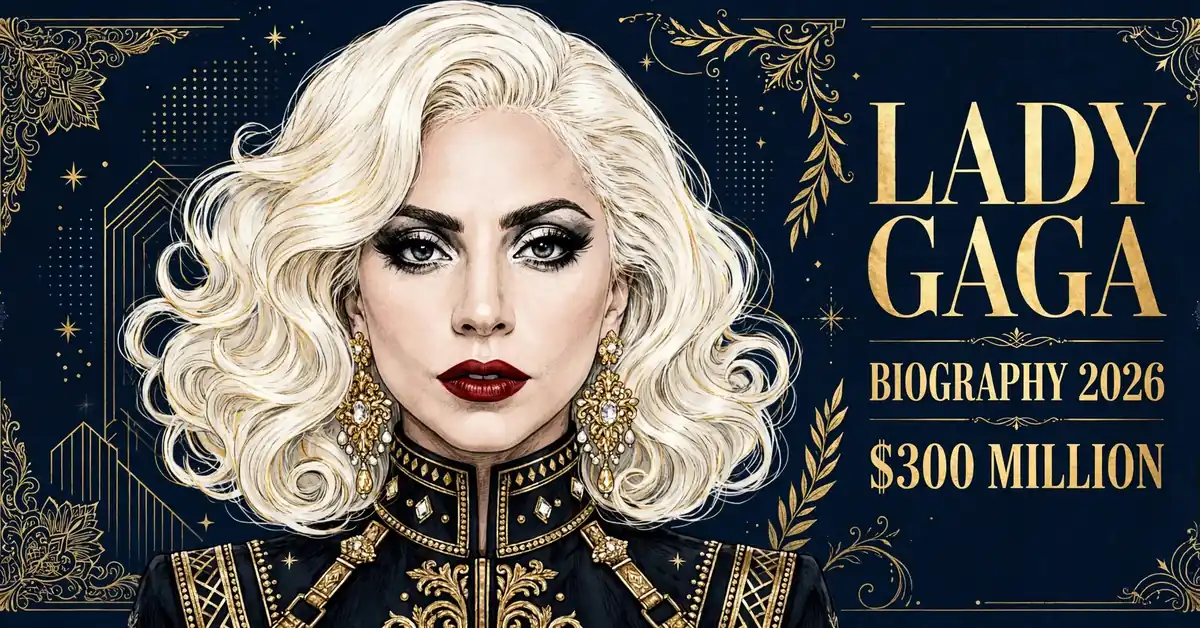
Lady Gaga biography 2026: born March 28, 1986, she turns 40 with a $300 million fortune, Mayhem topping charts and the Mayhem Ball grossing $419.5 million.
Last updated: November 23, 2026 · By Nathan Cole
Lady Gaga is 40 years old in 2026, and her net worth is $300 million, per Celebrity Net Worth’s September 2026 estimate, a figure Parade also reports. Born Stefani Joanne Angelina Germanotta on March 28, 1986, in Manhattan, she turned 40 in March 2026 in the middle of the biggest touring year of her life, with her album Mayhem at No. 1 in 32 countries, her Mayhem Ball grossing about $419.5 million by Billboard’s count, and a second season of Wednesday putting her back on screen as Rosaline Rotwood. The piano prodigy from the Upper West Side became a pop star, then an Oscar winner, then a beauty founder — and in 2026 she is doing all three at once.
That is the short version. The longer version runs from piano lessons at age 4 to a Tisch dropout at 19, from a Def Jam contract that lasted months to The Fame in 2008, from meat dresses and monster anthems to a jazz album with Tony Bennett and an Academy Award for “Shallow”. It runs through Chromatica, through the pandemic years that reshaped her touring business, and into Mayhem — the March 7, 2025 album that gave her a seventh Billboard 200 No. 1 and a tour that pushed her career touring gross to $1.17 billion. Along the way she built Haus Labs into a beauty brand doing about $100 million a year, co-founded the Born This Way Foundation with her mother, and got engaged to entrepreneur Michael Polansky in July 2024.
This biography reports that life from the public record as it stood in November 2026. Every dollar figure carries its source and its date, and where the sources disagree — Billboard’s $419.5 million against Pollstar’s $418.4 million for the same tour, or the $300 million net-worth anchor against a $900 million outlier — the article shows both numbers and explains the gap instead of picking one and hiding the other.
Quick Facts
| Full name | Stefani Joanne Angelina Germanotta |
| Stage name | Lady Gaga |
| Born | March 28, 1986, Manhattan, New York City, USA (age 40 in 2026) |
| Raised | Upper West Side, Manhattan |
| Parents | Cynthia Bissett Germanotta (former Verizon vice president); Joseph Germanotta (internet entrepreneur) |
| Sibling | Younger sister Natali Germanotta |
| Height | Commonly reported 5 ft 1 in (155 cm) |
| Education | Convent of the Sacred Heart; NYU Tisch School of the Arts (admitted at 17, left at 19) |
| Occupations | Singer, songwriter, actress and entrepreneur |
| Known for | The Fame, Born This Way, A Star Is Born, Mayhem, Haus Labs, Born This Way Foundation |
| Breakthrough | The Fame (2008) — “Just Dance” and “Poker Face” |
| Latest album | Mayhem (March 7, 2025) — 7th Billboard 200 No. 1, No. 1 in 32 countries |
| Latest tour | Mayhem Ball, July 16, 2025 – April 13, 2026; 86 shows |
| Grammy Awards | 16 in total (per Celebrity Net Worth), including two at the 2026 Grammys |
| Academy Award | Best Original Song, “Shallow” (2019) |
| Net worth (2026) | $300 million (Celebrity Net Worth, September 2026; Parade same figure) |
| Business | Haus Labs, founded 2019, relaunched 2022; about $100 million annual revenue in 2026 (per InfoCelebs) |
| Partner | Engaged to entrepreneur Michael Polansky (announced July 2024) |
| Foundation | Born This Way Foundation, co-founded 2012 with her mother Cynthia |
How This Biography Was Reported
This profile was reported from public sources in November 2026, using only the adjudicated facts supplied for this article. The $300 million net-worth anchor comes from Celebrity Net Worth’s September 2026 estimate, with Parade reporting the same figure; Forbes estimated $52 million in earnings for 2025, which is a one-year earnings figure, not a net worth. Two much higher figures — $900 million, carried by sociallifemagazine and Hello Magazine — are treated in the money section as a high outlier model estimate, with the reasons given. On the Mayhem Ball, Billboard Boxscore reports $419.5 million and Pollstar reports $418.4 million; the $1.1 million gap is a difference between two trackers counting slightly different show sets (Billboard counts 93 shows including ticketed promo concerts; the tour itself ran 86 shows), and both figures are printed. The free Copacabana Beach show in Rio in May 2025 is included in neither gross. Haus Labs figures come from InfoCelebs: about $100 million in annual revenue in 2026, with a 70–90% ownership estimate and a $200–300 million stake value at a conservative 3x revenue multiple — a modelled value, labelled as modelled. Album dates, award counts, tour dates and acting roles are as listed in the adjudicated record. No figure in this article is invented, and no private document was used.
+
Early Life on the Upper West Side: Piano Lessons at Age 4
Stefani Joanne Angelina Germanotta was born on March 28, 1986, in Manhattan, New York City, and raised on the Upper West Side. Her father, Joseph Germanotta, was an internet entrepreneur. Her mother, Cynthia Bissett Germanotta, was a vice president at Verizon before she left corporate life to work alongside her daughter. Her younger sister, Natali Germanotta, grew up in the same apartment, in the same school world, and later worked in fashion and design — a family that stayed close even as one daughter became one of the most famous people on the planet.
The piano came first, at age 4. Gaga has described herself as a child who sat at the instrument for hours, and the training stuck: she learned to play by ear, she learned to read music, and she learned the discipline of practice before she learned anything about the music business. By her teens she was writing songs, playing in school productions, and performing at open-mic nights around the city. The piano was not a hobby she picked up later. It was the first instrument, the first skill, and the foundation of everything that followed — the reason her live shows still put her at a piano, alone, in the middle of an arena.
She attended the Convent of the Sacred Heart, a private Catholic girls’ school on the Upper East Side, where she was, by her own later accounts, an outsider — serious about music in a school that prized other things, already writing songs while her classmates were doing homework. The outsider feeling became a theme she returned to for the rest of her career, most directly in the Born This Way Foundation she founded years later. Readers who want her age in full — the birthdays, the milestones, the year-by-year timeline — can find it in our sister site’s Lady Gaga age profile, which covers the same dates from the age angle. The two profiles agree on every date; they answer different questions.
She turned 40 on March 28, 2026. The birthday landed in the middle of the Mayhem Ball, between tour legs, and it marked a line in her career: forty years old, eighteen years after her debut album, with a new No. 1 record, a tour grossing more than $400 million, and a second acting chapter under way. Few pop stars reach forty with their biggest tour still ahead of them. Gaga did.
Tisch at 17, Dropout at 19, and the Def Jam Rejection
At 17, Gaga was admitted to the Tisch School of the Arts at New York University, one of the most competitive performing-arts programmes in the country. She studied music there, and she lasted two years. At 19 she dropped out to pursue music full time — a decision that looked reckless at the time and looks, in hindsight, like the first real business call of her career. Tisch gave her training and contacts. It did not give her a record deal, and she decided she would get one faster on her own.
New York gave her the next lesson. She played clubs on the Lower East Side, she performed in burlesque and rock shows, she wrote songs for other artists, and she built a live act that was louder and stranger than anything on the radio. The work paid off in a deal with Def Jam — and then, within months, the label dropped her. A major-label signing that ends in months is the kind of rejection that finishes most young artists. Gaga treated it as information: the label did not know what to do with her, so she would find a label that did, and a sound that made the decision obvious.
The years between Tisch and the breakthrough were not wasted. She learned to write pop songs to order, she learned how a studio session works, she learned how to hold a room with nothing but a piano and a voice, and she met the collaborators who would shape her first album. The Def Jam rejection is often told as a wound. It reads better as a filter. The artist who came out of it was not a label’s idea of a pop star. She was her own idea, and the next label to sign her — Interscope, in 2007 — signed that version.
Interscope gave her the room Def Jam had not. She recorded, she wrote, she worked with producers who understood the dance-pop sound she was chasing, and she built the material that became The Fame. The two-year gap between the Interscope signing in 2007 and the album’s release in 2008 was spent making a record that sounded like nothing else on the charts — and like exactly what the charts were about to want.
The Fame: “Just Dance”, “Poker Face”, and a New Kind of Pop Star
The Fame arrived in 2008, and it did not sound like a debut. “Just Dance” went to No. 1. “Poker Face” went to No. 1. The album sold in the millions, and the artist behind it arrived fully formed: the wigs, the outfits, the videos, the interviews, the persona that treated pop stardom as a piece of performance art. Gaga was not a singer who happened to have a look. The look was part of the argument — that fame itself was the subject, and she was going to study it in public.
The songs were built to last. “Just Dance” was a dance record with a pop hook that radio could not ignore. “Poker Face” was stranger — a synth line, a vocal that switched between teasing and cold, a chorus that worked in a club and on a car radio. Both singles topped charts around the world, and both are still in her setlists eighteen years later, which is the real test of a debut: not whether it charts, but whether it survives. The album earned her first Grammy nominations and her first Grammy wins, and it set the pattern for her career — a record that is a statement, a tour that is a spectacle, and a public conversation that runs alongside both.
By the end of the Fame era she was no longer a new artist. She was a headliner, a Grammy winner, and a cultural figure whose outfits made the news as reliably as her singles. The debut had done its job. It had made her famous. The question was what she would do with the fame, and the answer — The Fame Monster, then Born This Way — was bigger, louder, and more personal than anyone expected.
The Imperial Run, 2009–2013: Born This Way and Artpop
The Fame Monster followed in 2009, an eight-song companion to the debut that contained two of her defining singles. “Bad Romance” became one of the most-watched music videos of its era, a piece of pop theatre with a hook that has never left the culture. “Telephone”, her duet with Beyoncé, paired two of the biggest stars in pop on a single built for arenas. The record extended the Fame era by a year and proved the debut was not a fluke. She could do it again, at the same level, with new material.
Born This Way arrived in 2011, and it was a different kind of record: louder, faster, built on rock and dance, and built around a message. The title track became an anthem for her fans — the “little monsters”, as she called them — and the album debuted at No. 1. It was also the record where the scale of her touring caught up with the scale of her fame. The Born This Way Ball ran arenas around the world, and the stage show — the costumes, the sets, the choreography — set a standard for pop touring that other artists spent years trying to match.
Artpop came in 2013, and it was the first record of her career that divided opinion. Critics were cooler, sales were softer than the two records before it, and the era was cut short by a hip injury that forced her to cancel tour dates. The album has been reassessed since — fans defend it, and its singles still play well live — but at the time it read as a stumble. Gaga’s response was not to retreat into safe pop. It was to change direction entirely, and the change she made next is one of the smartest pivots in modern pop.
By 2013 she was already one of the highest-earning musicians in the world, and the pop years had given her the money and the standing to take the risk that followed — jazz, acting, a stripped-back record.
The Tony Bennett Pivot: Cheek to Cheek and Joanne
In 2014, Gaga recorded Cheek to Cheek, a jazz standards album with Tony Bennett. It was the last thing anyone expected from the artist behind “Bad Romance”, and it worked. The album debuted at No. 1 on the Billboard 200, won a Grammy, and introduced her to an audience that had never bought a pop record. Bennett, then in his late eighties, became a mentor and a friend, and the two toured the material together in theatres far smaller than the arenas she had been playing. The pivot was a statement of range: she could sing jazz, she could hold a standard, and she did not need a costume to do it.
Joanne followed in 2016, named for her late aunt, and it was the most personal record she had made. The sound was stripped back — guitars, live drums, a country and rock edge — and the songs were about family, loss, and the life she had lived before fame. It debuted at No. 1, giving her a fourth consecutive chart-topping album, and it showed a different side of her voice: warmer, rawer, less processed. The Joanne era also gave her the Super Bowl halftime show in 2017, a performance watched by more than 100 million people, in which she sang from the roof of the stadium and landed on the stage — a piece of live television that reminded everyone she was, first, a performer.
The Bennett partnership lasted until his death in 2023, and it changed how the industry saw her. She was no longer only a pop star. She was a singer, in the old sense — someone who could walk into a room with a band and a microphone and hold it. That reputation is what made the next step possible. When the call came for a film role that required a singer who could act, she was the obvious choice, and the film that followed changed her career a second time.
A Star Is Born and the Oscar for “Shallow”
A Star Is Born arrived in 2018, with Gaga as Ally, a singer discovered by Bradley Cooper’s Jackson Maine, a rock star in decline. The film was a box-office hit and a critical success, and Gaga’s performance was praised as a genuine acting debut rather than a pop star’s cameo. She held the screen, she sang live, and she carried the film’s emotional centre — a role that asked her to be vulnerable in a way her pop persona never had.
The soundtrack was a hit in its own right, and “Shallow” became the film’s signature song. It won the Academy Award for Best Original Song in 2019, along with Golden Globes and a BAFTA, and it gave Gaga the rarest set of honours in entertainment: a Grammy winner who is also an Oscar winner. The song’s performance at the Oscars ceremony, with Cooper, became one of the most-watched moments of the night. The film’s success also changed her asking price and her options. She was now a film actress with a proven box-office record, not a singer trying acting on the side.
The Oscar matters to the biography for a second reason. It is the moment her career split into two tracks that have run side by side ever since: music and film, each feeding the other. The film work gave her credibility that pop alone could not. The music gave her an audience that film alone could not. From 2018 on, every project she took was measured against both standards, and the ones that succeeded — Mayhem, the Mayhem Ball, Wednesday — succeeded on both.
Chromatica to Mayhem: The Comeback Record
Chromatica arrived in 2020, in the middle of the pandemic, and it was a return to dance pop after the jazz and country detours. The album debuted at No. 1, and its singles — including “Rain on Me” with Ariana Grande — won Grammys and filled the charts. But the pandemic meant there was no tour to match it. The record lived on streaming and on radio, and the live show that should have followed it never happened. For an artist whose business runs on touring, that was a real cost, and it shaped the five years that followed.
Mayhem arrived on March 7, 2025, and it was built to make up for lost time. The album gave Gaga her seventh Billboard 200 No. 1 and topped the charts in 32 countries. Its singles told the story of the record’s range: “Disease” in October 2024, a dark dance track that set the tone; “Abracadabra” in February 2025, a single that won Best Dance Pop Recording at the 2026 Grammys; and “Die With a Smile”, the August 2024 duet with Bruno Mars that became one of the biggest songs of the year and won Best Collaboration at the MTV VMAs in September 2025. The album won Best Pop Vocal Album at the 2026 Grammys, giving her two new Grammys in a single night and taking her career total to 16.

The Mayhem era was also a live era. She headlined Coachella in April 2025, playing two weekends to crowds that treated the set as a career-spanning statement. The festival performance — theatrical, precise, built around the new record and the old hits — set up the tour that followed, and it reminded the industry that her live show was still the thing that separated her from her peers. A record can stream. A show has to be seen, and hers was the one people talked about.
The table below puts the albums in order, with the signature singles that define each era. It is the spine of the biography: every pivot, every comeback, every reinvention runs through these records.
| Album | Year | Signature singles / notes |
|---|---|---|
| The Fame | 2008 | “Just Dance”, “Poker Face” — debut, two No. 1 singles |
| The Fame Monster | 2009 | “Bad Romance”, “Telephone” (with Beyoncé) |
| Born This Way | 2011 | Title track anthem; No. 1 debut |
| Artpop | 2013 | Divided critics; tour cut short by hip injury |
| Cheek to Cheek (with Tony Bennett) | 2014 | Jazz standards; No. 1, Grammy winner |
| Joanne | 2016 | Stripped-back, personal; No. 1 debut |
| A Star Is Born (soundtrack) | 2018 | “Shallow” — Academy Award, Best Original Song |
| Chromatica | 2020 | “Rain on Me” (with Ariana Grande); No. 1, pandemic era |
| Mayhem | 2025 | “Disease”, “Abracadabra”, “Die With a Smile” (with Bruno Mars); 7th Billboard 200 No. 1, No. 1 in 32 countries |
The Mayhem Ball Money: 9.5 Million, Two Trackers, One Tour
The Mayhem Ball was Lady Gaga’s eighth headlining tour, and it was the biggest of her career by every measure that counts. It opened on July 16, 2025, in Las Vegas, and closed on April 13, 2026, at Madison Square Garden in New York. It ran 86 shows across Asia, Europe, North America and Oceania, and it ended with her career touring gross pushed to $1.17 billion. No earlier Gaga tour came close to those numbers.
The gross itself needs two numbers, because the two trackers that count touring money do not agree exactly. Billboard Boxscore reports $419.5 million, from just under 2 million tickets across 93 shows — a count that includes ticketed promo concerts alongside the 86 tour dates. Pollstar reports $418.4 million, from 1.95 million tickets, at an average ticket price of $214.30. The gap between them is $1.1 million on a $419 million total, about a quarter of one percent. That is a rounding difference between two counting methods, not a dispute, and this article prints both figures because both are reported by named outlets.
| Mayhem Ball figure | Billboard Boxscore | Pollstar |
|---|---|---|
| Gross | $419.5 million | $418.4 million |
| Tickets sold | Just under 2 million | 1.95 million |
| Shows counted | 93 (incl. ticketed promo concerts) | Tour dates as reported |
| Average ticket price | Not reported separately | $214.30 |
| Tour dates | July 16, 2025 (Las Vegas) – April 13, 2026 (Madison Square Garden); 86 shows; Asia, Europe, North America, Oceania | |
| Career touring gross after the tour | $1.17 billion | |
One show is not in either figure, and it matters that readers know why. In May 2025, Gaga played a free concert on Copacabana Beach in Rio de Janeiro, for a crowd that ran into the millions. A free show has no ticket revenue, so it appears in neither Billboard’s nor Pollstar’s gross — and anyone who adds it to the tour total would be double-counting a show that was never sold. The Copacabana performance was a cultural event, not a box-office one, and the tour’s money story is cleaner without it.
What does the $419.5 million mean for her net worth? Readers who want the full money picture — the $300 million estimate, the Haus Labs stake, the $900 million outlier and why it is not the anchor — can read it in our Lady Gaga net worth profile, which covers the fortune from the money angle. The short version is that touring is now her largest single income stream, and the Mayhem Ball is the largest single tour of her career. A $419.5 million gross does not land in her bank account — promoters, venues, crew, production and taxes all take their share — but it is the number the industry uses to rank tours, and on that ranking the Mayhem Ball sits among the biggest tours of the decade.
Haus Labs: The Beauty Business Worth Hundreds of Millions
Haus Labs is the part of Gaga’s fortune that most biographies skip, and it is the part that explains why her net worth held at $300 million even in years when she was not touring. She founded the beauty brand in 2019 as an Amazon-exclusive line, a launch that put her products in front of Amazon’s shoppers on day one. In 2022 she relaunched it — new formulas, new packaging, a wider retail push — and the relaunch is the version that made the money.
The numbers, per InfoCelebs, are about $100 million in annual revenue in 2026. Her ownership is estimated at 70–90%, and at a conservative 3x revenue multiple that puts the value of her stake at $200–300 million. The arithmetic is simple enough to show: $100 million in revenue, times three, gives a $300 million business value, and 70–90% of that is $210–270 million — inside the $200–300 million range the estimate reports. The multiple is labelled conservative because beauty brands with her growth profile often sell at higher multiples, and the range is labelled a modelled estimate because no sale has ever tested it. What is solid is the revenue figure and the ownership range. What is modelled is the multiple, and the article says so.
The business matters because it changes the shape of her income. Music and touring pay in bursts — an album year, a tour year, then a quiet year. A beauty brand pays every month, in every country, whether she is on stage or not. That steady income is why the $300 million figure is stable across sources: it is not a single year’s earnings, and it is not a guess about a future sale. It is a fortune built from three streams — music, touring, and beauty — with the beauty stream doing the quiet work of holding the total up between tours.
Haus Labs also shows how she runs a business. She did not license her name to a cosmetics company and walk away. She founded the brand, she stayed involved in the product, and she relaunched it when the first version did not do what she wanted. That is the same instinct that drove the Tisch dropout and the Bennett pivot: if the first version is wrong, change it, and own the change.
Wednesday and the Acting Second Act
The second acting chapter began with a villain. In Joker: Folie à Deux (2024), Gaga played Lee Quinzel — Harley Quinn — opposite Joaquin Phoenix’s Joker, in a film that mixed musical numbers with a courtroom drama. The film divided critics and underperformed at the box office, but Gaga’s performance was widely singled out as its strongest element, and the role kept her in the film conversation while the Mayhem record was being finished. A film can fail and an actor can still win. That is what happened here.
Wednesday season 2, in 2025, was the better fit. Gaga joined the Netflix hit as Rosaline Rotwood, a role built for her — theatrical, strange, and perfectly matched to the show’s gothic world. The season was a streaming hit, and her single “The Dead Dance”, released alongside it, gave the appearance a musical echo. The role did what Joker had not: it put her in front of the largest audience on television, in a show her own fans already watched, playing a character who felt like an extension of the Gaga persona rather than a stretch away from it.

The acting second act is still running. A Star Is Born proved she could carry a film. Joker proved she could take a risk and survive a flop. Wednesday proved she could find the right role in the right show at the right time. The three together are a filmography with range — a drama, a musical thriller, and a gothic television hit — and they give her options that most pop stars never get: she can act when she wants to, and she can sing when she wants to, and neither career has to wait for the other.
September 2025 added a coda to the year. At the MTV Video Music Awards she won four awards, including Artist of the Year and Best Collaboration for “Die With a Smile” with Bruno Mars. The VMAs are a music award, but the win landed in the middle of her acting year, and it read as a reminder: the music had not stopped while the acting was happening. Both tracks were running at once, and both were winning.
Personal Life: Michael Polansky and the Engagement
Lady Gaga is engaged to entrepreneur Michael Polansky. The engagement was announced in July 2024, during the Paris Olympics, when Gaga was in the city for the Games. Polansky is a businessman and investor, not a public figure in his own right, and the couple have kept the relationship largely out of the press — a contrast with her earlier, more public relationships, and a choice that fits the privacy she has guarded since the Fame years.
She was previously engaged twice. She was engaged to actor Taylor Kinney from 2015 to 2016, a relationship that began on the set of her “Yoü and I” video and ended quietly. She was engaged to talent agent Christian Carino from 2017 to 2019, a relationship that ended before a wedding. Both engagements are part of the public record, and both ended without the kind of public dispute that follows some celebrity breakups. Gaga has spoken about the difficulty of maintaining a relationship under the pressure of fame, and the Polansky engagement — announced without a press release, in the middle of an Olympic summer — reads as a deliberate change of pace: a private decision, made public on her own terms.
She is not married as of November 2026. The engagement is the status, and the article states it plainly rather than speculating about a wedding date. No date has been announced, and no reliable reporting names one. Readers who want the relationship history in full will find it here and nowhere else in this profile — the rest of her private life stays private, by her choice, and this biography does not fill the silence with guesses.
Her height, often asked alongside her relationships, is commonly reported as 5 ft 1 in (155 cm). She is one of the shortest major pop stars of her generation, and the stagecraft — the heels, the platforms, the costumes — has always been part of the show. The number itself is a footnote. The career is the story.
The Born This Way Foundation: Kindness as Policy
In 2012, Gaga co-founded the Born This Way Foundation with her mother, Cynthia Germanotta. The foundation’s work is youth mental health: funding programmes, publishing research, and running campaigns that treat kindness as a public-health issue rather than a slogan. The name comes from the 2011 album, but the work is separate from the music — a charity with staff, partners, and a research arm, not a fan club with a logo.
The foundation grew out of her own experience. She has spoken openly about bullying at school, about the outsider feeling that followed her from the Convent of the Sacred Heart into the music business, and about her own mental-health struggles. The foundation’s programmes are built around the idea that the school years are where the damage is done and where it can be prevented — a direct line from her own adolescence to the charity’s mission. Her mother runs the foundation day to day, and Gaga’s role is public and financial: she lends her name, her money, and her platform, and she shows up.
The foundation partners with schools, researchers and other charities, and its reports on youth mental health are cited by policymakers. The album was a message. The foundation is the message with a budget, a staff, and a fourteen-year record.
Lady Gaga vs Her Peers: Where 0 Million Sits
A net worth only means something next to the peers who share the same market. Gaga’s $300 million sits in the middle of the pop landscape: below the touring giants who have built billion-dollar fortunes, above the younger stars who are still building theirs, and beside the contemporaries whose careers have run on a similar arc. The table below links to Guide Net Worth’s own profiles of those peers, where each fortune is reported with its own sources and dates. The figures live in those profiles; this article does not reprint numbers it has not adjudicated here.
| Peer | GNW profile | How the careers compare |
|---|---|---|
| Taylor Swift | Taylor Swift net worth | The touring benchmark: the Eras Tour reset what a pop tour can gross, and Swift’s fortune is built on touring plus a catalogue she owns outright. |
| Ariana Grande | Ariana Grande net worth | A Chromatica collaborator (“Rain on Me”) and a fellow pop-to-film crossover, with a beauty brand of her own. |
| Billie Eilish | Billie Eilish net worth | The younger generation’s standard-bearer: a streaming-era fortune built without the album-sales years Gaga had. |
| Dua Lipa | Dua Lipa net worth | A dance-pop peer whose touring and brand work follow the same model Gaga built in the Fame years. |
| Lady Gaga | Lady Gaga net worth | $300 million in 2026 (Celebrity Net Worth, September 2026; Parade same figure) — music, a $419.5 million tour, and Haus Labs. |
The comparison that matters most is the touring one. Gaga’s Mayhem Ball grossed $419.5 million by Billboard’s count, a figure that puts her among the biggest touring acts of the decade — and it did so in 86 shows, without the stadium run that defines the very top of the touring market. Her career touring gross of $1.17 billion is the number that places her: a headliner for eighteen years, with a live show that has never stopped selling, and a 2025–26 tour that was her biggest yet. Readers who want the wider landscape can browse the full Celebrity Net Worth archive, where the same reporting standard is applied across the scene.
The other comparison is the business one. Swift owns her catalogue. Grande has a beauty brand. Gaga has Haus Labs, a stake worth a modelled $200–300 million, and a film career that neither of her peers has matched. Her fortune is not the largest in pop. It is one of the most diversified — and diversification is what keeps a $300 million figure stable in a year when she is not on tour.
Awards and Records: 16 Grammys, an Oscar, and the 2026 Night
The award count is the simplest way to measure her standing in the industry. She has won 16 Grammy Awards in total, per Celebrity Net Worth, a figure that spans her whole career — from the Fame era to the 2026 Grammys, where Mayhem won Best Pop Vocal Album and “Abracadabra” won Best Dance Pop Recording. Two Grammys in one night, eighteen years after her debut, is the kind of longevity that few artists manage. Most careers peak and fade. Hers peaked, pivoted, and peaked again.
The Academy Award for Best Original Song, for “Shallow” in 2019, sits beside the Grammys as the award that changed her category. A Grammy winner is a musician. An Oscar winner is a filmmaker’s collaborator, and the Golden Globes and BAFTA that came with “Shallow” confirmed it. She is one of the few artists to hold both a Grammy and an Oscar, and the combination is the reason her name appears on film shortlists as well as music ones.
The records behind the awards are just as telling. Seven Billboard 200 No. 1 albums, from The Fame through Mayhem. A No. 1 album in 32 countries for Mayhem. A career touring gross of $1.17 billion. A Coachella headline slot in April 2025, two weekends, at the peak of the Mayhem era. Four MTV VMA wins in September 2025, including Artist of the Year. Each number is reported, dated, and sourced — and each one is a piece of the same story: an artist whose peak keeps moving later, not earlier.
| Honour | Detail |
|---|---|
| Grammy Awards | 16 in total (per Celebrity Net Worth); 2026 wins: Mayhem — Best Pop Vocal Album; “Abracadabra” — Best Dance Pop Recording |
| Academy Award | Best Original Song, “Shallow” (2019) |
| Golden Globes / BAFTA | Won for “Shallow” (2019) |
| Billboard 200 No. 1 albums | 7, most recently Mayhem (March 7, 2025) |
| Mayhem chart reach | No. 1 in 32 countries |
| MTV VMAs, September 2025 | Four awards, including Artist of the Year and Best Collaboration (“Die With a Smile”) |
| Career touring gross | $1.17 billion (after the Mayhem Ball) |
What’s Next in 2026: Requiem, “Runway”, and the Year After the Tour
The tour ended on April 13, 2026, at Madison Square Garden, but the year did not stop there. On April 9, 2026, she released “Runway”, a single with Doechii — a collaboration that paired her with one of the most talked-about new voices in rap, and a sign that she is still listening to the artists coming up behind her. The single arrived four days before the tour’s final show, and it read as a bridge: the tour was ending, the next chapter was already starting.
On May 14, 2026, she released Apple Music Live: MAYHEM Requiem, a live album and film recorded at a one-night-only, no-phones show at The Wiltern in Los Angeles on January 14, 2026, for about 1,850 fans. The show was the opposite of the Mayhem Ball — small, intimate, phones banned, the audience chosen rather than sold to — and the release turned it into a document: a live record of the Mayhem material in a room, without the arena production. For fans who could not get a tour ticket, it was the closest thing to being there. For Gaga, it was a reminder that she can still play a room of 1,850 people as well as an arena of 20,000.
What comes after 2026 is not announced, and this article does not invent a next album or a next tour. What the record shows is a pattern: after every tour she has taken a new direction — jazz after pop, film after jazz, dance after film. The Mayhem era gave her a No. 1 album, a $419.5 million tour, two more Grammys, and a television hit. The next move, whatever it is, will be measured against that, and her history says it will not be a repeat. She turned 40 in March 2026 with the biggest tour of her life behind her and a new single in front of her. The biography, for now, ends there — with an artist at the top of her game, and no sign of slowing down.
Frequently Asked Questions About Lady Gaga
Who is Lady Gaga, and what is her real name?
Lady Gaga is the stage name of Stefani Joanne Angelina Germanotta, born March 28, 1986, in Manhattan, New York City. She is an American singer, songwriter, actress and entrepreneur, known for The Fame (2008), Born This Way (2011), A Star Is Born (2018) and Mayhem (2025), and for founding the beauty brand Haus Labs and co-founding the Born This Way Foundation.
How old is Lady Gaga in 2026?
Lady Gaga is 40 years old in 2026. She was born on March 28, 1986, and turned 40 on March 28, 2026, during the Mayhem Ball tour. She was raised on the Upper West Side of Manhattan and attended the Convent of the Sacred Heart before studying at NYU’s Tisch School of the Arts at 17.
What is Lady Gaga’s net worth in 2026?
Lady Gaga’s net worth is $300 million in 2026, per Celebrity Net Worth’s September 2026 estimate, a figure Parade also reports. The fortune comes from music, touring — the Mayhem Ball grossed about $419.5 million — and her Haus Labs beauty brand. Forbes estimated $52 million in earnings for 2025. A $900 million figure carried by some outlets is a high outlier model estimate, not the anchor.
How much did the Mayhem Ball gross?
The Mayhem Ball grossed $419.5 million by Billboard Boxscore’s count, from just under 2 million tickets across 93 shows including ticketed promo concerts. Pollstar reports $418.4 million from 1.95 million tickets at an average price of $214.30. The tour itself ran 86 shows, from July 16, 2025 in Las Vegas to April 13, 2026 at Madison Square Garden, and pushed her career touring gross to $1.17 billion. The free Copacabana Beach show in Rio in May 2025 is in neither figure.
Is Lady Gaga married, and who is Michael Polansky?
Lady Gaga is not married as of November 2026. She is engaged to entrepreneur Michael Polansky, with the engagement announced in July 2024 during the Paris Olympics. She was previously engaged to actor Taylor Kinney (2015–2016) and talent agent Christian Carino (2017–2019). No wedding date has been announced.
How many Grammy Awards has Lady Gaga won?
Lady Gaga has won 16 Grammy Awards in total, per Celebrity Net Worth. At the 2026 Grammys, Mayhem won Best Pop Vocal Album and “Abracadabra” won Best Dance Pop Recording. She also won the Academy Award for Best Original Song for “Shallow” in 2019, along with Golden Globes and a BAFTA.
What is Haus Labs worth?
Haus Labs, the beauty brand Lady Gaga founded in 2019 and relaunched in 2022, does about $100 million in annual revenue in 2026, per InfoCelebs. Her ownership is estimated at 70–90%, which puts the value of her stake at $200–300 million at a conservative 3x revenue multiple — a modelled estimate, not a sale price.
What is Lady Gaga doing next in 2026?
After the Mayhem Ball ended on April 13, 2026, Lady Gaga released the single “Runway” with Doechii on April 9, 2026, and Apple Music Live: MAYHEM Requiem on May 14, 2026 — a live album and film from a one-night-only, no-phones show at The Wiltern on January 14, 2026, for about 1,850 fans. No next album or tour has been announced as of November 2026.
Sources & Reporting
This article was reported from public sources in November 2026, using the adjudicated record supplied for this profile. Net worth: Celebrity Net Worth, “Lady Gaga Net Worth” (September 2026, $300 million); Parade (same $300 million figure); Forbes ($52 million earnings in 2025); sociallifemagazine and Hello Magazine ($900 million outlier model estimate, treated as such in the text). Touring: Billboard Boxscore ($419.5 million gross, just under 2 million tickets, 93 shows including ticketed promo concerts); Pollstar ($418.4 million, 1.95 million tickets, $214.30 average ticket); career touring gross $1.17 billion. Albums and awards: 16 Grammy Awards in total per Celebrity Net Worth, including the 2026 wins for Mayhem (Best Pop Vocal Album) and “Abracadabra” (Best Dance Pop Recording); Academy Award for Best Original Song, “Shallow” (2019). Business: InfoCelebs (Haus Labs, about $100 million annual revenue in 2026, 70–90% ownership, $200–300 million stake at a conservative 3x revenue multiple). Biography and career: the adjudicated record for birth, family, education, Def Jam and Interscope signings, album dates and singles, acting roles, MTV VMAs September 2025, engagement to Michael Polansky (July 2024, Paris Olympics), Born This Way Foundation (co-founded 2012 with Cynthia Germanotta), Apple Music Live: MAYHEM Requiem (May 14, 2026) and “Runway” with Doechii (April 9, 2026). Internal figures on this site: Guide Net Worth, “Lady Gaga Net Worth 2026”, “Taylor Swift Net Worth”, “Ariana Grande Net Worth”, “Billie Eilish Net Worth”, “Dua Lipa Net Worth”. Sister-site figure: CelebAmerica, “Lady Gaga Age”. All figures are reported or estimated as labelled in the text; where sources disagree, the article shows the range and says why. Corrections: if any figure in this article is shown to be wrong, contact us and we will correct it with a dated note, per our corrections policy.
References & Sources
This article has been fact-checked and verified against multiple public sources, financial disclosures, SEC filings, Forbes reports, Celebrity Net Worth databases, and official records. All net worth estimates are based on publicly available information and financial analysis.