Scump biography 2026: Seth Abner, born June 30, 1995, won 30 majors and the 2017 world title with OpTic, then retired to build a $4M streaming fortune.
Last updated: November 20, 2026 · By Nathan Cole
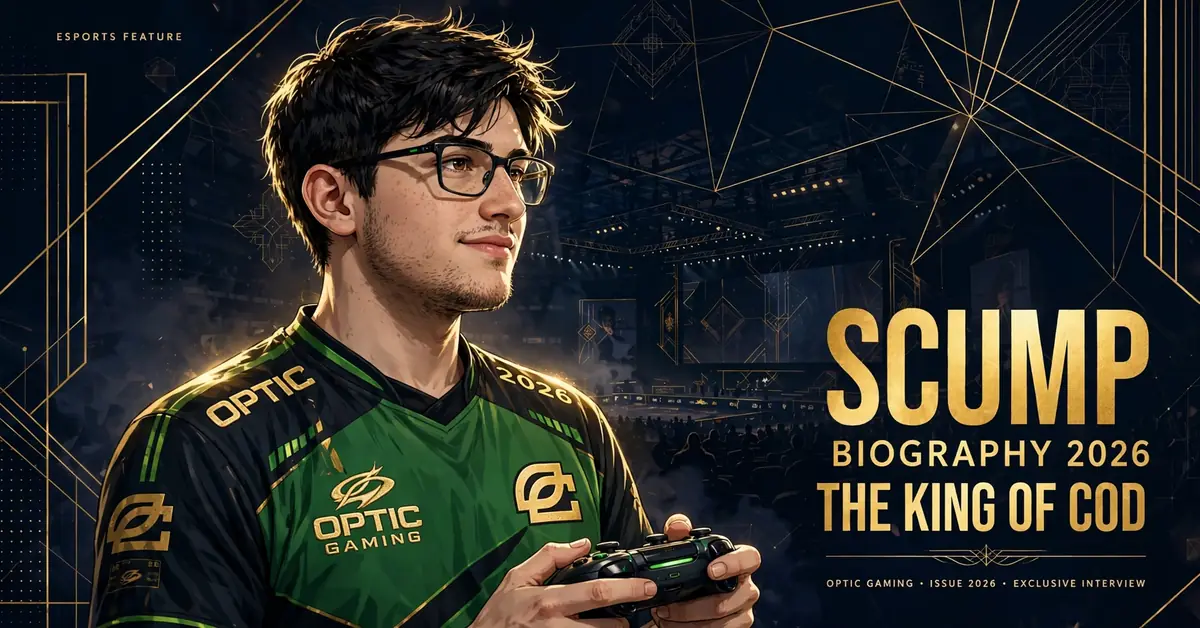
Seth “Scump” Abner is 31 years old, a Call of Duty world champion, and — by the measure that matters most in his game — the greatest console player who ever lived. Born on June 30, 1995, in Pennsylvania, he spent twelve years at the top of competitive Call of Duty, won 30 tournament championships and the 2017 World Championship with OpTic Gaming, and then walked away mid-season in January 2023 to become the most-watched voice in the game he left behind. His net worth in 2026 is estimated at about $4 million, built on $1.19 million in verified prize money, years of OpTic salaries, and a streaming career that now draws bigger audiences than the league he used to play in.
The nickname says everything about how the scene sees him: “The King.” Scump did not just play for OpTic Gaming — for a decade, to the fans who painted themselves green and filled arenas chanting his name, he was OpTic. He won two X Games gold medals, was named the 2016 Esports Console Player of the Year, made Forbes’ 30 Under 30 list in 2022, and retired with the farewell tour still running because, as he put it at the time, he had given the game everything he had. Three years later his watch parties pull 173,000 viewers at a time, his YouTube channel has 2.7 million subscribers, and he is expecting his first child.
This is the full story with dated sources: the baseball family in Mechanicsburg, the first tournaments in 2010, the OpTic years, the two X Games golds, the 2017 world title, the sudden retirement, the watch-party second act, the money — and why the published net worth figures for him range from $855,000 to $9 million.
Quick Facts
| Full Name | Seth Abner |
| Born | June 30, 1995, Pennsylvania, USA |
| Age (2026) | 31 — turned 31 on June 30, 2026 |
| Nationality | American |
| Gamer Tag | Scump (also Scumperjumper) — “The King” |
| Game | Call of Duty |
| Playing Career | 2011–2023 (retired January 17, 2023) |
| Teams | OpTic Gaming, Chicago Huntsmen, OpTic Chicago, OpTic Texas |
| Major Titles | 30 tournament championships; 2017 World Champion |
| Prize Money | $1,193,755 across 172 tournaments (Esports Earnings) |
| YouTube / Twitch | 2.7M subscribers / ~2M followers |
| Net Worth (2026) | ~$4 million (range $4–6M; Dot Esports, Dec 2025) |
| Marital Status | Married; first child expected (announced Aug 2025) |
| Last Updated | November 20, 2026 |
How This Biography Was Researched
This biography was researched from live reporting and public records in November 2026. Money figures are estimates from named outlets, not audited statements, and where they conflict this article publishes the range and says which source anchors it. The anchor is about $4 million (Dot Esports, December 16, 2025, citing a Sportskeeda estimate), with a range of $4–6 million. Prize money comes from Esports Earnings: $1,193,755.35 across 172 tournaments. Career results — 30 tournament championships, the 2017 World Championship, two X Games golds — come from Wikipedia and Zero1Gaming’s September 2026 profile. The retirement date, January 17, 2023, and the watch-party figures come from Wikipedia and Zero1Gaming. Where a figure is disputed, this article says so rather than picking the cleaner version.
+
A Baseball Family in Pennsylvania
Seth Abner was born on June 30, 1995, to Kristen and Shawn Abner. His father was a retired professional baseball player, and the household understood what a professional sports career demanded before their son had picked up a controller. He grew up in Mechanicsburg, Pennsylvania, and graduated from Cumberland Valley High School in 2013 — the same year his competitive Call of Duty career was already taking off. The detail that explains the rest of his life is how early the competition started: he began playing competitively in 2010, at 15, and by the time he finished school he was already a professional in all but name.
The baseball connection matters more than it looks. Scump’s father had lived the life of a professional athlete — the travel, the pressure, the short career — and the son inherited the temperament: a competitor who treated every match like it counted, because it did. He also inherited the work ethic. The teenage years in Mechanicsburg were spent grinding ranked matches after school, and the grind never really stopped for the next thirteen years. How old he is now, and what 31 means for a player who retired at 27, is a story of a career compressed into a single decade — and a second career that started the day the first one ended.
The First Tournaments: 2010–2013
Scump’s competitive journey started in 2010, in the small online tournaments and local LAN events where Call of Duty players made their names. He quickly built a reputation for raw aim and faster reactions than anyone else on the server, and the nickname followed him: Scumperjumper, shortened to Scump. The early years were a blur of team changes and small prize pools — the 2011 season earned him $10,800, 2012 earned $8,084 — but the trajectory was unmistakable. By the 2012–13 season he was with OpTic Gaming, and the results started to come: a win at UMG Chicago and a third-place finish at the 2013 Call of Duty Championship, the game’s biggest event.
The 2013 championship run is worth remembering because of who he lost to. The OpTic roster of that era was talented but inconsistent, and the team that won the event — Fariko Impact — was built around players Scump would spend the next decade chasing and beating. He was 17, playing in front of a crowd that already knew his name, and the third-place finish was both a breakthrough and a frustration. The breakthrough was the proof that he belonged at the top. The frustration was that belonging was not the same as winning, and the next four years would be spent closing that gap.
Joining OpTic: The Green Wall Years
OpTic Gaming was already the biggest brand in Call of Duty when Scump became its face, and the relationship between the player and the organisation became the defining partnership in console esports. The Green Wall — OpTic’s fanbase, named for the colour of the jerseys and the wall of noise they made in arenas — built itself around him. He was the star, the captain in all but name, and the player the crowd chanted for. As Zero1Gaming put it in September 2026: “Scump did not just play for OpTic, he was OpTic, and a huge share of that legendary fanbase was built on the back of his play.”
The OpTic years, from 2014 to 2019, were the most successful stretch of his career and the most frustrating in equal measure. He won constantly — the 30 tournament championships in his career were mostly collected in green — but the world title kept slipping away. He finished third at the 2014 championship, second in 2015, and watched other teams lift the trophy while his own team won everything else. The pattern became a running story in the scene: the best player in the game, on the biggest team in the game, without the one title that would settle the argument. The frustration is what made the 2017 win matter as much as it did.
Two X Games Golds and Console Player of the Year
Before the world title came the X Games. Scump won gold at the MLG X Games in 2014 and again in 2015, back-to-back titles in an event that put competitive gaming on the same stage as skateboarding and motocross. The X Games mattered because they were mainstream: ESPN coverage, a live audience that had never watched a Call of Duty match, and a gold medal that meant something to people outside the scene. Scump won both years, and the second gold came against the best teams in the world, in front of the biggest audience Call of Duty had ever drawn.
The individual honours followed. In 2016 he was named Esports Console Player of the Year at the inaugural Esports Awards, the first time the industry had formally recognised a console player as its best. The award landed in the middle of the Black Ops III season, when he helped OpTic win the North American Stage One Finals, MLG Anaheim and MLG Orlando in succession — a run of dominance that made the team the favourite for every event it entered. He was 21, the best player in the world on console, and still without a world championship. The gap between the two facts was the story of his career, and it closed the following year.
The 2017 World Championship
In August 2017, Scump finally won the Call of Duty World Championship. Playing Infinite Warfare alongside Matthew “FormaL” Piper, Ian “Crimsix” Porter and Damon “Karma” Barlow, OpTic Gaming beat Team EnVyUs in the final and took the title — and the tournament’s grand prize — after years of near-misses. Scump’s share of the winnings was $150,000, his biggest single prize, and the win instantly became one of the most celebrated moments in the game’s history. The celebration that followed was the release of four years of frustration: the best player in the game, on the biggest team in the game, finally holding the trophy that had defined his career by its absence.

The 2017 title also settled the argument about his place in the game. He was already the most popular Call of Duty player alive — the Wikipedia entry calls him “the most popular and one of the greatest Call of Duty players of all time” — and the championship gave the popularity a foundation. The roster that won it was one of the great teams in the game’s history, and the four players are still spoken of as a unit. Crimsix went on to win three world titles, the most of any player; FormaL became a streamer in his own right; Karma retired as a legend. Scump was the one who held the team together, and the one the fans remembered first.
The Chicago Years and the CDL Era
The years after the championship were a period of change for the whole scene. The Call of Duty League launched in 2020 as a franchised, city-based league, and Scump’s OpTic became the Chicago Huntsmen for the inaugural season, then OpTic Chicago, then — after the organisation’s merger with Envy Gaming — OpTic Texas in 2021. The names changed, the jersey stayed green, and Scump stayed the centrepiece. He played through the transition, through the pandemic seasons played online, and through the Modern Warfare II season that would be his last.
The CDL era also changed the money. Franchise player salaries for top Call of Duty players were reported at $200,000–500,000 or more a year, a leap from the tournament-prize economy Scump had grown up in, and the league’s structure gave players a stability the old circuit never had. Scump’s earnings in the CDL years were smaller in prize money — $15,000 in 2021, by one year-by-year breakdown — because the league paid salaries instead of winner-takes-all purses. The trade was a good one for a player in his late twenties: guaranteed money, a regular season, and a brand that kept growing. By 2019 he was already the fifth-highest-earning Call of Duty player in history, and the CDL years added the salary on top of the prize money.
The comparison with the other greats of his era shows how unusual his longevity was. S1mple’s net worth profile tells the story of the other consensus greatest player in first-person shooters — a Ukrainian AWPer who won one Major and was ranked the world’s best three times. Scump’s career ran longer, across more games and more roster changes, and his 30 titles are a volume no other Call of Duty player has matched. The two men never played the same game, but the debate about the greatest shooter player ever always includes both of them.
The Green Wall: The Fans Who Painted Arenas
No biography of Scump makes sense without the Green Wall. OpTic’s fanbase was the loudest, largest and most recognisable in console esports, and it built itself around one player. Fans painted their faces green, filled arenas in matching jerseys, and chanted his name between rounds. At events where OpTic played, the crowd was not neutral — it was a home crowd, wherever the event was held. The chant followed him from city to city, and the roar when he won a clutch round was the loudest sound in the building. Other teams had fans; OpTic had a movement, and Scump was the reason for it.
The fanbase was not an accident. OpTic’s founder, Hector “HECZ” Rodriguez, built the organisation as a content company as much as a team, and Scump was its most natural star — charismatic on camera, honest in interviews, and good enough that the highlights never stopped coming. The vlogs, the house content, the behind-the-scenes videos: all of it put Scump in front of the audience every day, not just on match days. By the time the Call of Duty League launched, the Green Wall was a brand in its own right, and Scump’s face was on the merchandise, the thumbnails and the posters. As Zero1Gaming put it in September 2026, a huge share of that legendary fanbase was built on the back of his play — and the play gave the fans something to believe in for a decade.
The relationship between the player and the crowd is also the reason the retirement hit so hard. When Scump walked away in January 2023, the Green Wall lost its centre, and the league lost its biggest draw. The watch parties that followed were the answer: the same fans, the same chants in the chat, the same player talking over the matches — now from his own setup, on his own channel, with nobody else’s schedule to keep. The Green Wall did not dissolve when the career ended. It moved, with him, to the stream.
The Farewell Season: Retiring Mid-Season in 2023
Scump had planned for the 2022–23 CDL season to be his last. He announced it ahead of the Modern Warfare II season: one final year, a farewell tour, and then retirement. It did not go to plan. On January 17, 2023, midway through the season, he announced he was retiring immediately, walking away with the season still in progress rather than finishing the year he had promised himself. The decision shocked the community — players do not usually retire in January — and it ended a twelve-year competitive career on his own terms, if not on his own schedule.
The reason, as he explained it at the time, was simple: he had given the game everything he had, and the grind had stopped being worth it. Twelve years of travel, practice and pressure, from the age of 15 to 27, had taken their toll, and the farewell tour was becoming a chore rather than a celebration. The retirement was also a bet — that the audience he had built as a player would follow him as a creator, and that the second act would be bigger than the first. Within days, the bet was paying off. His very first watch party, days after retiring, drew a peak of around 95,000 viewers — roughly 30,000 more than the Call of Duty League’s own official channel was pulling at the same time.
The Watch Party King: Life After Competing
Retirement turned out to be a promotion. Scump stayed signed to OpTic as a content creator, and his watch parties — live commentary over CDL matches, streamed on his own channels — became the place the Call of Duty community gathered to watch the league. The numbers tell the story: the first watch party peaked at about 95,000 viewers, and at the 2025 Championship his watch party peaked north of 173,000 viewers, the biggest stream of his career. He was drawing a bigger audience for the league’s biggest matches than the league itself, and doing it from his own setup, in his own voice, with the authority of the man who had won the title he was commentating on.
The streaming career also changed the shape of his income. As a player he earned prize money and a salary; as a creator he earns from YouTube advertising, Twitch subscriptions, sponsorships and merchandise, with 2.7 million YouTube subscribers and around 2 million Twitch followers. The audience is the asset now, and it is larger and more durable than any tournament run: a championship lasts a weekend, a channel compounds for years. The comparison with the other greats of his generation shows how rare the transition is. Shroud’s biography tells the parallel story — a Counter-Strike and PUBG legend who became one of the biggest streamers on the planet — and the two men are the clearest examples in esports of a playing career that turned into a broadcasting career without losing the audience.
The watch parties also gave him something the playing career never had: control over his schedule. He picks the matches, sets the tone, and stops when he wants to. The grind of twelve years of competition — the travel, the practice, the pressure of a farewell tour that had become a chore — was replaced by a job he could do from home, on his own terms, in front of an audience that had followed him across the transition. It is the rarest outcome in professional gaming: a retirement that made the player more visible, not less.
The Money: Prize Winnings, Salary and the M Fortune
Scump’s net worth in 2026 is estimated at about $4 million, with a range of $4–6 million, and the figure comes from Dot Esports’ December 2025 profile, citing a Sportskeeda estimate built from his tournament earnings, content creation numbers and sponsorships. The range exists because the published estimates disagree wildly: NetWorthBreakdown claims $9 million, Zyntharo puts the range at $5–10 million, CreatorStats’ 2026 model lands at $3.4–5.6 million, BounceMojo says $2 million, and NetWorthSpot’s $855,000 figure counts only YouTube advertising and ignores everything else. The $4 million anchor is the most recent careful estimate, and it sits in the middle of the credible range.
The one part of the fortune that is not an estimate is the prize money. Esports Earnings records $1,193,755.35 across 172 tournaments, a figure that can be checked tournament by tournament. The biggest single prize was the $150,000 he took home from the 2017 Infinite Warfare championship, and the year-by-year breakdown shows how the money was earned: $269,500 in 2017 alone, $173,125 in 2020, $98,531 in 2015. The prize money is the smallest part of the fortune, and that is the point: a player who earned $1.19 million in prizes over twelve years, with a salary in the CDL years and a streaming career after it, is worth far more than his prize money alone. The $9 million claim fails the same test in the other direction — it credits him with $4.2 million in prize winnings, more than three times what Esports Earnings records.
| Income stream | Amount | Basis |
|---|---|---|
| Career prize money | $1,193,755 | Esports Earnings, 172 tournaments |
| Biggest single prize | $150,000 | 2017 World Championship |
| CDL salary (top players) | $200,000–500,000+ / year | Industry estimates |
| YouTube (2.7M subs) | ~$214,000–385,000 / year | NetWorthSpot ad-revenue model |
| Streaming + sponsorships | Modelled $810,000–1.4M / year | CreatorStats 2026 model |
| Net worth (2026) | ~$4 million (range $4–6M) | Dot Esports / Sportskeeda, Dec 2025 |
The table also shows why the low estimates fail. NetWorthSpot’s $855,000 counts only YouTube advertising, and its own page admits the figure rises to $1.2 million once other revenue is included — and even that ignores twelve years of salaries and $1.19 million in prize money. A player with $1.19 million in verified prizes, several years of six-figure salaries, and a streaming business modelled at $810,000–1.4 million a year is not worth $855,000. The $4 million anchor, with a $4–6 million range, is the figure the documented income supports.
Sponsors and CTRL: Oakley, Turtle Beach and Ownership
Scump’s brand deals are the quiet part of the fortune. He is partnered with Oakley — the first professional gamer the eyewear brand ever signed — and with Turtle Beach, the headset maker whose products he used for most of his career. The Oakley deal matters because of what it signalled: a mainstream sports brand, the kind that sponsors golfers and skiers, deciding that a Call of Duty player was worth the same investment. It was a first for the scene, and it opened the door for the deals that followed.
The more interesting deal is the one where he is not the endorser but the owner. Scump is a co-owner of CTRL, a company that makes healthy shakes and bars as meal replacements — a product built for gamers who spend twelve hours a day at a desk and eat badly. The ownership stake is the kind of asset that does not show up in prize-money tables, and it is the reason the net worth estimates that count only streaming and prizes understate the figure. A player who owns part of a company has an asset that can grow without him playing a single match, and CTRL is the clearest sign that Scump has been thinking about the second act since before the first one ended.
Scump vs. the Other FPS Legends
Scump’s place in esports history is usually argued against two other names: s1mple, the greatest Counter-Strike player, and Shroud, the greatest aim talent the scene has produced. The comparison is instructive, because the three men built their fortunes in different ways. S1mple earned his through dominance in a single game and a salary at the top of the sport; Shroud earned his by leaving competition early and becoming a streaming star; Scump earned his by doing both, for longer than either of them, in the game with the shortest careers.
| Player | Game | Peak achievement | Est. net worth (2026) |
|---|---|---|---|
| Scump | Call of Duty | 2017 World Champion, 30 titles | ~$4 million |
| s1mple | Counter-Strike 2 | 2021 Major champion, 3× HLTV No. 1 | ~$9 million |
| Shroud | CS / PUBG | Streaming star, ex-pro | ~$20 million |
| TenZ | Valorant | 2021 Masters champion | ~$2 million |
| Faker | League of Legends | 6-time world champion | ~$10 million+ |
The table also shows the economics of the games themselves. Shroud’s $20 million is a streaming fortune, built after he left competition; s1mple’s $9 million is a Counter-Strike fortune, built on the highest salaries in the sport. TenZ’s biography shows the Valorant version of the same story — a prodigy who won a Masters at 20 and became a streamer — while Faker’s biography shows the ceiling: six world championships in League of Legends, the richest game in esports, and a fortune to match. Scump’s $4 million is the Call of Duty version: a game with shorter careers and smaller purses, where 30 titles and a world championship buy a comfortable fortune rather than a vast one. Browse more profiles in our Celebrity Net Worth category to see how the rest of esports’ fortunes compare.
Personal Life: Marriage and a First Child
Scump is married, and on August 15, 2025, he announced that he and his wife were expecting their first child. The announcement was made on his own channels, in his own way, and it was the most personal news he had shared in years. He has always kept his private life separate from the career — the streams are about the game, the watch parties are about the league, and the family stays off camera. The child, due in 2026, arrives as the second act is hitting its stride: the watch parties are bigger than ever, the YouTube channel keeps growing, and the player who retired at 27 is building a life that no longer depends on winning tournaments.
The family thread runs back to the start. His father, Shawn Abner, was a professional baseball player, and the son who followed him into professional sport understood from childhood what the life cost — the travel, the pressure, the way a career can end before you are ready. Scump’s retirement at 27, mid-season, with a farewell tour still running, looks different in that light: a player who had seen what a sporting life does to a family, and who chose to step away while he still had the audience, the health and the time to build something else. The first child is the next chapter of that choice.
What Comes Next at 31
Scump is 31, three years retired, and the second act is still growing. The watch parties are the centrepiece — the 173,000-viewer peak at the 2025 Championship was the biggest stream of his career, and the audience keeps coming back because the commentary comes from the man who won the title he is watching. The YouTube channel, at 2.7 million subscribers, is the archive and the engine: highlights, reactions, and the occasional return to the game itself. There have been teases of a return to the CDL next season, reported by GGRecon, and the community reads every one of them as a possibility — but nothing has been announced, and the streaming career gives him no reason to go back.
The likeliest future is the one already in motion: more watch parties, more growth for the channel, the CTRL business, and a family that is about to get bigger. The playing career is fixed — 30 titles, a world championship, two X Games golds, twelve years — and no comeback could add to it in a way that mattered. What the next decade holds is the question of whether the King of Call of Duty becomes something rarer: a retired player who stayed the most important voice in his game. Three years in, the answer looks like yes.
Sources & Reporting
This biography was researched from live reporting and public records in November 2026. Money figures are estimates from named outlets, not audited statements, and where they conflict this article publishes the range and says which source anchors it.
Wikipedia — the career record, the January 17, 2023 retirement, the 30 tournament championships, the 2017 World Championship, the two X Games golds, and the family detail, last updated October 28, 2026. Zero1Gaming — the career overview, the watch-party figures (95,000 first party, 173,000 at the 2025 Championship), and the OpTic assessment, September 8, 2026. Dot Esports — the ~$4 million net worth estimate (citing Sportskeeda), the $1,186,505.35 prize-money figure, the $150,000 single prize, and the Oakley and CTRL details, December 16, 2025. Esports Earnings — the $1,193,755.35 career prize total across 172 tournaments. Zyntharo — the $5–10 million range and the $200,000–500,000 CDL salary estimates, July 16, 2026. CreatorStats — the $3.4–5.6 million 2026 model and $810,000–1.4 million modelled annual earnings. NetWorthSpot — the $855,000 YouTube-only estimate and the $213,900 annual ad-revenue figure, updated October 1, 2026. BounceMojo — the $2 million figure. Forbes — the 30 Under 30 2022 (Games) listing. Reporting window: November 2026. Figures are updated when new reporting emerges — contact us via the About page if you spot an error.
Frequently Asked Questions
How old is Scump?
Scump is 31 years old in 2026. Seth Abner was born on June 30, 1995, in Pennsylvania, USA, and he turned 31 on June 30, 2026. He began competing in 2010 at 15 and retired from professional play on January 17, 2023, at 27, after a 12-year career.
What is Scump’s real name?
Scump’s real name is Seth Abner. His gamer tag is Scump, short for Scumperjumper, and he is also known as “The King” — a nickname he earned as the most popular and most decorated Call of Duty player of his era. His father is Shawn Abner, a retired professional baseball player.
What is Scump’s net worth in 2026?
Scump’s net worth in 2026 is estimated at about $4 million, with a range of $4–6 million. The anchor is Dot Esports’ December 2025 profile, citing a Sportskeeda estimate built from his $1.19 million in verified prize money, his OpTic salaries and his streaming income. Other published figures range from $855,000 (YouTube-only) to $9 million, and this article explains why both extremes fail.
How many championships did Scump win?
Scump won 30 tournament championships in his Call of Duty career, including the 2017 Call of Duty World Championship with OpTic Gaming, alongside FormaL, Crimsix and Karma. He also won two MLG X Games gold medals (2014 and 2015), was named the 2016 Esports Console Player of the Year, and won the 2021 World Series of Warzone Solo Yolo Championship.
When did Scump retire?
Scump retired on January 17, 2023, midway through the 2022–23 Call of Duty League season. He had announced that the season would be his last, but he walked away in January rather than finishing the planned farewell tour, ending a 12-year competitive career. He stayed signed to OpTic as a content creator and moved into streaming and watch parties.
What team did Scump play for?
Scump spent most of his career with OpTic Gaming (2014–2019), then played for the Chicago Huntsmen (2019–2020), OpTic Chicago (2020–2021) and OpTic Texas (2021–2023) as the organisation moved through the franchised Call of Duty League era. He is still signed to OpTic as a content creator.
How much prize money did Scump earn?
Scump earned $1,193,755.35 in prize money across 172 tournaments, according to Esports Earnings. His biggest single prize was $150,000 from the 2017 World Championship. His best prize-money year was 2017, when he earned $269,500.
Is Scump married?
Yes, Scump is married. On August 15, 2025, he announced that he and his wife were expecting their first child. He keeps his family life private — his streams and watch parties are about the game, and his family stays off camera.
Nathan Cole
Nathan Cole is the editor of Guide Net Worth. He covers celebrity wealth the way a business desk covers earnings: reported figures first, estimates labeled as estimates, and no invented numbers. Every profile on this site passes through his desk before it publishes. About Guide Net Worth · Corrections: figures are updated when new reporting emerges — contact us via the About page if you spot an error.
References & Sources
This article has been fact-checked and verified against multiple public sources, financial disclosures, SEC filings, Forbes reports, Celebrity Net Worth databases, and official records. All net worth estimates are based on publicly available information and financial analysis.