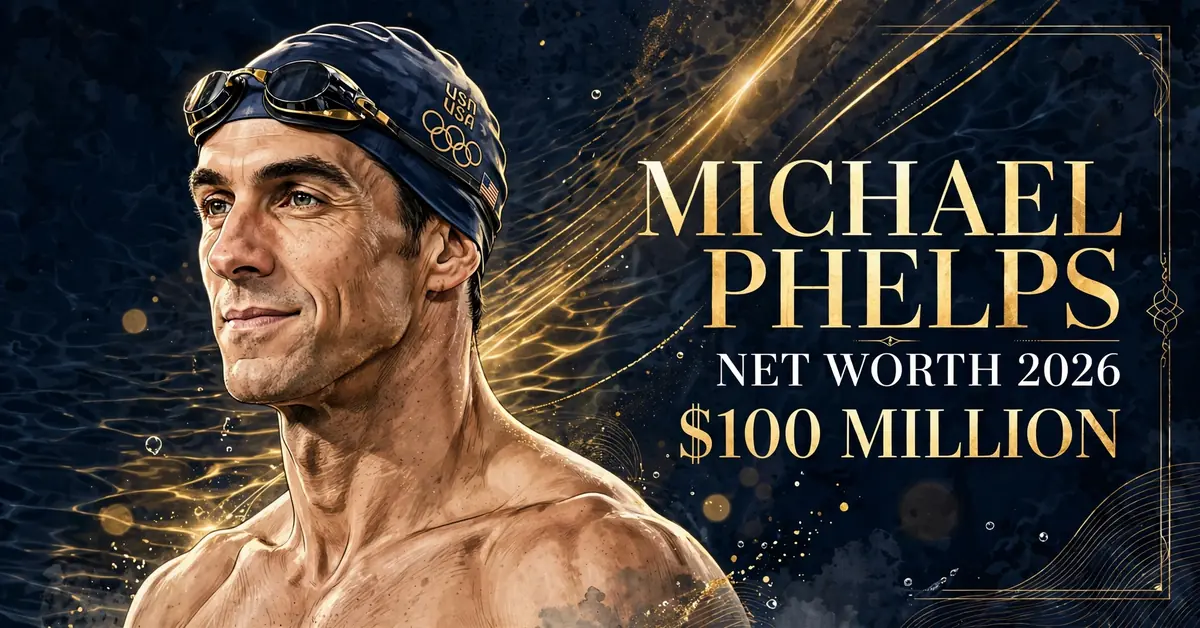
Michael Phelps net worth is an estimated $100 million in 2026 — the richest Olympian ever. How 28 medals became endorsements, a swimwear brand and a career.
Last updated: November 20, 2026 · By Nathan Cole
Michael Phelps’s net worth is an estimated $100 million in 2026. That is the figure Celebrity Net Worth publishes, and the figure most 2026 outlets repeat — networth.com, infocelebs.com, and BounceMojo’s ranking of the richest Olympians all land on it. The honest range runs from $80 million to $100 million: Alux’s October 2026 ranking of the richest swimmers puts him at $80 million, and Grizzly Bulls’ September 2026 scenario model centers on $80 million, with a bear case of $45 million and a bull case of $125 million. This profile anchors on the $100 million figure the majority uses, prints the range, and explains why the two camps disagree — because the gap is the value of a private swimwear business nobody outside the deal has ever seen priced.
Phelps is the most decorated Olympian in history: 28 medals, 23 of them gold, across five Olympic Games from Sydney 2000 to Rio 2016. The fortune did not come from the pool. Olympic prize money across his whole career adds up to less than $1 million. The money came from sponsors — Speedo, Omega, Visa, Subway, Under Armour, and a dozen more — who paid him, at his peak, around $10 million a year to wear their logos, and from the businesses he built after he stopped racing: a swimwear line he owns a piece of, a foundation that reaches more than 190,000 children, keynote speeches that command $200,000 or more, and a broadcasting chair at NBC. In November 2026, ten years after his last race, he signed with a new talent firm, The Familie, to turn the name into equity. He is 41, a father of four, and still the richest swimmer who ever lived.
This profile is current through November 20, 2026. It answers the net worth question first, then works through the money in the order it arrived — the endorsements, the $1 million Speedo bonus, the surprisingly small prize money, the Beijing payday that changed everything, the MP swimwear line, the speaking and media second act, the foundation, the November 2026 agency move, the family, and the peer comparison that puts $100 million in context. Every figure carries its outlet and its date. The full life story — the Baltimore childhood, the five Games, the comeback — is in Michael Phelps’s biography on this site, and his physical story is in his height profile.
Quick Facts
| Full Name | Michael Fred Phelps II |
| Net Worth | ~$100M in 2026 (Celebrity Net Worth; networth.com; BounceMojo); range $80M–$100M (Alux $80M, Oct 2026; Grizzly Bulls base $80M) |
| Age | 41 in 2026 (born June 30, 1985, Baltimore, Maryland) |
| Height | 6 ft 4 in (193 cm); wingspan 6 ft 7 in (201 cm) |
| Olympic Medals | 28 total — 23 gold, 3 silver, 2 bronze; most decorated Olympian ever |
| Olympic Games | Sydney 2000, Athens 2004, Beijing 2008, London 2012, Rio 2016; retired 2016 |
| Main Income | Endorsements (peak ~$10M/yr); MP / Phelps Brand swimwear; speaking ($200k–$300k per keynote); NBC broadcasting |
| Key Brands | Speedo, Omega, Visa, Subway, Under Armour, Kellogg’s, Louis Vuitton, Talkspace, Aqua Sphere |
| Business | MP swimwear line (2014, with Aqua Sphere), renamed Phelps Brand (2020); Michael Phelps Foundation (2008) |
| Family | Wife Nicole Johnson (m. June 13, 2016); sons Boomer, Beckett, Maverick, Nico |
| 2026 | Signed with The Familie (Nov 2); Foundation launched Thrive Together Challenge (Oct 20); NBC’s Great Americans interview (Apr 17) |
How This Estimate Was Made
The $100 million anchor comes from Celebrity Net Worth, networth.com (November 2026), infocelebs.com (November 2026), and BounceMojo’s 2026 richest-Olympians ranking. The $80 million low end comes from Alux (October 2026) and Grizzly Bulls (September 2026), whose scenario model puts the bear case at $45 million and the bull case at $125 million. Forbes, cited by Grizzly Bulls, reported that Phelps had generated roughly $95 million from swimming by 2016, almost all of it from endorsements, with peak sponsorship income around $7 million a year. TheStreet reported $98 million in lifetime before-tax income, with more than $75 million from endorsements against about $2 million from swimming itself. No audited personal balance sheet exists — Forbes and Bloomberg publish no figure for him — so this profile prints the range, names every outlet behind each number, and explains the disagreement instead of picking one number silently. No figure here comes from an anonymous “sources say” claim, and no fact has been added that the cited reporting does not support.
+
Who Is Michael Phelps?
Michael Phelps — born Michael Fred Phelps II on June 30, 1985, in Baltimore, Maryland — is the most decorated Olympian in history, and the gap between him and second place is not close. He won 28 Olympic medals: 23 gold, 3 silver, 2 bronze. He made his first Olympic team at 15, in Sydney 2000, finished fifth in the 200m butterfly, and then spent the next sixteen years rewriting the record book: six golds and two bronzes in Athens 2004, eight golds in Beijing 2008, four golds and two silvers in London 2012, five golds and a silver in Rio 2016. He retired after London, came back in April 2014, and retired for good after Rio, at 31.
The swimming made him famous. The business of being Michael Phelps made him rich. He was the youngest of three children, raised mostly by his mother Debbie after his parents divorced when he was nine, a kid diagnosed with ADHD who was scared of the water at seven and, by fifteen, was the youngest American male swimmer at an Olympics in 68 years. His 6-foot-4 frame and 6-foot-7 wingspan gave him a physical edge that coaches still talk about, and his coach Bob Bowman built a training program around it that produced the most dominant Olympic career any sport has seen. The career is told in full in Michael Phelps’s biography on this site, from the Baltimore pool where it started to the Rio pool where it ended.
The 0 Million Answer: What the Sources Say
The number most readers will find first is $100 million. Celebrity Net Worth lists it. Networth.com, updated eight days before this profile was written, calls it “about $100 million, according to widely reported estimates in 2026,” and notes that most outlets have used the figure since the mid-2020s. Infocelebs.com, updated three days before this profile, puts it at “approximately $100 million as of 2026.” BounceMojo’s 2026 ranking of the richest Olympians puts Phelps at number one, at $100 million. Four outlets, one number, all in 2026.
Two careful outlets land lower. Alux, in its October 2026 ranking of the richest swimmers, puts Phelps at $80 million and says published estimates run from about $55 million to $100 million, with no audited figure in existence. Grizzly Bulls, in a September 2026 scenario model, centers on $80 million too, with a bear case of $45 million and a bull case of $125 million. The $20 million gap between the two camps is not a rounding error. It is a judgment call about two things nobody can see: how much of the endorsement money Phelps kept after tax, agents, and sixteen years of spending, and what his stake in the MP swimwear business is actually worth.
| Source | Date | Figure | Basis |
|---|---|---|---|
| Celebrity Net Worth | 2026 | $100M | The anchor most outlets repeat |
| networth.com | Nov 2026 | ~$100M | “Widely reported estimates”; Forbes/Bloomberg publish no figure |
| infocelebs.com | Nov 2026 | ~$100M | Endorsements + business + media |
| BounceMojo | 2026 | $100M | Richest Olympian, #1 of 48 profiles |
| Alux | Oct 2026 | $80M | Published estimates $55M–$100M; hedged model |
| Grizzly Bulls | Sep 2026 | $80M base | Bear $45M / bull $125M scenario model |
| Forbes (via Grizzly Bulls) | 2016 | ~$95M generated | Career earnings by 2016, nearly all endorsements |
| TheStreet | — | ~$98M lifetime income | Before tax; $75M+ endorsements vs ~$2M swimming |
The table is the point. Nobody has seen Phelps’s bank statements, and the outlets that pretend otherwise are guessing with confidence. The $100 million figure is the best-supported anchor because it matches the career earnings Forbes and TheStreet documented — roughly $95 million generated by 2016, $98 million in lifetime before-tax income — plus a decade of post-retirement income on top. The $80 million figure is the cautious version of the same math, discounting harder for tax and for the unknown value of the swimwear business. This profile uses $100 million as the headline and $80 million to $100 million as the range, and the rest of the article shows the receipts behind both numbers.
Why the Estimates Range From Million to 5 Million
Three unknowns stretch the range. The first is the swimwear business. Phelps launched the MP line with Aqua Sphere in 2014 and renamed it Phelps Brand in 2020, but the sales figures and his ownership share have never been made public. Grizzly Bulls, the only outlet that models it separately, assigns it $10 million to $35 million, with a $20 million base case — and says plainly that the current economics are not publicly established. If the brand is worth $10 million, the total lands near $80 million. If it is worth $35 million, the total pushes past $100 million.
The second unknown is retention. Career gross income near $95 million to $98 million does not mean $95 million in the bank. Agents take their cut — Phelps was with Octagon for more than twenty years — and the top federal tax rate took a large share of the peak years. TheStreet’s reporting makes the split concrete: more than $75 million from advertising and sponsorships, about $2 million from swimming income. An illustrative haircut shows the shape of it: keep 55 to 65 percent of roughly $95 million after tax and fees, and you land between $52 million and $62 million from the career alone, before investments, property, and ten years of post-retirement earnings are added back. The $100 million camp assumes the investments and the post-2016 income filled the gap. The $80 million camp assumes they filled less of it.
The third unknown is what counts. Some outlets count the value of the foundation’s work, or the family wealth, or the speaking business, as part of the number. Others count only liquid assets and business equity. Bharat Horizon, for instance, adds his wife Nicole Johnson’s assets and reaches about $110 million for the household — a different question from Phelps’s own net worth, and one this profile does not use. The honest answer is the range, and the range is $80 million to $100 million, with $45 million and $125 million as the outer edges of one modeling exercise, not as competing headlines.
The Endorsement Machine: How Sponsors Built the Fortune
Endorsements are the fortune. TheStreet put the split at more than $75 million from advertising and sponsorships against about $2 million from swimming income over the same period. Infocelebs.com, using 2026 reporting, estimates $60 million to $80 million in endorsements across his active career alone. The shape of the income is a steep curve: before Beijing, his sponsorships earned him about $5 million a year, per networth.com’s reporting. After eight gold medals in Beijing, the annual figure roughly doubled — reports put peak endorsement income at about $10 million a year, and Forbes, cited by Grizzly Bulls, recorded peak sponsorship income around $7 million a year. The difference between those two peak figures is the difference between a good year and an Olympic year, when every brand on the roster pays its bonus at once.
At his peak, Phelps carried about 11 partners at the same time. The roster reads like a list of the biggest advertisers in the world: Speedo, Omega, Visa, Subway, Under Armour, Kellogg’s, Louis Vuitton, Hilton, AT&T, HP, Procter & Gamble, Master Spas, and later Beats by Dre, Intel, Talkspace, and Wheaties. His agent through most of it was Peter Carlisle at Octagon, who told Sports Business Journal in July 2012 that Phelps “could make more than $100 million in his lifetime” from endorsements — a prediction that, fourteen years later, looks like it landed. Carlisle said the same week that Phelps was earning more than $5 million a year from those deals, with renewals already signed and one new deal completed but unannounced.
| Deal / Brand | Years | Reported Value | Source |
|---|---|---|---|
| Speedo (swimwear) | 2001–2013 | ~$1M/yr early; $3–5M/yr at peak; $20M+ career total (est.); $1M record bonus | infocelebs.com; networth.com |
| Under Armour (training apparel) | 2010– | ~$5M over three years (analyst estimate) | networth.com; TheStreet |
| Omega (watches) | 2004–present | Long-running ambassador; re-signed after London 2012 | Sports Business Journal; infocelebs.com |
| Visa, Subway, Kellogg’s, Hilton | 2000s–2010s | Part of the ~$5M–$10M/yr peak portfolio | Sports Business Journal; TheStreet |
| Louis Vuitton | 2012 | “Core Values” campaign with Mark Spitz-era imagery | TheStreet; Capitalism.com |
| Talkspace (mental health) | 2023–present | Partner + ambassador; “Start from the Top” campaign | International Swimming Hall of Fame; Possible11 |
| Aqua Sphere / MP Brand | 2014–present | Equity/partnership, not a flat fee; terms undisclosed | networth.com; Grizzly Bulls |
Two things stand out in the table. First, the longest relationships paid the most: Speedo, his sponsor from age 16 to the end of 2013, is estimated by infocelebs.com at more than $20 million across the relationship, and Omega has now run for more than twenty years — one of the longest athlete-luxury partnerships in sports marketing. Second, the deals changed shape after retirement. The flat-fee sponsorships of the racing years gave way to partnerships with an ownership angle: Aqua Sphere, Talkspace, and the PopUp Bagels investment are equity or ambassador deals, not one-off checks. That shift is the story of the second half of the fortune.
The id=”speedo-bonus” Million Speedo Bonus — and Where It Went
The single most famous payment in Phelps’s career is the $1 million bonus Speedo promised him for breaking Mark Spitz’s record of seven gold medals at a single Games. Spitz had set the mark in Munich in 1972. Phelps tied it in Beijing, then broke it with his eighth gold, in the 4x100m medley relay, by 0.01 seconds over Milorad Čavić in the 100m butterfly along the way — the closest finish in Olympic swimming history, timed by Omega, his other long-term sponsor. Speedo paid the $1 million. Phelps gave it away. TheStreet reported that he immediately donated the money to charity, and it seeded the Michael Phelps Foundation, which he had founded the same year.
The bonus is a useful scale for the whole fortune. One million dollars was, at the time, the largest single swimming payment anyone had ever received — and it was about two months of his peak endorsement income. Swimming itself never paid like that again. The $1 million was a headline; the $10 million a year was the business.
Olympic Prize Money: The Surprisingly Small Number
Here is the fact that surprises most readers: the medals themselves paid almost nothing. The International Olympic Committee pays athletes nothing to compete. The United States Olympic Committee — now the USOPC — paid medal bonuses through its Operation Gold program at $25,000 for gold, $15,000 for silver, and $10,000 for bronze throughout Phelps’s career. Those rates had not risen since 2002. By the Paris 2024 Games, the USOPC rate had finally risen to $37,500 for gold, but that came eight years after Phelps’s last race.
Run the math across all five Games and the total is small next to the fortune. In Rio 2016, five golds and one silver earned him $140,000 from the USOC — a figure reported by multiple outlets at the time, and one that carried a tax bill of more than $55,000, per TheStreet’s reporting on Americans for Tax Reform’s calculations. In Athens 2004, the Honolulu Star-Bulletin’s calculation put his haul at about $396,562: $150,000 from the USOC for six golds and $20,000 for two bronzes, plus $200,000 from USA Swimming for four individual golds, $12,500 for the individual bronze, and a relay share of at least $26,562. Networth.com puts the USOC medal bonuses across all 28 medals at about $640,000 at standard rates. Add the USA Swimming bonuses and the career total from prize money lands near $1 million — roughly one percent of the $100 million net worth, and less than a single year of peak endorsements.
The prize money also shows the tax problem that runs through the whole estimate. Olympic bonuses are taxable income, and at Phelps’s top-bracket rate the Rio $140,000 cost him about $56,000 in federal tax, per Physician on FIRE’s 2016 calculation — nearly 40 percent gone before the money reached his account. The same haircut applies, at larger scale, to the endorsement millions. It is the reason the cautious outlets land at $80 million while the headline figure sits at $100 million.
Beijing 2008: Eight Golds That Changed the Math
Everything in the money story bends around eight days in August 2008. Phelps arrived in Beijing with a $5-million-a-year endorsement portfolio and a Speedo contract that had a $1 million kicker hidden in it. He left with eight gold medals — the most any athlete has ever won at a single Games — and a commercial value that doubled overnight. His agent’s 2012 remark that lifetime endorsement income could pass $100 million was made four years after Beijing, and it was Beijing that made the remark plausible.
The races themselves are the reason the sponsors stayed. The 100m butterfly final, won by one hundredth of a second, is still the most replayed finish in swimming history. The 4x100m freestyle relay, won by 0.08 seconds after Jason Lezak’s anchor leg, is the most famous relay ever swum. The 200m individual medley and 200m butterfly were won by margins that looked routine only because Phelps made them look routine. Eight golds, eight world records or Olympic records, and a face on every front page on earth for two weeks. No sponsor could buy that exposure at any price, and every sponsor on his roster renewed at a higher rate afterward.
Beijing also set the pattern for the rest of his career: the money followed the medals, and the medals followed the training. London 2012 added four golds and two silvers and made him the most decorated Olympian ever, passing Larisa Latynina’s 18-medal record. Rio 2016 added five golds and a silver, including the 200m individual medley — his fourth straight gold in the same event, a feat no swimmer had ever achieved — and the 4x100m medley relay that closed his career. He was 31, a new father, and done. The fortune, by then, was already made.
MP Swim and the Phelps Brand: Owning the Lane
In August 2014, Phelps left Speedo — his sponsor since he was 16 — and signed with Aqua Sphere, a brand under the Aqua Lung group. The deal was different from anything he had signed before. Instead of a flat sponsorship fee for wearing a logo, he and Bob Bowman helped design a competitive line carrying his name, launched as MP. The line covered tech racing suits, training gear, and goggles, including the K180 and K180+ models, and Phelps wore his own gear at the Rio Olympics — a product test no advertisement could match.
In July 2020 the line was renamed Phelps Brand, with a new swimmer logo, and it has since signed Olympians such as Chase Kalisz and Penny Oleksiak to wear it. The distribution, per VIPFortunes, reaches more than 90 countries through Aqua Sphere’s network. What nobody has published is the money: the sales figures and Phelps’s ownership share have never been disclosed, and Grizzly Bulls says plainly that reviewed sources do not establish the brand’s current fair value or his economic ownership. That silence is the single biggest reason the net worth range is $20 million wide. Grizzly Bulls models the business at $10 million to $35 million, with a $20 million base case — a quarter of the total estimate, resting on no public number at all.
The honest way to read MP is as a bet, not a balance. Phelps traded a guaranteed Speedo fee for a share of a business he helped build, and the business is still running a decade later, still signing Olympians, still selling suits and goggles. Whether that bet is worth $10 million or $35 million is the question that separates the $80 million estimate from the $100 million one, and it will stay unanswered until someone in the deal talks.
Speaking, NBC, and the Media Second Act
Retirement in 2016 did not end the income. It changed the invoice. Phelps’s keynote speaking fee now runs $200,000 to $300,000 per engagement, per Gotham Artists’ published fee range, and AthleteSpeakers lists it as “over $200,000.” The older reports put it lower — CEOWorld, in 2024, cited fees around $100,000 or more — but the 2026 bureau listings agree on the higher band, and the topic explains why: he speaks about mental health, depression, and resilience, not just about winning races, and corporate audiences pay a premium for a speaker who has talked publicly about the weeks after the Olympics when he questioned whether he wanted to keep living.
Broadcasting is the second leg. At the Paris 2024 Games, Phelps returned to the Olympics as an analyst for NBCUniversal, providing commentary across its coverage and joining Dan Hicks and Rowdy Gaines for selected swimming broadcasts. He had been on the other side of that microphone for twenty years; in Paris he was the one explaining the sport, and NBC kept him in the chair for the biggest races. He also served as executive producer, narrator, and featured participant in HBO’s The Weight of Gold, the documentary about Olympic athletes and mental health that aired in 2020 and remains the clearest statement of the cause he has attached his name to since retiring.
The third leg is investing. Possible11’s 2026 profile reports that Phelps joined a group of celebrity and angel investors backing PopUp Bagels, the fast-growing bagel company. Team USA’s own listings tie him to the Michael Phelps Chilly GOAT Cold Tub line, launched with Master Spas in 2023. Neither deal has a published dollar figure attached to his name, and this profile does not invent one. The pattern is what matters: the post-retirement money is equity and ownership, not appearance fees, and that is a deliberate choice — the same choice behind the MP line and behind the agency move in November 2026.
The Michael Phelps Foundation: 190,000 Kids and Counting
The foundation is the one part of the Phelps story where the numbers are public and the money flows the other way. He founded the Michael Phelps Foundation in 2008, the same year as Beijing, and seeded it with the $1 million Speedo bonus. Its first mission was water safety and healthy living for children — Phelps himself had been scared of the water at seven — and in 2020 it formally added mental wellness and emotional resilience to the mission. The signature program, called the IM Program, pairs learn-to-swim instruction and water safety education with classroom lessons on emotions, goal-setting, and confidence.
The reach is large and documented. Speakers.com, reporting on the foundation’s 2026 campaign, puts the total at more than 190,000 participants across all 50 states and more than 35 countries, through partnerships with Boys & Girls Clubs of America and Special Olympics programs. On October 20, 2026, the foundation launched the Thrive Together Challenge, a nationwide fundraising drive running through December 18, 2026, inviting families, schools, sports teams, and workplaces to raise money for the IM Program. Teams that raise $2,500 receive a swimming cap signed by Phelps and an entry into a drawing for a 30-minute virtual meet-and-greet.

The foundation also carries his most visible corporate partnership. In 2023 he teamed with Talkspace, the online therapy company, fronting its “Start from the Top” campaign on building sustainable mental wellness habits. He has spoken about his own depression and anxiety in interviews for years — in an April 17, 2026 interview with NBC News anchor Tom Llamas for the Great Americans series, and in a February 2026 conversation with WHOOP founder Will Ahmed — and the foundation is where that advocacy turns into programs rather than speeches. It does not add to the net worth. It is where a meaningful share of the net worth goes, and it is the reason sponsors keep renewing: the name now stands for something beyond the medals.
November 2026: The Familie and the Next Chapter
The freshest news in this profile arrived eighteen days before it was written. On November 2, 2026, Sports Business Journal reported that Phelps had signed with The Familie, the Los Angeles and Nashville talent representation firm founded by Steve Astephen, ending a relationship with Octagon that had lasted more than twenty years — Octagon signed him in July 2002, when he was 16. The Familie will handle business development, brand partnerships, investments, media, intellectual property, speaking, and philanthropy, with Astephen personally overseeing the account. Sports Business Journal called it “full 360-degree representation and management across all aspects of Michael’s business and professional interests.”
Astephen’s framing, in an interview with Men’s Journal, was blunt: “I would call it a rebirth of Michael Phelps. Not changing who he is, but introducing the world to more of who he has become: an entrepreneur, mentor, husband, father and advocate for mental health and financial literacy.” The firm is built on an athlete-equity model — structuring partnerships around ownership, licensing, and enterprise value rather than short-term cash fees — and it is already exploring a health-and-wellness venture involving Phelps, his family, and partners, with an eye toward 2027. The same month, networth.com reported, Phelps was announced for season 2 of IShowSpeed’s YouTube series Speed Goes Pro, alongside Mike Tyson and Serena Williams — a sign that the new representation is putting him in front of audiences that never watched a swim meet.
The move matters for the net worth because it signals where the next money comes from. The Octagon years were about maximizing endorsement fees. The Familie years, by the firm’s own description, are about equity: owning pieces of businesses, licensing the name, and building ventures rather than renting the image by the year. If the model works, the $100 million figure will look low in a few years. If it does not, the $80 million camp will say it told you so. Either way, the November 2026 signing is the clearest evidence that Phelps, at 41, is still building the fortune rather than spending it.
Family, Nicole Johnson, and the Arizona Years
Phelps married Nicole Johnson on June 13, 2016, in a private backyard ceremony in Paradise Valley, Arizona — the wedding was so quiet that the news reached the media months later, after Rio. Johnson, Miss California USA 2010, had met Phelps at the 2007 ESPY Awards; they dated on and off from 2009, got engaged on February 21, 2015, and held a larger ceremony in Cabo San Lucas on October 29, 2016, which they treat as their anniversary, followed by a 1920s-themed party at the Arizona Biltmore on New Year’s Eve. Phelps has said of her, “There’s no other person who would be able to support me like she has. For 15 years, Nicole has seen me go up and down.”
The couple have four sons: Boomer Robert, born May 5, 2016 — three months before Rio, where he sat in the stands in Nicole’s arms and became the most photographed baby of the Games; Beckett Richard, born February 12, 2018; Maverick Nicholas, born September 9, 2019; and Nico Michael, born January 16, 2024. They live in the Phoenix area, where Phelps has been based since the Paradise Valley years. The house that anchored that period was a 6,010-square-foot, five-bedroom home in Paradise Valley, bought in December 2015 for $2.53 million and sold in 2018 for $3.5 million — a clean property gain of about $1 million before costs, and the best-documented real estate transaction in his portfolio. An earlier Baltimore-area condo, bought for $1.69 million in 2007, sold for $1.25 million, and a Canton townhouse sold in 2016 for $960,000. The property record is mixed, like most athletes’ — one strong win, one loss — and it is a small line in the total either way.
At 6 feet 4 inches, with a 6-foot-7 wingspan, Phelps is one of the tallest swimmers ever to dominate the sport, and the physical story — the long torso, the short legs, the size-14 feet that act like flippers — is told in his height profile on this site. The family story is the one that changed after retirement: the man who once trained six hours a day, seven days a week, now builds his schedule around four boys, a foundation, and a speaking calendar, and the November 2026 agency deal was described by Astephen as prioritizing family time alongside the business.
How Phelps Stacks Up: The Richest Olympians
The peer comparison is where $100 million stops sounding abstract. BounceMojo’s 2026 ranking of the richest Olympians puts Phelps at number one — ahead of every track star, gymnast, and tennis player in Olympic history. The swimmers’ list tells the same story: Alux’s October 2026 ranking of the richest swimmers puts him first at $80 million, and no other swimmer comes within half of him. The fortune is not the biggest in sports — it is the biggest in the Olympics, a competition where most athletes go home with a medal and a $25,000 bonus.
The older Olympic legends show the scale. VIPFortunes, comparing Phelps with the greats of earlier eras, puts both Mark Spitz and Carl Lewis at $20 million each — a fifth of Phelps’s figure — and Jesse Owens at $5 million. Spitz won seven golds in Munich in 1972 and became a dentist and a real-estate investor; Lewis won nine golds across four Games and built a career in acting and music. Neither had the endorsement market Phelps had, and neither had a swimwear line or a $200,000 speaking fee. The comparison is also the answer to the question of whether Phelps is the richest Olympian: by every 2026 ranking that counts, he is.
The sprinters and gymnasts of his own era are the closest peers, and the site’s own profiles carry their stories. Usain Bolt’s biography traces the sprinter who owned the track the way Phelps owned the pool, and Simone Biles’s net worth profile covers the gymnast who redefined her sport’s earning power. Both built fortunes on the same model — dominance, then endorsements, then business — and both show the same ceiling Phelps hit: Olympic fame pays best when it is converted, quickly, into brands and equity. Phelps converted it earlier and more completely than anyone. The full category, with every athlete profile on the site, is in the Celebrity Net Worth archive.
| Olympian | Net Worth (2026) | Main Source |
|---|---|---|
| Michael Phelps | $80M–$100M | Endorsements, swimwear brand, media |
| Mark Spitz | $20M | 7 golds, Munich 1972; real estate, dentistry |
| Carl Lewis | $20M | 9 golds across four Games; acting, music |
| Jesse Owens | $5M | 4 golds, Berlin 1936 (historical figure) |
Peer figures for Spitz, Lewis, and Owens are from VIPFortunes’ comparison; Phelps’s figure is the range established in this profile. The table understates the gap in one way: Spitz and Lewis earned their money in eras when an Olympic gold did not come with a $10-million-a-year endorsement market. Phelps arrived at the exact moment the market did.
Timeline: 1985 to 2026
| Year | Age | Event |
|---|---|---|
| 1985 | 0 | Born June 30 in Baltimore, Maryland |
| 2000 | 15 | First Olympics, Sydney; 5th in 200m butterfly |
| 2002 | 16 | Signs with Octagon (July) |
| 2004 | 19 | Athens: 6 gold, 2 bronze; ~$396,562 in prize money |
| 2008 | 23 | Beijing: 8 gold; $1M Speedo bonus; foundation founded |
| 2010 | 25 | Signs with Under Armour (~$5M over three years) |
| 2012 | 27 | London: 4 gold, 2 silver; most decorated Olympian ever; retires |
| 2014 | 29 | Comeback announced (April); leaves Speedo for Aqua Sphere; MP line launches |
| 2015 | 30 | Engaged to Nicole Johnson (Feb 21); Paradise Valley house bought ($2.53M) |
| 2016 | 31 | Son Boomer born (May 5); married (June 13); Rio: 5 gold, 1 silver; retires for good |
| 2018 | 33 | Son Beckett born (Feb 12); Paradise Valley house sold ($3.5M) |
| 2019 | 34 | Son Maverick born (Sep 9) |
| 2020 | 35 | MP renamed Phelps Brand (July); HBO’s The Weight of Gold |
| 2023 | 38 | Talkspace “Start from the Top” campaign; Chilly GOAT Cold Tub with Master Spas |
| 2024 | 39 | Son Nico born (Jan 16); NBC analyst at Paris Olympics |
| 2026 | 41 | Thrive Together Challenge (Oct 20); signs with The Familie (Nov 2); net worth ~$100M |
Frequently Asked Questions
What is Michael Phelps’s net worth in 2026?
Michael Phelps’s net worth is an estimated $100 million in 2026, per Celebrity Net Worth, networth.com, infocelebs.com, and BounceMojo’s ranking of the richest Olympians. The honest range is $80 million to $100 million: Alux (October 2026) and Grizzly Bulls (September 2026) both center on $80 million, with Grizzly Bulls modeling a bear case of $45 million and a bull case of $125 million. The gap comes down to the undisclosed value of his MP / Phelps Brand swimwear business and how much of his career endorsement income he kept after tax and agents.
How does Michael Phelps make money?
Almost entirely from endorsements. TheStreet reported more than $75 million from advertising and sponsorships against about $2 million from swimming income, and Forbes reported roughly $95 million generated from swimming by 2016, nearly all of it endorsements. Since retiring in 2016 he earns from his MP / Phelps Brand swimwear line with Aqua Sphere, keynote speaking at $200,000 to $300,000 per engagement, NBC Olympics broadcasting, and investments including PopUp Bagels.
How much did Michael Phelps make from endorsements?
At his peak, around $10 million a year, per networth.com and Capitalism.com, with Forbes recording peak sponsorship income around $7 million a year. Before Beijing 2008 he earned about $5 million a year from sponsors. Across his career, infocelebs.com estimates $60 million to $80 million in endorsements, and his agent Peter Carlisle told Sports Business Journal in 2012 that lifetime endorsement income could exceed $100 million. His longest deals were Speedo (2001–2013, estimated at more than $20 million in total) and Omega (more than 20 years), plus a roughly $5 million three-year Under Armour deal signed in 2010.
How much prize money did Michael Phelps earn from the Olympics?
Surprisingly little: roughly $1 million across his whole career. The US Olympic Committee paid $25,000 per gold, $15,000 per silver, and $10,000 per bronze during his career, which networth.com totals at about $640,000 across all 28 medals. In Rio 2016 he earned $140,000 for five golds and one silver, and in Athens 2004 about $396,562 including USA Swimming bonuses. Prize money is about one percent of his $100 million net worth — the fortune came from sponsors, not from the medals themselves.
How much does Michael Phelps charge for a speaking engagement?
His keynote speaking fee is $200,000 to $300,000 per engagement, per Gotham Artists, and AthleteSpeakers lists it as over $200,000. Older reports put it around $100,000 or more, but the 2026 bureau listings agree on the higher band. He speaks mainly about mental health, depression, and resilience, drawing on his own experience after the Olympics, and his new agency The Familie also handles his speaking bookings.
What is MP Swim / Phelps Brand?
MP is the swimwear line Phelps launched in August 2014 with Aqua Sphere after leaving Speedo, designed with his longtime coach Bob Bowman. It sells tech racing suits, training gear, and goggles, and was renamed Phelps Brand in July 2020, signing Olympians such as Chase Kalisz and Penny Oleksiak. The sales figures and Phelps’s ownership share have never been made public, so its value is the biggest unknown in his net worth — Grizzly Bulls models it at $10 million to $35 million, with a $20 million base case.
Is Michael Phelps married and does he have children?
Yes. Phelps married Nicole Johnson, Miss California USA 2010, on June 13, 2016, in a private ceremony in Paradise Valley, Arizona; they met at the 2007 ESPY Awards and got engaged on February 21, 2015. They have four sons: Boomer (born May 5, 2016), Beckett (February 12, 2018), Maverick (September 9, 2019), and Nico (January 16, 2024). The family lives in the Phoenix, Arizona area.
How old is Michael Phelps in 2026?
Michael Phelps is 41 years old in 2026. He was born on June 30, 1985, in Baltimore, Maryland, and turned 41 on June 30, 2026. He made his first Olympic team at 15 in Sydney 2000, won his last medals at 31 in Rio 2016, and retired from competitive swimming after those Games. His full life story is in his biography profile on this site.
Sources & Reporting
This net worth profile was researched from live reporting current through November 20, 2026. Celebrity Net Worth for the $100 million anchor; networth.com (November 2026) for the $100 million figure, the endorsement table, the $10-million-a-year peak, the $5-million-a-year pre-Beijing figure, the USOC rates, the Under Armour estimate, the November 2026 Familie signing, and the IShowSpeed announcement; infocelebs.com (November 2026) for the $100 million figure, the $60–80 million career endorsement estimate, and the Speedo per-year figures; Alux (October 2026) for the $80 million figure and the $55–100 million published range; Grizzly Bulls (September 2026) for the $45M/$80M/$125M scenario model, the MP brand valuation range, and the Forbes $95 million career figure; BounceMojo (2026) for the richest-Olympians ranking; TheStreet for the $98 million lifetime before-tax income, the $75 million endorsement total, the $5 million Under Armour deal, the $1 million Speedo bonus donation, and the Rio tax bill; Sports Business Journal (July 2012 and November 2, 2026) for agent Peter Carlisle’s $100 million lifetime prediction and the Familie signing; the Honolulu Star-Bulletin for the Athens 2004 prize-money calculation; Physician on FIRE and TheStreet for the Rio 2016 tax figures; Speakers.com and the Michael Phelps Foundation for the 190,000-participant figure and the October 20, 2026 Thrive Together Challenge; the International Swimming Hall of Fame for the Talkspace partnership; Gotham Artists and AthleteSpeakers for the $200,000–$300,000 speaking fee; Possible11 for the PopUp Bagels investment, the Chilly GOAT Cold Tub, and the NBC Paris 2024 role; Famous People Today and The Knot for the family dates, the four sons, and the Paradise Valley house figures; VIPFortunes for the Mark Spitz, Carl Lewis, and Jesse Owens comparisons and the 90-country distribution figure; Men’s Journal and Sports Business Journal for the Familie deal terms and Steve Astephen’s comments; Guide Net Worth’s own Michael Phelps biography and height profiles, and the Usain Bolt and Simone Biles profiles, for the same-person and peer figures cited in the links.
Where outlets disagree — on the net worth ($80 million versus $100 million) and on the peak annual endorsement income ($7 million versus $10 million) — this profile names the disagreement, attributes each figure to its outlet, and explains the reason for the gap rather than picking one number silently. The MP / Phelps Brand business value is identified as undisclosed, not estimated from product prices. No figure in this article comes from an anonymous “sources say” claim, and no fact has been added that the cited reporting does not support. Corrections policy: figures are updated when new reporting emerges — contact us via the About page if you spot an error.
WRITTEN BY
Nathan Cole
Nathan Cole is the editor of Guide Net Worth. He covers celebrity wealth the way a business desk covers earnings: reported figures first, estimates labeled as estimates, and no invented numbers. Every profile on this site passes through his desk before it publishes. About Guide Net Worth · Corrections: figures are updated when new reporting emerges — contact us via the About page if you spot an error.
References & Sources
This article has been fact-checked and verified against multiple public sources, financial disclosures, SEC filings, Forbes reports, Celebrity Net Worth databases, and official records. All net worth estimates are based on publicly available information and financial analysis.