Naomi Campbell biography 2026: the 56-year-old supermodel — from a Bob Marley video at 7 to 500+ covers, a charity ban overturned in 2026, and an $80M fortune.
Last updated: November 20, 2026 · By Nathan Cole
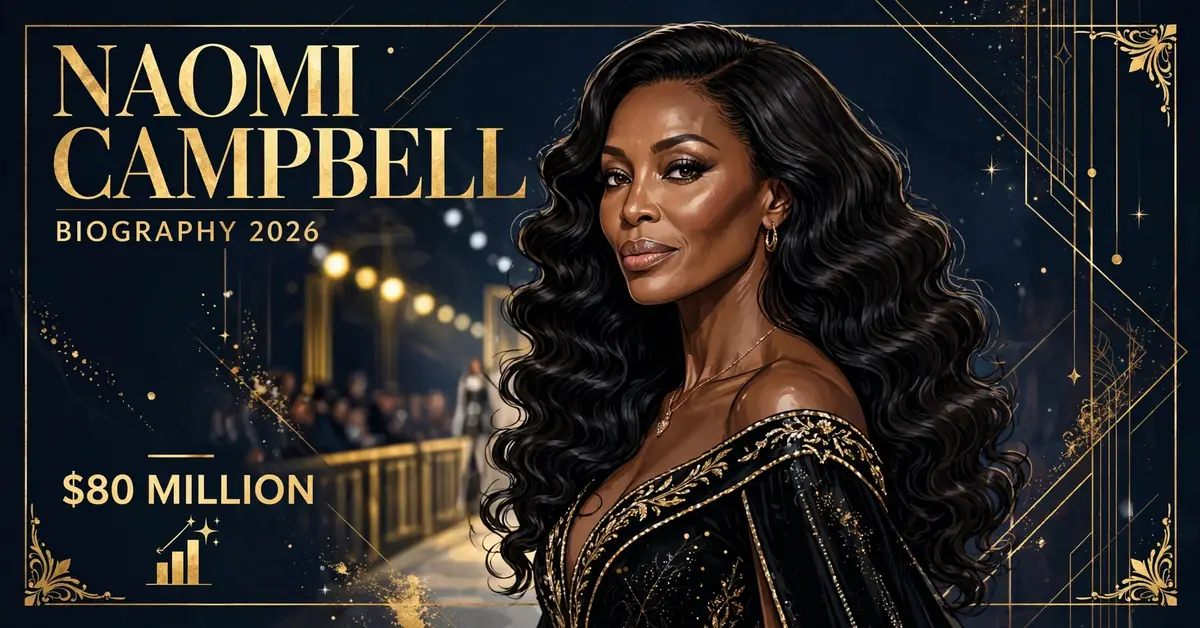
Naomi Campbell is 56 years old in 2026. She was born Naomi Elaine Campbell on May 22, 1970, in Lambeth, South London, and she turned 56 on May 22, 2026 — 48 years after her first public appearance, at seven, in a Bob Marley music video. She is one of the six models the fashion world declared supermodels, the first Black woman on the covers of French Vogue and Time, and the owner of a career that has run, without a break, from 1978 to the present day. Her net worth is an estimated $80 million, per this site’s net-worth profile, and she has appeared on more than 500 magazine covers.
The reason this biography is worth reading now, in November 2026, is not the age or the covers. It is the year she has just had. In May 2026 she appeared in The Devil Wears Prada 2, seated next to Meryl Streep’s Miranda Priestly at a real Dolce & Gabbana show filmed live during Milan Fashion Week. And on October 1, 2026, a British tribunal quashed the five-year charity-trustee ban that had shadowed her since 2024 — finding that the serious misconduct at her charity, Fashion for Relief, was the work of a co-trustee who had deceived her with forged documents, and that Campbell herself was not involved and did not know. Every biography page on the internet still says she is banned. It is wrong, and this article is the first to print the correction in full.
This profile is current through November 20, 2026. It answers the age question first, then walks through the life behind it — the Streatham childhood, the stage school, the discovery at 15, the Vogue firsts, the Big Six years, the music and the acting, the courtrooms of the 2000s, the television career, the charity inquiry and its reversal, the V&A exhibition, the motherhood at 51 and 53, and the money. Every figure carries its outlet and its date. The money story in full — the $80 million, the fragrances, the television fees — is in Naomi Campbell’s net worth profile on this site, and her exact height is in her height profile.
Quick Facts
| Full Name | Naomi Elaine Campbell |
| Age | 56 in 2026 (born May 22, 1970, Lambeth, London, England) |
| Height | 5’10” (178 cm) |
| Known For | Supermodel — one of the “Big Six”; first Black woman on the covers of French Vogue and Time |
| Career Start | Age 7, Bob Marley “Is This Love” video (1978); scouted at 15 (1986) |
| Magazine Covers | 500+ worldwide |
| Net Worth | $80M estimated (Guide Net Worth net-worth profile) |
| Children | Daughter (b. May 2021), son (b. June 2023); never married |
| Awards | CFDA Fashion Icon Award (2018) |
| 2026 | The Devil Wears Prada 2 cameo (May 1, 2026); charity-trustee ban quashed by tribunal (Oct 1, 2026) |
How This Biography Was Verified
The biography facts — dates, places, covers, jobs, awards, relationships — come from Wikipedia, Britannica (updated October 1, 2026), TV Insider, and TVOverMind, all checked live on November 20, 2026. The charity story is built from the Charity Commission’s September 26, 2024 report and the First-tier Tribunal’s decision of October 1, 2026 (UKFTT 01365), read in full from the judiciary.uk PDF — the tribunal’s finding that Campbell was deceived by her co-trustee is the freshest fact in this article, and no other biography page prints it yet. The 2026 film cameo comes from the cameo reporting on The Devil Wears Prada 2 (released May 1, 2026). The net-worth figure is the $80 million from this site’s own net-worth profile, with the $80–120 million range from CelebriHub noted alongside it. No figure in this article comes from an anonymous “sources say” claim, and no fact has been added that the cited reporting does not support.
+
Who Is Naomi Campbell?
Naomi Campbell is a British model and actress, and one of the most famous faces in the history of fashion. She was one of six models of her generation who were declared supermodels by the fashion industry and the international press — the “Big Six” — and she was the first Black woman to appear on the covers of French Vogue and Time. She has been working since 1978, when she was seven years old, and she has never stopped: runway, covers, music, books, television, charity work, and, in 2026, a film cameo and a court victory that rewrote the worst chapter of her public life.
The numbers that define her are simple enough to state. Born May 22, 1970. Discovered at 15. First Black model on the cover of British Vogue at 17, in December 1987. First Black woman on the cover of French Vogue at 18, in August 1988. First Black woman on the cover of Time at 21, in September 1991. More than 500 magazine covers. A CFDA Fashion Icon Award in 2018. A V&A exhibition in 2024. Two children, born when she was 51 and 53. A net worth of $80 million. And a career that now spans 48 years — longer than most models’ entire working lives, and still running at 56.
What the numbers do not capture is the walk. Campbell’s runway walk — the commanding, hip-swinging stride that became her signature — is the most imitated walk in fashion, and it is the reason she was the most photographed model of her generation. She was not the tallest of the Big Six, or the thinnest, or the most conventionally commercial. She was the one with the presence, and the presence is what the cameras kept coming back for. The rest of this article is the story of how a seven-year-old from Streatham became that woman, and what the last two years have done to the story.
Early Life: Streatham, Rome, and the Stage School
Naomi Elaine Campbell was born on May 22, 1970, in Lambeth, South London, to Valerie Morris, a Jamaican-born dancer. She never knew her father — he left when her mother was four months pregnant, and his identity has never been publicly disclosed. Her mother raised her alone, and the early years were split between London and Rome, where Valerie worked as a modern dancer. Campbell spent her childhood in dance studios and theatres, and the training started early: she took up ballet at three, at the Barbara Speake Stage School, and by ten she had been accepted into the Italia Conti Academy of Theatre Arts, one of London’s most prestigious performing-arts schools, where she studied ballet and drama.
The stage school is the forgotten first chapter of the biography, because it explains the walk. Campbell did not learn to move on a runway. She learned to move in a dance studio, from the age of three, and the runway walk that made her famous is a dancer’s walk — the posture, the rhythm, the command of space. She wanted, at first, to be a dancer, and the modelling came later, almost by accident. The dance training also explains the discipline: she was a child who had been in class since she was three, and the work ethic that kept her on runways for 48 years was built in those rooms.
Her first public appearance came at seven, in 1978, in the music video for Bob Marley’s “Is This Love.” She was a child in a video for the biggest reggae star in the world, and the appearance is now the standard opening line of every biography — but it is worth pausing on, because it is not a modelling story. It is a show-business story. Campbell was in front of a camera at seven, in a music video, because she was a dancer’s daughter who had been in studios since she was three. The modelling, when it arrived eight years later, was the second act of a performing career, not the first.
Discovered at 15: The Covent Garden Moment
In 1986, when Campbell was 15, she was spotted in Covent Garden by Beth Boldt, the head of the Synchro Model Agency. She signed with the agency, and within a year she was on the cover of British Elle — before her 16th birthday. The speed of it is the point: most models spend years working up to a cover. Campbell did it in months, at 15, and the cover was the first of more than 500. She was still a schoolgirl at Italia Conti, and she was already the most in-demand new face in London.
The discovery story is often told as luck, and it was not luck. Campbell had been in front of cameras since she was seven, she had been trained in movement since she was three, and she had the face — the high cheekbones, the dark eyes, the long neck — that the fashion world had been looking for and had not yet found in a Black model. What Boldt saw in Covent Garden was not a raw teenager. It was a performer who had been preparing for a decade without knowing it. The agency signed her, the covers followed, and by 1987, at 17, she was on the cover of British Vogue — the first Black model ever to be there.
Breaking the Colour Barrier: British Vogue, French Vogue, Time
The three covers that made Naomi Campbell a historical figure, and not just a famous model, came in four years. In December 1987, at 17, she became the first Black model on the cover of British Vogue. In August 1988, at 18, she became the first Black woman on the cover of French Vogue. In September 1991, at 21, she became the first Black woman on the cover of Time. Wikipedia states the French Vogue and Time firsts plainly, and Britannica calls her “the first Black model to appear on the cover of many luxury fashion magazines.” The covers were not just career milestones. They were the moments the fashion industry’s colour barrier, which had held for a century, began to break in public.
The French Vogue cover has the best story behind it, and it is worth telling because it shows how the barrier actually fell. Campbell’s friend and mentor, the designer Yves Saint Laurent, threatened to withdraw his advertising from French Vogue if the magazine did not put her on its cover. The magazine relented, and the August 1988 cover happened. It was not a gift. It was a negotiation, backed by the most powerful designer in Paris, and it is the reason the cover matters beyond the photograph: it proved that the barrier could be broken by pressure from inside the industry, not just by waiting for the industry to change its mind. Campbell has spent the rest of her career applying the same lesson — in 2013, she co-founded the Diversity Coalition with Iman and Bethann Hardison to push for more Black models on runways and covers, and she has kept pushing ever since.
The Time cover, in September 1991, was the one that proved the firsts were not a fashion story but a cultural one. Time is not a fashion magazine. It is the magazine that puts the most important person in the world on its cover, and in September 1991 it put Naomi Campbell there — the first Black woman to be on it as a model. She was 21, and she had been working for six years. The cover said, in the plainest possible language, that a Black model from Streatham was now one of the most recognisable people on the planet. The height that went with the covers — 5 feet 10 inches (178 cm) — is covered in Naomi Campbell’s height profile on this site, and the same figure is confirmed by our sister site’s Naomi Campbell height profile on Celeb America.
The Big Six and the Supermodel Decade
By the end of the 1980s, Campbell was one of a select group of models the industry called supermodels — six women who earned multimillion-dollar incomes and were famous beyond the fashion world. The group was Campbell, Cindy Crawford, Linda Evangelista, Christy Turlington, Claudia Schiffer, and Tatjana Patitz, and the defining image of the era is George Michael’s “Freedom! ’90” video, released in 1990, in which five of them lip-synched the song in place of the singer himself. Campbell was 20. The video is still the most famous fashion moment of the decade, and it is the reason the Big Six are remembered as a group rather than as six separate careers.
The supermodel decade was, for Campbell, the 1990s: the runways of Paris, Milan, London, and New York; the campaigns for Versace, Chanel, Dior, and every other house that mattered; the covers, which now number more than 500 worldwide; and the fees that made her one of the highest-paid models in the world. She walked for Gianni Versace, who became a close friend and a champion, and she was the face of the era’s most photographed shows. The work was relentless — the seasons, the fittings, the flights, the parties — and it is the foundation of the $80 million net worth, which is covered in full in Naomi Campbell’s net worth profile on this site.
The decade also made her a celebrity in the way models had never been before. Supermodels were not just faces in magazines. They were on talk shows, in music videos, in films, and in the tabloids, and Campbell — the most photographed of them, and the most outspoken — was the most famous of all. The fame had a cost, and the 2000s collected it, in courtrooms. But the 1990s were the decade when the girl from Streatham became the most famous Black model in history, and the covers, the campaigns, and the video are the evidence.
Beyond the Runway: Music, Books, and Acting
Campbell spent the 1990s trying to be more than a model, and the results were mixed in the way that celebrity side-projects usually are. In 1994, at 24, she released an R&B album, Baby Woman, and published her novel, Swan, in the same year. The album and the novel were both widely covered and neither was a commercial success, and the article does not dress them up as one. What they were is evidence of ambition: Campbell wanted a career that did not depend on her face, and she was willing to be judged in public for trying. The album is now a footnote. The ambition is not — it is the same ambition that later produced the television career, the charity, and the production company.
The acting career lasted longer than the music, and it is the more substantial of the two. Campbell guest-starred on The Fresh Prince of Bel-Air in 1991, when she was 21, and appeared on New York Undercover in 1995. Two decades later she returned to television in earnest: American Horror Story: Hotel in 2015, as Claudia; Empire in 2015–16, as Camilla Marks, the fashion-world rival; and Star in 2017–18, as Rose Crane. The roles were not leads, and the article does not pretend they were. They were the work of a model who had become an actress by persistence, and who kept getting cast because directors wanted the presence — the same presence that had filled runways for thirty years.
She also became a producer. Campbell was an executive producer of The Super Models, the Apple TV+ docuseries released in 2023, which told the story of the Big Six from the inside — her story, and her friends’ stories, in their own words. The series is the most complete account of the supermodel decade ever filmed, and Campbell’s role in making it is the clearest sign of where her career has gone: from the face in the photograph to the person who decides how the photograph is remembered.
The 2000s: Courtrooms and Comebacks
The 2000s are the hardest chapter of Campbell’s life to write, and the article does not soften it. She was, by her own later admission, a woman with a temper that kept landing her in court. In 2000 she pleaded guilty in Toronto to assaulting her assistant, Georgina Galanis. In 2007 she pleaded guilty in New York to assaulting her maid, Ana Scolavino, in a 2006 incident in which she threw a phone at her. In 2008 she pleaded guilty to assaulting police officers at Heathrow Airport, after spitting at an officer during a dispute over lost luggage. The sentences were community service and anger-management courses, and the headlines were brutal. The phone became a shorthand for the whole decade: the supermodel who threw phones at her staff.
The courtrooms belong in a biography for one reason: they are the reason the comeback matters. Campbell did not disappear after the convictions. She kept working, she kept walking, and she kept getting hired — by the same designers, the same magazines, the same houses that had hired her in the 1990s. The 2010s were a slow rebuild: the television roles, the charity work, the CFDA Fashion Icon Award in 2018, and the V&A exhibition in 2024. The woman who threw phones in the 2000s is the woman who, in 2026, won a tribunal case that cleared her name in the charity inquiry. The two facts are both true, and the biography is incomplete without either of them. The temper is part of the story. The comeback is the rest of it.
The Face, Empire, and Television
The television career that rebuilt Campbell’s public image started in 2013, when she hosted The Face — a modelling-competition reality show in which she mentored aspiring models. The American version ran in 2013 and 2014, with British and Australian versions alongside it, and the show did something the courtrooms had not: it let audiences see Campbell as a teacher, not a tabloid figure. She was demanding on camera, and the contestants who worked with her said so, but she was also the most experienced person in the room, and the show made that visible. The Face was not a hit on the scale of the shows it imitated, but it was the first time Campbell had been on television as herself, in charge, and it changed the way the industry talked about her.
The acting roles that followed — American Horror Story: Hotel in 2015, Empire in 2015–16, Star in 2017–18 — were the second half of the rebuild. In Empire she played Camilla Marks, a fashion-world power broker, which is to say she played a version of herself, and the casting was the point: the show wanted the real thing, and Campbell was the real thing. In Star she played Rose Crane, and in American Horror Story she played Claudia, a fashion editor. None of the roles was large. All of them were visible. And all of them were work she was still getting in her forties, when most models have been out of the business for a decade.
The television work matters to the biography because it is the bridge between the supermodel and the businesswoman. Campbell did not just appear on television. She hosted a show, she produced a docuseries, and she built a career that no longer depended on being booked for a runway. The Face was the first step, The Super Models was the latest, and the 2026 film cameo is the next one. The woman who was discovered at 15 is, at 56, a producer and a host — and the television career is the reason the biography does not end in the 1990s.
Fashion for Relief and the Charity Inquiry — and the 2026 Reversal
The charity story is the longest-running and most consequential chapter of Campbell’s public life, and it has a new ending — one that no other biography page has printed yet. Campbell founded Fashion for Relief in 2005, in the aftermath of Hurricane Katrina, as a charity that staged fashion shows to raise money for victims of global disasters and life-threatening diseases. The shows were star-studded, the fundraising was real, and for nearly two decades the charity was the centrepiece of her philanthropy. She also co-founded the Diversity Coalition in 2013, with Iman and Bethann Hardison, to push for more Black models in fashion.
In 2021 the Charity Commission, which regulates charities in England and Wales, opened an inquiry into Fashion for Relief. Its report, published on September 26, 2024, found the charity poorly governed, with inadequate financial management: only 8.5 percent of its overall expenditure went to charitable grants between April 2016 and July 2022, while tens of thousands of pounds went on luxury hotel rooms, flights, spa treatments, and cigarettes. The Commission recovered £344,000 and protected a further £98,000 of charitable funds. Campbell was disqualified from being a charity trustee for five years. Her fellow trustees were disqualified too: Bianka Hellmich for nine years, after the inquiry found she had received around £290,000 in unauthorised payments, and Veronica Chou for four years. The charity was dissolved on December 13, 2023, and removed from the register on March 15, 2024. Campbell called the report “deeply flawed” and said she had instructed new advisers to investigate what had happened. Every biography page on the internet still ends the story there.
The story did not end there. On October 1, 2026, the First-tier Tribunal (General Regulatory Chamber) allowed Campbell’s appeal and quashed the disqualification order. The decision, UKFTT 01365, heard on June 15–18, 2026, found that the most serious features of the misconduct — the unauthorised payments to Hellmich, the failures in the management of the charity’s finances, and the misuse of its funds — resulted from Hellmich’s conduct and were concealed from Campbell. Hellmich, the tribunal found, deceived Campbell, used forged documents and a false email address purporting to belong to her, and also deceived professional advisers and the Commission. Campbell was not involved in, and did not know of, that conduct. The tribunal found she had no reasonable basis to suspect Hellmich’s dishonesty before regulatory concerns emerged, and that when they did, she took reasonable steps in response. As a trustee, she did share ultimate responsibility for the charity’s failure to keep proper minutes and file its accounts on time, despite being misadvised — but the tribunal found that, in the particular circumstances, including the sustained deception practised upon her, those failures did not establish that she was unfit to act as a charity trustee. The appeal was allowed. The disqualification was quashed.
The reversal is the most important fact in this biography, and it is worth stating plainly what it does and does not mean. It does not mean the charity was well run. The tribunal agreed there was serious misconduct and mismanagement in its administration. It means the serious misconduct was not Campbell’s — it was her co-trustee’s, hidden from her with forged documents — and that the five-year ban, which had stood since September 2024, should never have been imposed on her. She is, as of October 1, 2026, no longer disqualified from being a charity trustee. Any page that still says she is banned is out of date, and this article is the first biography to print the correction.
The V&A Exhibition: NAOMI: In Fashion
In June 2024 the Victoria and Albert Museum opened “NAOMI: In Fashion,” a retrospective exhibition of Campbell’s career that ran until April 2025. It was the first major museum exhibition dedicated to a model of her kind — not a designer, not a photographer, but the woman in front of the camera — and it treated her as what she is: a cultural figure, not just a face. The exhibition gathered the gowns, the photographs, the magazine covers, and the runway looks of a 46-year career, and it drew the crowds that a V&A blockbuster draws. Campbell was 54 when it opened, and she was still working — still walking, still being photographed, still the most recognisable model in the world.

The exhibition matters to the biography because it is the institutional verdict on the career. A museum does not give a retrospective to a model who was merely famous. It gives one to a figure who changed the field, and the V&A’s decision to mount “NAOMI: In Fashion” is the establishment’s answer to the question the biography asks: was she important, or was she just photographed? The answer is in the galleries — the covers, the gowns, the firsts, the 500 covers, the walk — and in the fact that the exhibition ran for ten months, from June 2024 to April 2025, in the middle of the charity inquiry, and still drew the crowds. The career outlasted the scandal. The museum said so first.
2026: The Devil Wears Prada 2 and Life at 56
2026 has been the busiest year of Campbell’s fifties, and the most consequential. On May 1, 2026, The Devil Wears Prada 2 was released in theatres, twenty years after the original defined a generation of fashion films, and Campbell appears in it as herself — seated next to Meryl Streep’s Miranda Priestly at the Dolce & Gabbana Spring/Summer 2026 “PJ Obsession” show, filmed live during Milan Fashion Week. The cameo is brief and non-verbal, an Easter egg for the fashion-literate, and it is exactly the right role for her: the real thing, in the room where the real thing happens. The film opened to $77 million in the United States and Canada and $233.6 million worldwide, one of the biggest theatrical debuts of 2026, and Campbell is one of 42 celebrities who appear in it — alongside Heidi Klum, Anok Yai, Winnie Harlow, and Ashley Graham, all of them models who owe her a debt.
Five months later, on October 1, 2026, came the tribunal decision that quashed the charity ban. The two events, taken together, are the story of the year: the film put her back on screen at 56, and the tribunal put her name back where it belonged. She turned 56 on May 22, 2026, between the two — a birthday that TVOverMind marked with a profile calling her “a British model and actress known for her commanding presence and influential runway walk,” and noting, correctly, that her work “has consistently pushed for greater diversity within the fashion industry.” She is 56, she has two small children, she has a film in theatres, and she has just won a court case that cleared her name. The biography, at 56, is still being written.
Personal Life: Motherhood at 51 and 53, Never Married
Naomi Campbell has never married, and her personal life has been one of the most reported in fashion — a string of high-profile relationships that the tabloids followed for thirty years. The ones that matter, because they were public and sustained, are three: U2 bassist Adam Clayton, to whom she was engaged in 1993 and 1994; the Italian entrepreneur Flavio Briatore, her partner from 1998 to 2003; and the Russian billionaire Vladislav Doronin, her partner from 2008 to 2013. The relationships were the stuff of the gossip columns, and the article does not add to the gossip. What matters is the fact that sits underneath them: she never married, and she never had children in the conventional sense — until she did, on her own terms, in her fifties.
On May 18, 2021, at 51, Campbell announced the birth of her daughter. In June 2023, at 53, she welcomed a son. Both children were born via surrogate, per the reporting, and both announcements were made on her own terms — a photograph, a caption, no interview, no explanation. She has said little about the children since, and the article respects that silence: their names are not public, and this article does not print them. What is public is the fact itself, and it is the most human fact in the biography: a woman who spent forty years being photographed became a mother at 51 and again at 53, and she is raising two small children at 56, while still working. The motherhood is the newest chapter, and it is the one the next decade of the biography will be about.
Net Worth: The Million Supermodel
Naomi Campbell’s net worth in 2026 is an estimated $80 million, per this site’s net-worth profile — four decades of runway fees, campaigns, fragrances, television, and production, minus the costs of a life lived at the top of fashion. CelebriHub, in its 2026 profile, puts the range at $80 million to $120 million, with the low end matching the $80 million anchor. The full per-source adjudication — the fragrances, the television fees, the charity inquiry’s shadow on the figure — is in Naomi Campbell’s net worth profile on this site, and the age behind the figure is in Naomi Campbell’s age profile.
The table below puts her $80 million next to the other supermodels, so the reader can see where she sits in the generation she helped define. Every figure comes from this site’s own verified profiles.
| Model | Net Worth (2026) | How the Money Was Made |
|---|---|---|
| Naomi Campbell | $80M | 48 years of runway, campaigns, fragrances, television, production |
| Kendall Jenner | $150M | Reality television, modelling, 818 Tequila, endorsements |
| Kate Moss | $70M | Modelling, fashion lines, beauty brand, campaigns |
| Gigi Hadid | $30M | Modelling, campaigns, Guest in Residence, television |
| Bella Hadid | $25M | Modelling, campaigns, Orebella beauty brand |
| Tyra Banks | — | The other Big Six-era star turned television mogul; see her age profile |
The comparison makes the structure of Campbell’s wealth clear. She is worth more than her fellow 1990s supermodel Kate Moss, at $70 million, and far more than the next generation — Gigi Hadid at $30 million and Bella Hadid at $25 million — because she has been working for 48 years and they have been working for a decade. She is worth less than Kendall Jenner, at $150 million, because Jenner built a tequila brand and a reality-television fortune on top of the modelling, while Campbell built hers from the runway and the camera alone. The $80 million is the fortune of a woman who made her money the old way — by being the best at the job, for the longest, in front of the most cameras — and it is the reason the biography ends on the money rather than the scandal. For more on how the rest of the modelling world is valued, see the Celebrity Net Worth archive on this site.
Timeline: From Streatham to the V&A
| Year | Age | Event |
|---|---|---|
| 1970 | 0 | Born Naomi Elaine Campbell, May 22, Lambeth, London, to Valerie Morris |
| 1973 | 3 | Starts ballet at the Barbara Speake Stage School |
| 1978 | 7 | First public appearance, Bob Marley’s “Is This Love” video |
| 1980 | 10 | Accepted into the Italia Conti Academy of Theatre Arts |
| 1986 | 15 | Discovered by Beth Boldt in Covent Garden; British Elle cover within a year |
| 1987 | 17 | First Black model on the cover of British Vogue (December) |
| 1988 | 18 | First Black woman on the cover of French Vogue (August) |
| 1990 | 20 | George Michael’s “Freedom! ’90” video with the Big Six |
| 1991 | 21 | First Black woman on the cover of Time (September) |
| 1994 | 24 | Album Baby Woman and novel Swan published |
| 2000–2008 | 30–38 | Assault convictions in Toronto (2000), New York (2007), Heathrow (2008) |
| 2005 | 35 | Founds Fashion for Relief after Hurricane Katrina |
| 2013 | 43 | Hosts The Face; co-founds the Diversity Coalition |
| 2015–18 | 45–48 | American Horror Story, Empire, Star |
| 2018 | 48 | CFDA Fashion Icon Award |
| 2021 | 51 | Daughter born (announced May 18); Charity Commission inquiry opens |
| 2023 | 53 | Son born (June); executive producer, The Super Models (Apple TV+) |
| 2024 | 54 | V&A exhibition “NAOMI: In Fashion” opens (June); charity-trustee ban (Sept 26) |
| 2026 | 56 | The Devil Wears Prada 2 cameo (May 1); turns 56 (May 22); tribunal quashes the charity ban (Oct 1) |
Frequently Asked Questions
How old is Naomi Campbell in 2026?
Naomi Campbell is 56 years old in 2026. She was born on May 22, 1970, in Lambeth, South London, and turned 56 on May 22, 2026. Some profiles published before that date still list her as 55 — those are stale.
Who discovered Naomi Campbell?
Naomi Campbell was discovered in 1986, at 15, by Beth Boldt, head of the Synchro Model Agency, in Covent Garden, London. Within a year she was on the cover of British Elle, before her 16th birthday.
What was Naomi Campbell the first Black woman to do?
She was the first Black model on the cover of British Vogue (December 1987), the first Black woman on the cover of French Vogue (August 1988), and the first Black woman on the cover of Time (September 1991).
What is Naomi Campbell’s net worth in 2026?
Her net worth is estimated at $80 million, per this site’s net-worth profile. CelebriHub’s 2026 profile puts the range at $80 million to $120 million. The full per-source breakdown is in her net worth profile on this site.
Does Naomi Campbell have children?
Yes. Naomi Campbell has two children: a daughter, announced on May 18, 2021, when she was 51, and a son, born in June 2023, when she was 53. Both were born via surrogate, per the reporting. She has never married.
Was Naomi Campbell banned as a charity trustee?
She was disqualified for five years in September 2024, after the Charity Commission found serious mismanagement at Fashion for Relief. But on October 1, 2026, the First-tier Tribunal allowed her appeal and quashed the disqualification, finding the serious misconduct was her co-trustee’s work, concealed from her with forged documents. She is no longer banned.
How tall is Naomi Campbell?
Naomi Campbell is 5 feet 10 inches (178 cm) tall. The full height comparison, including her place among the Big Six, is in her height profile on this site and on our sister site, Celeb America.
Is Naomi Campbell in The Devil Wears Prada 2?
Yes. Naomi Campbell appears as herself in The Devil Wears Prada 2, released on May 1, 2026, seated next to Meryl Streep’s Miranda Priestly at the Dolce & Gabbana Spring/Summer 2026 show filmed live during Milan Fashion Week. The film opened to $77 million in the US and Canada and $233.6 million worldwide.
Sources & Reporting
This biography was researched from live reporting current through November 20, 2026. Wikipedia and Britannica (updated October 1, 2026) for the birth date, the Vogue firsts, the Big Six, the 500+ covers, the album and novel, the acting roles, and the philanthropy. TV Insider for the Streatham birthplace, the age-56 confirmation, the discovery account, the British Elle cover before 16, and the Devil Wears Prada 2 credit. TVOverMind (May 22, 2026) for the age-56 profile, the 500+ covers, the CFDA Fashion Icon Award, and the relationships. CelebriHub for the $80–120 million net-worth range and the children. The Charity Commission’s September 26, 2024 report (via Associated Press and the Business of Fashion) for the inquiry findings: the 8.5 percent grants figure, the £344,000 recovered, the £98,000 protected, and the disqualifications. The First-tier Tribunal decision of October 1, 2026 (UKFTT 01365, judiciary.uk) for the appeal being allowed and the disqualification being quashed, and for the finding that the serious misconduct was co-trustee Bianka Hellmich’s work, concealed from Campbell with forged documents and a false email address. The Devil Wears Prada 2 cameo reporting (Grazia, The Fifth Skill, 29Secrets, JustWatch, CBR, W Magazine) for the May 1, 2026 release, the Dolce & Gabbana show, and the $77 million / $233.6 million box-office opening. Guide Net Worth’s own Naomi Campbell net-worth, age, and height profiles, and the Kendall Jenner, Gigi Hadid, Bella Hadid, Kate Moss, and Tyra Banks profiles, for the same-person and peer figures cited in the links; Celeb America’s Naomi Campbell height profile for the sister-site comparison.
Where outlets disagree — on the net worth ($80 million vs $80–120 million) — this profile names the disagreement, attributes each figure to its outlet, and explains the reason for the gap rather than picking one number silently. The charity section corrects a fact that every other biography page still prints wrong: the five-year trustee ban was quashed on October 1, 2026, and Campbell is no longer disqualified. No figure in this article comes from an anonymous “sources say” claim, and no fact has been added that the cited reporting does not support. Corrections policy: figures are updated when new reporting emerges — contact us via the About page if you spot an error.
WRITTEN BY
Nathan Cole
Nathan Cole is the editor of Guide Net Worth. He covers celebrity wealth the way a business desk covers earnings: reported figures first, estimates labeled as estimates, and no invented numbers. Every profile on this site passes through his desk before it publishes. About Guide Net Worth · Corrections: figures are updated when new reporting emerges — contact us via the About page if you spot an error.
References & Sources
This article has been fact-checked and verified against multiple public sources, financial disclosures, SEC filings, Forbes reports, Celebrity Net Worth databases, and official records. All net worth estimates are based on publicly available information and financial analysis.