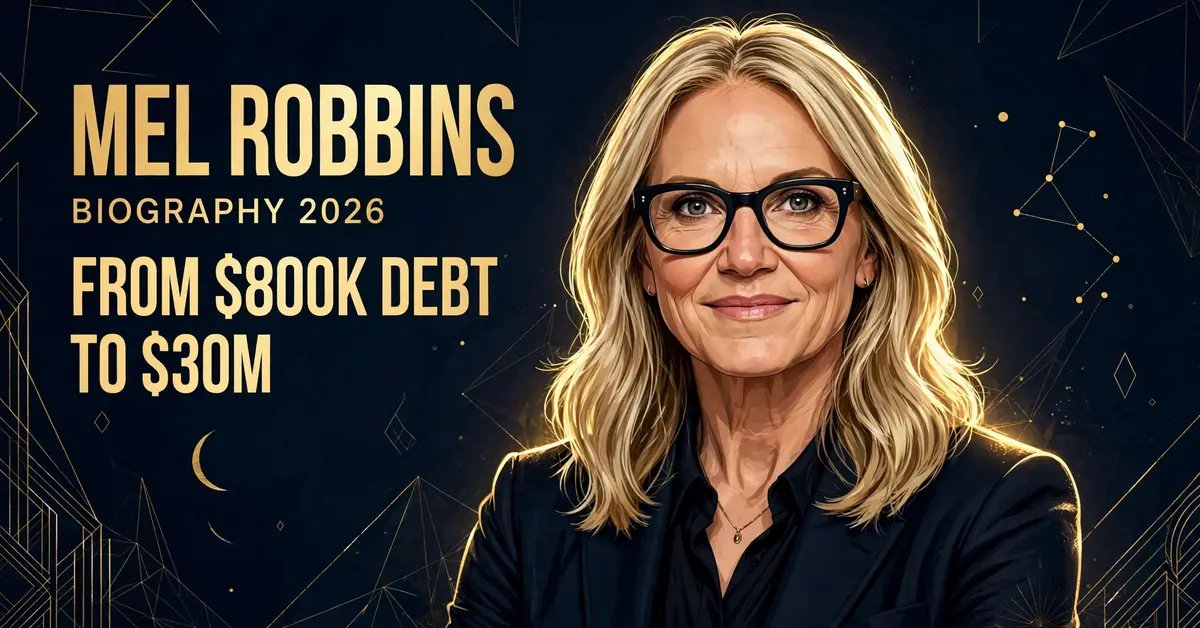
Mel Robbins biography 2026: born October 6, 1968, the $800K-debt lawyer turned $30M author of The Let Them Theory and host of the world’s top podcast.
Last updated: November 18, 2026 · By Nathan Cole
Mel Robbins is 58 years old in 2026, and her net worth is estimated at $30 million. She was born Melanie Lee Schneeberger on October 6, 1968, in Kansas City, Missouri, and the road from there to the top of the publishing and podcast charts ran through a law degree, a CNN analyst chair, a daytime talk show, and a stretch at age 41 when she was roughly $800,000 in debt with three small children and no steady income. The turnaround started with a five-second countdown she invented to get herself out of bed. That countdown became a TEDx talk, then a book, then a media company — and in 2025 her fourth book, The Let Them Theory, became the best-selling print book in America.
That is the short version. The longer version is worth telling properly, because most profiles of Robbins stop at the motivational slogans and skip the money mechanics: how a self-published author kept the royalties a traditional deal would have taken, how a podcast recorded in a garage became the most-followed show on Apple Podcasts, and why the net-worth figures about her disagree so wildly — from $1.4 million on one YouTube-only calculator to $30 million on Celebrity Net Worth, updated July 31, 2026. This biography lays out the life year by year, the books with their real sales numbers, the podcast with its real download figures, and the fortune with the sources named and the disagreements left visible.
Quick Facts
| Full Name | Melanie Lee Robbins (née Schneeberger) |
| Born | October 6, 1968, Kansas City, Missouri, United States |
| Age in 2026 | 58 years old (turned 58 on October 6, 2026) |
| Occupation | Author, podcast host, motivational speaker, former lawyer and CNN legal analyst |
| Education | Dartmouth College (BA); Boston College Law School (JD, 1994) |
| Spouse | Christopher Robbins (married 1996) |
| Children | Three — Sawyer, Kendall, and Oakley Robbins |
| Residence | Southern Vermont, United States |
| Net Worth 2026 | Estimated $17 million – $30 million; $30 million anchor (Celebrity Net Worth, updated July 31, 2026) |
| Best Known For | The 5 Second Rule, The Let Them Theory, The Mel Robbins Podcast |
How This Estimate Was Made
Mel Robbins has never published a personal balance sheet, and her company 143 Studios is private. Every net-worth figure about her is an estimate built from public information. This article anchors on Celebrity Net Worth’s $30 million (updated July 31, 2026) because it is the most-cited current figure, and sets the bottom of the range at $17 million, where two independent 2025–2026 estimates land (WealthySpeak’s $17–20 million, built from book sales, speaking fees and podcast ad economics; TheCityCeleb’s $17 million). Figures below that — $9–10 million from 2023 profiles and a $1.4 million YouTube-only calculation — predate The Let Them Theory or ignore her books, podcast and speaking income entirely, so the article names them and explains why they are left out of the range. The $35 million Celebrity Net Worth lists as her earnings between July 2025 and July 2026 is gross earnings, not wealth, and is treated as such.
+
The Number: What Mel Robbins Is Worth in 2026
Start with the disagreement, because it tells you more than any single figure. Search “Mel Robbins net worth” and you will find $1.4 million, $9 million, $10 million, $17 million, $20 million and $30 million — a spread so wide it looks like different people. It is not. The spread is a timeline problem and a method problem, and once you sort both, the picture sharpens.
The low numbers are old or narrow. The $9 million figure comes from a profile last updated in August 2023, before The Let Them Theory existed and before the podcast’s biggest growth years. The $10 million figure is Celebrity Net Worth’s own older snapshot — the same site now lists $30 million after its July 31, 2026 update. The $1.4 million figure, published October 1, 2026 by Net Worth Spot, is built only from estimated YouTube advertising revenue. It counts one income stream and ignores the books, the podcast, the speaking fees and the company. It is not a serious estimate of her wealth, and this article does not use it.
The current estimates cluster in two places. WealthySpeak, the only source in the set that shows its working, puts her at $17 million to $20 million in October 2026, built from public book-sales data, known speaking-fee ranges and standard podcast advertising economics. NetWorthBreakdown lands at $20 million. DiffSense, writing in early 2026, gives $15 million to $20 million. And Celebrity Net Worth, updated July 31, 2026, gives $30 million — and adds a separate, striking data point: between July 2025 and July 2026, Robbins earned $35 million, enough to place her on its highest-paid podcasters list.
That $35 million earnings figure is the key to the whole argument. A person who grosses $35 million in a single year from podcasting, books and speaking is very unlikely to be worth $17 million in total — unless the money is very new, which it partly is. Her fortune is young. The $800,000 of debt dates to 2009–2010. The big book money dates to 2024–2025. The honest published range is therefore $17 million to $30 million, with $30 million as the anchor because it is the freshest figure from the most-cited source, and $17 million as the floor set by the most careful independent methodology. No audited number exists. Anyone who states one as fact is guessing with confidence.
A Kansas City Birth, a Michigan Childhood
Melanie Lee Schneeberger was born on October 6, 1968, in Kansas City, Missouri. The family moved while she was young, and she grew up in North Muskegon, a small town in Michigan, where her father worked as a doctor and her mother ran a small retail store. The Women’s Weekly, profiling her during a 2025 visit to Australia, describes a driven schoolgirl — voted class president — in a household where work was visible and constant: a doctor father, a shopkeeper mother, and a daughter who learned early that effort was the family currency.
That upbringing matters to the story because Robbins’ entire public persona is built on plain, unsentimental self-discipline, and it did not come from a guru phase. It came from a Midwestern childhood, a competitive streak, and a habit of showing up. She has talked openly about the other side of that childhood too: she was diagnosed with ADHD and dyslexia, the ADHD diagnosis coming only at age 47, and she has spoken about anxiety as a constant companion rather than a phase she outgrew. The diagnoses explain a lot about the way she works — short, concrete tools instead of grand systems, and a distrust of advice that sounds good but cannot be used before breakfast.
North Muskegon to Dartmouth is a long jump, and she made it on merit. She arrived at Dartmouth College in 1986 and studied history, film and women’s studies, graduating in 1990. At her father’s suggestion she went on to law school — Boston College Law School, where she earned her Juris Doctor in 1994. Nothing in that record suggests a future motivational speaker. It suggests a lawyer, and for the first stretch of her adult life, that is what she was.
Dartmouth, Law School, and the Public Defender Years
After law school Robbins went to work as a criminal defense attorney in New York City, at the Legal Aid Society, defending people who could not afford a lawyer. It was hard, unglamorous work, and it gave her two things that still show in everything she does: a direct way of speaking, learned from addressing judges and juries, and a comfort with high-stakes conversations that most self-help authors never develop. She was not theorizing about courage in a studio. She was standing next to defendants in courtrooms.
The law career also gave her the television break. Her courtroom fluency translated to commentary, and she became a legal analyst for CNN, covering high-profile trials including the George Zimmerman case. Television suited her — the camera liked the bluntness, and the bluntness was real. For a while it looked like the path: lawyer, analyst, broadcaster, a steady climb inside mainstream media.
Then the climb stopped. By her own account, and by the Women’s Weekly reconstruction of those years, the media work dried up around the same time her husband’s restaurant business failed. She was 41, with three children under ten, and the household was roughly $800,000 in debt. The figure is one she has repeated herself, in interviews and on stage, and it is the hinge of her whole biography: the motivational empire was not built from a comfortable platform. It was built from a hole.
41, Broke, and 0,000 in Debt
It is worth pausing on what $800,000 of debt at 41 actually means, because the number gets repeated so often it risks sounding like a slogan. It meant a mortgage under pressure, a failed business, a career that had gone quiet, and three small children in a house where the adults were, by her own description, barely holding it together. She has described lying in bed, hitting snooze, and dreading the day — not as a metaphor but as a literal morning routine that had become a problem.
The way out, when it came, was absurdly small. One morning she counted down — 5, 4, 3, 2, 1 — and got up. The countdown was borrowed from rocket launches, a trick to bypass the part of the brain that negotiates its way back under the covers. She used it the next morning, and the next. Then she started using it for other things: making the call, sending the pitch, starting the workout. The rule was simple on purpose. A person $800,000 in debt with three children does not need a philosophy. She needs a way to move before the doubt arrives.
That countdown is the whole business, in embryo. Everything Robbins has sold since — four books, a podcast, courses, a media company — is a variation on the same idea: a tiny, physical, immediate tool that interrupts hesitation. The debt took years to clear. The tool took five seconds to invent. The gap between those two facts is the story.
The 5 Second Rule: A TEDx Talk That Changed Everything
In 2011 Robbins gave a TEDx talk in San Francisco titled “How to Stop Screwing Yourself Over.” She introduced the 5 Second Rule on that stage: when you have an instinct to act on a goal, count backward 5-4-3-2-1 and move before your brain can talk you out of it. The talk went viral — it now counts more than 30 million views, placing it among the most-watched TEDx talks ever — and it did something a viral talk rarely does: it converted into a durable business.
The book followed in 2017. The 5 Second Rule: Transform Your Life, Work, and Confidence with Everyday Courage became a bestseller, and Robbins has said it has sold more than 5 million copies worldwide. The publishing detail matters here: she was rejected by the big publishers when she first shopped the idea, according to reporting on her career, and the book’s success came through a route that left more of the royalties with her. That is the first of several moments in her career when keeping control of the work — rather than handing it to a traditional gatekeeper — turned out to be the money decision, not just the creative one.
The rule itself is easy to mock and hard to dismiss, which is exactly why it spread. It asks nothing except a countdown. It works, to the extent it works, because hesitation is usually a five-second window, and Robbins’ insight was to treat it as a physical problem with a physical answer. The TEDx talk made her famous. The book made her solvent. The habit of turning a tool into a product made her rich.
The Books: From Stop Saying You’re Fine to The Let Them Theory
Robbins’ first book, Stop Saying You’re Fine, appeared in 2011, the same year as the TEDx talk. It sold modestly. The 5 Second Rule in 2017 was the breakout. The High 5 Habit followed in 2021, built around another small physical ritual — giving yourself a high five in the mirror each morning — and it became a bestseller in its own right. Each book did the same job: take one behavior, make it physical, make it immediate, and give the reader a story about why it works.
The pattern is worth noting because it explains the sales figures that follow. Robbins does not write theory. She writes tools, and tools are easy to describe to a friend, which is how books sell in the 2020s — one reader telling another, “try this.” By the time her fourth book arrived, she had spent a decade building the audience that would carry it: more than 40 million followers across her platforms, a podcast audience in the hundreds of millions of downloads, and seven #1 releases on Audible. The launchpad was already built. The fourth book just needed to be good enough to light it.
| Book | Year | What it introduced | Scale |
|---|---|---|---|
| Stop Saying You’re Fine | 2011 | Her first book, on getting unstuck | Modest debut |
| The 5 Second Rule | 2017 | The 5-4-3-2-1 countdown | 5M+ copies claimed |
| The High 5 Habit | 2021 | The morning mirror high five | #1 bestseller |
| The Let Them Theory | 2024 | Let others be; decide your own response | #1 book of 2025 in the US |
The Let Them Theory: The Best-Selling Book of 2025
The Let Them Theory was published on December 24, 2024, by Hay House, co-written with Robbins’ daughter Sawyer Robbins. The idea is disarmingly simple: when other adults make choices you dislike, let them — and then decide what you will do about it. The book’s publisher page opens with the question, “What if the key to happiness, success, and love was as simple as two words?” It is a premise built for conversation, and the conversation carried it further than any marketing budget could have.
The sales numbers are the strongest part of the Robbins money story, because they are measured rather than estimated. Circana BookScan, the industry’s sales tracker, counted 2,812,799 print copies sold in the United States in 2025, making The Let Them Theory the best-selling print book in America that year, ahead of the field by more than 800,000 copies, according to Publishers Weekly’s full-year chart for the reporting year ended December 27, 2025. The publisher’s own claim, carried on current editions, is more than 11 million copies sold worldwide across all formats — a figure that includes ebooks and audiobooks, where the book also reached #1 on Audible. Within nine months of publication it had passed 7 million copies, according to the publisher’s listing.
Those numbers explain the net-worth jump better than any other single fact. A book that sells 2.8 million print copies in one country in one year, at a $29.99 hardcover list price, generates tens of millions of dollars in retail sales, and Robbins’ share — as a co-author with a strong royalty position and a self-built audience — is substantial. Add the audiobook, where she holds seven #1 Audible releases, and the translations into 64 languages, and the book alone accounts for a large share of the $17–30 million range. It also explains why the older $9–10 million estimates are obsolete: they were written before this book existed.
The co-authorship is part of the story too. Sawyer Robbins, her eldest daughter, worked on the book with her mother and now works in the family business. The book’s success is a family project as much as a publishing event — and it gave Robbins, at 56, the biggest commercial hit of her life, fifteen years after the TEDx talk that started it.
The Mel Robbins Podcast: From a Garage to the Top of the Charts
Robbins launched The Mel Robbins Podcast in 2022, recording the first episodes in her garage. Four years later it is one of the most-listened-to podcasts on earth. Reporting in 2025 put the show past 300 episodes and 300 million downloads, with listeners in nearly 100 countries. It was the most-followed show on Apple Podcasts in 2025 and has held a regular place in Spotify’s global top three. Those are not niche numbers. They put a self-help show recorded by a former public defender in the same conversation as the biggest entertainment podcasts in the world.
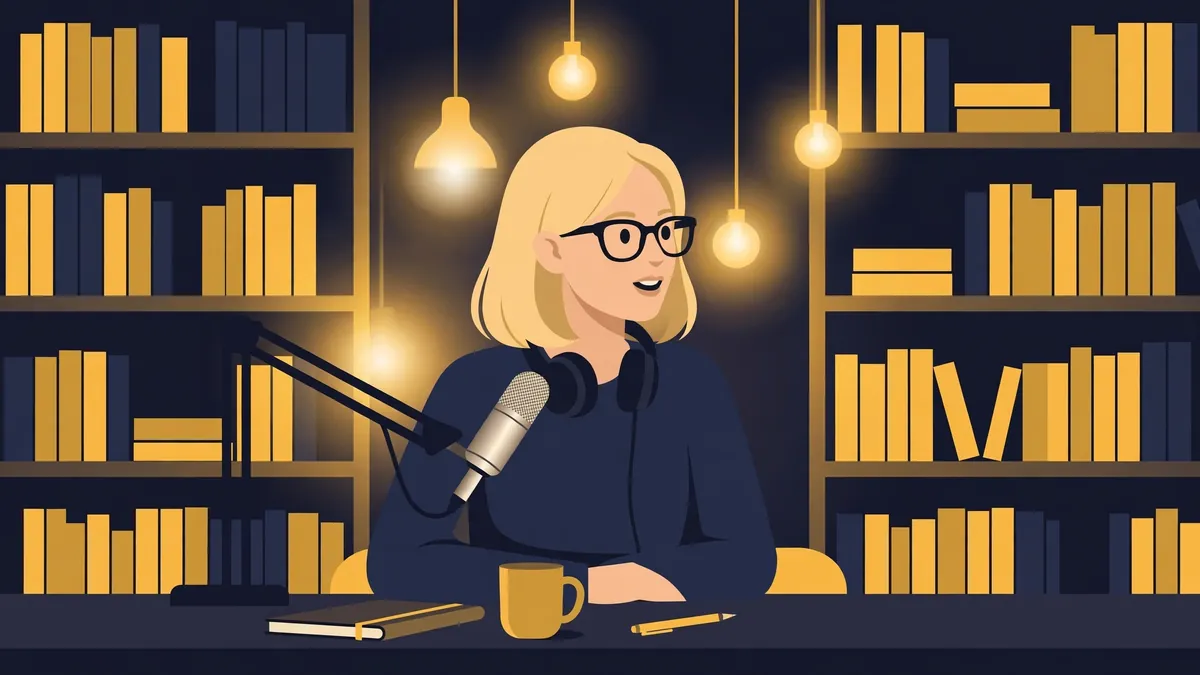
The podcast is also the engine of the book business. The Let Them Theory was introduced, explained and debated on the show before and after publication, and the show’s audience bought the book in numbers that traditional publishing rarely sees from a single author platform. It is a loop: the podcast builds trust, the book converts trust into sales, the book’s success brings new listeners to the podcast. Most authors rent an audience from a publisher’s marketing department. Robbins owns hers, and the ownership is the asset.
The money in podcasting at this scale comes from advertising, sponsorships and the live events the audience supports. Celebrity Net Worth’s highest-paid podcasters list credits Robbins with $35 million earned between July 2025 and July 2026 — a figure that covers the podcast, the books and the speaking together, and one that should be read as gross earnings rather than profit or wealth. Even discounted for the imprecision of such lists, it places her among the best-paid podcasters alive, alongside names like Jay Shetty, whose own biography we have profiled, and Alex Cooper, whose $125 million in deals reset the market for podcast contracts. Robbins’ path to the same table was slower and stranger than either of theirs — a courtroom, a debt crisis, a countdown — and that is why the audience trusts her.
The show has also brought her formal recognition. Her podcast was nominated for the inaugural Golden Globe award for Best Podcast, a new category for the 2026 ceremony, according to WealthySpeak’s October 2026 profile. The nomination is a marker of how far podcasting has moved into the mainstream — and how far Robbins has moved with it.
143 Studios and the Business Behind the Brand
Behind the books and the podcast sits a company: 143 Studios, Robbins’ Boston-based media and production business. The name is a reference to the number of letters in “I love you” — one, four, three — and the company produces her podcast, her events, her courses and journals, and professional-development content for corporate clients including Starbucks and JPMorgan. It is the structure that turns a personal brand into a business with employees, contracts and recurring revenue.
That structure is the difference between a famous author and a wealthy one. An author sells books and keeps a royalty. A media company sells books, advertising, speaking, courses, events and corporate training, and keeps the margin on all of it. Robbins’ earlier career taught her the cost of renting a platform: her television work dried up when someone else’s schedule changed. 143 Studios is the answer to that lesson — a platform she owns, with an audience she can reach directly, and a catalog of tools that sell whether or not she is on television that week.
She also had one earlier brush with mainstream television after the TEDx fame: The Mel Robbins Show, a syndicated daytime talk show that premiered in September 2019 and ran through 2020. It did not last, and the short run is instructive. Daytime television is someone else’s platform, with someone else’s ratings math. The podcast, by contrast, is hers. When the talk show ended, the audience did not disappear, because it had never belonged to the network. It belonged to the show she recorded in her garage.
How Mel Robbins Makes Her Money in 2026
Pull the streams together and the fortune has a clear shape. Books are the largest single contributor in 2025, driven by The Let Them Theory‘s record year. Podcast advertising and sponsorships are the steady earner, scaled by an audience in the hundreds of millions of downloads. Speaking is the high-margin stream: keynote fees are reported to start at $200,000 for a live appearance, according to DiffSense, though another profile cites $75,000–$100,000 per hour — the two figures measure different formats, and the article does not pretend they can be reconciled into one number. Courses, journals and events through 143 Studios add a fourth stream, and corporate training for clients like Starbucks and JPMorgan a fifth.
| Income stream | 2025–2026 evidence | Role in the fortune |
|---|---|---|
| Books | 2,812,799 US print copies of The Let Them Theory in 2025 (Circana BookScan); 11M+ copies claimed worldwide | Largest 2025 contributor |
| Podcast | 300M+ downloads; most-followed on Apple Podcasts 2025; $35M total earnings Jul 2025–Jul 2026 (CNW) | Steady earner; audience engine |
| Speaking | Keynote fees reported from $200,000 (DiffSense) | Highest margin per hour |
| 143 Studios | Courses, journals, events; corporate clients Starbucks, JPMorgan | Recurring business revenue |
| Audiobooks | Seven #1 Audible releases; The Let Them Theory #1 on Audible | Strong secondary stream |
What she does not have is also part of the picture. There is no reported venture-capital windfall, no equity exit, no inheritance, no real-estate empire — though one profile reports a 26-acre estate in Vermont, the property is a home, not a portfolio, and the article does not price it. The fortune is earned income, accumulated late, from work she controls. That is why the range is wide and the anchor is recent: the money arrived in a rush between 2024 and 2026, and the estimates are still catching up with the sales figures.
Family, Vermont, and Life Off the Microphone
Robbins married Christopher Robbins in 1996 — she has said she knew he was the one after only three dates — and the marriage has lasted through the debt crisis, the career change and the fame. They have three children: Sawyer, 27, who co-wrote The Let Them Theory and now works with her mother; Kendall, 25, who is pursuing a music career; and Oakley, 21, who is in college. The family lives in southern Vermont, in a home on a reported 26-acre property, a long way from the New York courtrooms where her career began.
The family is not kept separate from the work. Sawyer’s co-authorship is the clearest example, but the pattern runs through the whole enterprise: the garage where the podcast started was the family garage, the debt crisis was a family crisis, and the tools Robbins sells were first tested on her own mornings. That closeness is part of the appeal, and it is also a risk the article should name plainly: the business is built on one person’s voice, and a brand that personal cannot be handed to a successor. Robbins has built a company around herself. The company works because she does.
She has also been candid about the parts of her life that do not fit a success story. She has spoken about a botched breast implant, about anxiety that never fully left, and about the late diagnoses that reframed her own history. The candor is not an aside. It is the product: an audience that has heard her describe her worst year is more likely to believe her when she describes the way out of one.
ADHD, Anxiety, and Dyslexia — Talking About It Openly
Robbins was diagnosed with ADHD at 47, and she has spoken publicly about living with anxiety and dyslexia as well. The timing matters. She spent most of her adult life — law school, the courtroom, CNN — succeeding in environments that reward focus and rapid reading, without knowing why both cost her more effort than they seemed to cost everyone else. The diagnosis did not change the past. It changed the explanation.
It also changed the work. The 5 Second Rule, the High 5 Habit, the Let Them Theory — all three are short, physical, external tools, the kind of system a person with ADHD builds for herself because long, abstract systems do not stick. Robbins has never presented the tools as clinical treatment, and this article does not either. But the connection between her neurology and her method is one of the few genuinely original things about her, and it is why the tools feel different from the generic advice they sit next to on the shelf. They were designed by someone who needed them to work on a bad morning, not by someone theorizing about good ones.
How Mel Robbins Compares to Other Podcast Stars
Podcasting in 2026 has a clear top table, and Robbins sits at it — but she arrived by a different route from everyone else there. Joe Rogan built the biggest show in the medium from comedy and mixed martial arts, with a Spotify deal reported in the hundreds of millions. Alex Cooper turned a sex-and-dating show into $125 million in deals and a SiriusXM contract. Jay Shetty went from monk training to a $35 million media empire built on interviews about purpose. Andrew Huberman brought Stanford neuroscience to a mass audience and a reported $30 million fortune. Steven Bartlett built The Diary of a CEO into a global interview franchise. Lex Fridman turned long-form MIT-rooted conversations into one of the most respected shows in the medium.
Robbins is the only one of them whose fame started with a self-help tool rather than a conversation format, and the only one whose audience is overwhelmingly there to change something about their own lives rather than to watch her interview someone else. That difference shows in the economics: her biggest paydays come from books and speaking, not from a single platform deal, and her audience converts to buyers at a rate the interview shows do not match. The trade-off is that her fortune is smaller than Rogan’s or Cooper’s — the $17–30 million range is real money, but it is not $100 million money — because she built it from royalties and fees rather than from a nine-figure licensing deal. The comparison is not a ranking. It is a reminder that there is more than one way to get paid in podcasting, and Robbins found the one that fits a former lawyer who writes tools.

What Comes Next for Mel Robbins in 2026
As of November 2026, Robbins is 58, at the peak of her commercial success, and facing the question every creator with a hit book faces: what follows a once-in-a-career year. The Let Them Theory was the best-selling print book of 2025, and the publisher’s claim of 11 million copies sold keeps climbing. The podcast remains at the top of the charts. The speaking calendar is full. The obvious next steps are more of the same — a new book, more episodes, bigger rooms — and Robbins has the audience to carry all of it.
The harder question is whether the Let Them idea has the same long tail as the 5 Second Rule, which is still selling nine years after publication. The 5 Second Rule survived because it is a tool people use daily. The Let Them Theory is a perspective, and perspectives are easier to absorb once and set aside. If the next book lands with the same force, the $30 million anchor will look conservative within a year. If it does not, the range will tighten toward the $17–20 million floor. Either way, the story of Mel Robbins is no longer about a woman in debt. It is about a woman who turned a five-second trick into a media company — and who, at 58, is still writing the next chapter of it.
Frequently Asked Questions
How old is Mel Robbins in 2026?
Mel Robbins is 58 years old in 2026. She was born Melanie Lee Schneeberger on October 6, 1968, in Kansas City, Missouri, and turned 58 on October 6, 2026. She grew up in North Muskegon, Michigan.
What is Mel Robbins’ net worth in 2026?
Mel Robbins’ net worth in 2026 is estimated at $30 million, according to Celebrity Net Worth (updated July 31, 2026), inside a published range of $17 million to $30 million. The $17 million floor comes from WealthySpeak’s October 2026 methodology-based estimate of $17–20 million. No audited figure exists, and older $9–10 million estimates predate The Let Them Theory.
What is The Let Them Theory about, and how many copies has it sold?
The Let Them Theory, published December 24, 2024 and co-written with her daughter Sawyer Robbins, teaches readers to let other adults make their own choices and then decide what they will do about it. It was the best-selling print book in the United States in 2025, with 2,812,799 copies sold per Circana BookScan, and the publisher claims more than 11 million copies sold worldwide across all formats.
What is the 5 Second Rule?
The 5 Second Rule is Mel Robbins’ technique for beating hesitation: when you have an instinct to act on a goal, count backward 5-4-3-2-1 and move before your brain can talk you out of it. She introduced it in her 2011 TEDx talk “How to Stop Screwing Yourself Over,” which has been viewed more than 30 million times, and in her 2017 book The 5 Second Rule, which has sold more than 5 million copies.
Who is Mel Robbins’ husband?
Mel Robbins’ husband is Christopher Robbins, an entrepreneur. They married in 1996 — she has said she knew he was the one after only three dates — and they have three children: Sawyer, Kendall, and Oakley. The family lives in southern Vermont.
How did Mel Robbins become famous?
Mel Robbins became famous through her 2011 TEDx talk “How to Stop Screwing Yourself Over,” which introduced the 5 Second Rule and has been viewed more than 30 million times. Before that she was a criminal defense attorney with the Legal Aid Society in New York and a CNN legal analyst. The talk led to her bestselling 2017 book, and her podcast, launched in 2022, made her one of the most-listened-to hosts in the world.
How much does Mel Robbins make per year?
Celebrity Net Worth credits Mel Robbins with $35 million earned between July 2025 and July 2026 across her podcast, books and speaking, placing her on its highest-paid podcasters list. That is gross earnings, not net worth. Her keynote speaking fees are reported to start at $200,000 per appearance, and her 2025 book The Let Them Theory sold 2.8 million print copies in the United States alone.
Where does Mel Robbins live?
Mel Robbins lives in southern Vermont with her husband Christopher Robbins. She grew up in North Muskegon, Michigan, worked as a lawyer in New York City, and now runs her media company, 143 Studios, from Boston while recording her podcast from her Vermont-area base.
Sources & Reporting
This article was researched on 18 November 2026 from live reporting: Wikipedia for the birth date (October 6, 1968, Kansas City), the Dartmouth and Boston College Law School education, the Legal Aid Society and CNN career, the TEDx talk and the book list; Women’s Weekly Australia (2025) for the North Muskegon childhood, the class-president detail, the $800,000 debt at 41, the three children’s ages and the 143 Studios corporate clients; SeatGeek for the TEDx view count, the 187-million-download figure and the book history; Waploaded for the podcast’s 300-episode and 300-million-download milestones and the 1996 marriage; Blogsnark (updated ~August 2026) for the Celebrity Net Worth $30 million figure and its July 31, 2026 update date; Celebrity Net Worth (updated July 31, 2026) for the $30 million anchor and the $35 million July 2025–July 2026 earnings figure; WealthySpeak (October 2026) for the $17–20 million methodology-based estimate and the Golden Globe Best Podcast nomination; NetWorthBreakdown (2026) for the $20 million figure; TheCityCeleb for the $17 million figure, the 26-acre Vermont estate and the $75,000–$100,000 hourly speaking figure; DiffSense (early 2026) for the $15–20 million range, the $200,000 keynote fee and the 50,000–60,000 copies-per-week peak; Books of Brilliance (November 7, 2026) and Publishers Weekly via Circana BookScan for the 2,812,799 US print copies and the #1 book of 2025 ranking; the publisher’s listings via Google Books and The Nile for the 11-million-copy claim, the 64-language count and the seven #1 Audible releases; Audiobook Explorer for the 40-million-follower figure; and Guide Net Worth’s own published profiles for the peer comparison — Jay Shetty ($35 million), Alex Cooper ($125 million in deals), Andrew Huberman ($30 million). Where sources disagreed — the $1.4 million YouTube-only figure, the $9–10 million stale figures, the $17–20 million versus $30 million spread, the 64-versus-66-language count, the two speaking-fee figures — the article names the disagreement instead of picking a number silently. Corrections are welcome via the About page.
Nathan Cole
Nathan Cole is the editor of Guide Net Worth. He covers celebrity wealth the way a business desk covers earnings: reported figures first, estimates labeled as estimates, no invented numbers. Every profile passes through his desk before it publishes. About Guide Net Worth · Corrections: figures are updated when new reporting emerges — contact us via the About page if you spot an error.
References & Sources
This article has been fact-checked and verified against multiple public sources, financial disclosures, SEC filings, Forbes reports, Celebrity Net Worth databases, and official records. All net worth estimates are based on publicly available information and financial analysis.