Bill Burr biography 2026: the Canton kid who went from warehouse shifts to Fenway, Broadway and a $35M fortune — the full life story, honestly sourced.
Last updated: November 22, 2026 · By Nathan Cole
Bill Burr is 58 years old, has been doing stand-up comedy for 34 years, and — by the freshest named estimate — is worth $35 million. He was born William Frederic Burr on June 10, 1968, in Canton, Massachusetts, the son of a nurse and a dentist, and he spent his twenties working in warehouses before he ever held a microphone. He did his first set on March 2, 1992, at the age of 23. He did not become famous quickly. He became famous the slow way: clubs, late-night spots, a short-lived sitcom, a weekly podcast he started in 2007 and never stopped, eight hour-long specials, a scene-stealing turn on Breaking Bad, a role in the Star Wars universe, a Netflix animated series he created himself, a film he directed, and — in 2025 — a Broadway debut opposite Kieran Culkin and Bob Odenkirk. This page tells the whole story, with every figure tied to the outlet that reported it.
The money is settled first, because it is the part most biography pages get wrong. Celebrity Net Worth put Burr’s fortune at $35 million in November 2026, the freshest named figure available — and a jump from the $25 million the same outlet was publishing earlier in the year. Most other 2026 trackers cluster between $20 million and $25 million, and older pages still print $12 million or $14 million. The honest range, on the reporting available, is $14 million to $35 million, and the net-worth section below shows the working behind both ends of it, including the Pollstar touring figures and the Broadway gross that explain why the number moved.
What follows is a life told in order: the Canton childhood and the warehouse years, the Boston open mics and the move to New York, the specials one by one, the podcast that turned into a network, the acting roles that made him a household name, the animated series, the directing debut, the Broadway run, the Fenway Park record, the marriage and the two children, the Riyadh gig that drew fire from fellow comedians, and the 2026 projects — an Aaron Sorkin film, a Lego Star Wars special, and two more films already lined up. Nothing here is invented, and no sentence is copied from a competitor.
Quick Facts
| Full Name | William Frederic Burr |
| Born | June 10, 1968, Canton, Massachusetts, United States |
| Age in November 2026 | 58 (turned 58 on June 10, 2026) |
| Hometown | Canton, Massachusetts (Boston suburb) |
| Height | 5 ft 10 in (178 cm) |
| Net Worth 2026 | Estimated $35 million (Celebrity Net Worth, November 2026); honest range $14M–$35M |
| Occupation | Stand-up comedian, podcaster, actor, writer, director |
| Known For | Monday Morning Podcast, Breaking Bad (Patrick Kuby), The Mandalorian (Migs Mayfeld), F Is for Family, Paper Tiger, Fenway Park 2022 |
| Stand-Up Specials | 8 hour-long specials, 2008–2025 (Why Do I Do This? to Drop Dead Years) |
| Podcast | Bill Burr’s Monday Morning Podcast, weekly since May 2007; co-founder, All Things Comedy (2012) |
| Awards | 2 Grammy nominations (Paper Tiger 2021, Drop Dead Years 2026); 2 Emmy nominations (Immoral Compass 2022, Drop Dead Years 2025); Just for Laughs Stand-Up Comedian of the Year 2014 |
| Wife | Nia Renee Hill (actress/producer, married September 2013) |
| Children | Daughter Lola (born January 20, 2017); son (born June 2020) |
| Latest Work | The Social Reckoning (in theaters October 9, 2026); LEGO Star Wars: The Mandalorian (Disney+, September 2, 2026); Broadway debut Glengarry Glen Ross (March–June 2025) |
| Key Dates | Born 1968; first stand-up March 2, 1992; moved to NYC 1994; podcast begins May 2007; Breaking Bad 2011–2013; F Is for Family 2015–2021; Fenway Park August 21, 2022; Old Dads October 2023; Broadway March 2025 |
+
The Short Answer: 58 Years Old, 34 Years of Ranting, Million
Bill Burr’s biography does not read like a rise. It reads like a grind that finally paid off in every direction at once. He is 58 years old, he has been performing stand-up since 1992, and he is now — by Celebrity Net Worth’s November 2026 estimate — worth $35 million. The number is the least interesting part of the story. The interesting part is how many different careers he built to earn it: stand-up headliner, podcaster, network founder, television actor, Star Wars character, animated-series creator, film director, Broadway actor. Most comedians get one of those. Burr collected them all, and he did it without ever changing the act — the same red-faced, Boston-accented rant about modern life that he was doing in clubs in the nineties, only now it fills Fenway Park.
The timeline is the argument. First set in 1992. First album, Emotionally Unavailable, in 2003 — eleven years in. First special in 2008 — sixteen years in. The podcast started in 2007, when podcasting barely existed as a business. Breaking Bad came in 2011, nineteen years after the first set. The first time he headlined Madison Square Garden was 2015, twenty-three years in. Fenway Park came in 2022, thirty years in. Broadway came in 2025, thirty-three years in. Nothing about this career was overnight. That is the point of it, and it is also why the money held up: a fortune built over three decades of touring, specials, acting fees and a podcast network does not depend on any single year going well.
He is married to actress and producer Nia Renee Hill, whom he wed in September 2013. They have two children — a daughter, Lola, born in January 2017, and a son born in June 2020 — and they live in Los Angeles. He is 5 ft 10 in tall. He was ranked 17th on Rolling Stone’s 2017 list of the 50 best stand-up comics of all time. He has two Grammy nominations and two Emmy nominations and has never won either, which suits a comic whose whole persona is the guy who does the work and gets overlooked. The rest of this page fills in the detail, year by year, with the sources named as they come.
Canton Roots: A Dentist’s Son in a Boston Suburb
William Frederic Burr was born on June 10, 1968, in Canton, Massachusetts, a suburb about fifteen miles south of Boston. His mother, Linda Ann, was a nurse. His father, Robert Burr, was a dentist. He is of German and Irish descent and was raised Catholic. The details matter because the act is built from them: the Boston accent, the Catholic upbringing, the working-professional household that was comfortable but never rich, the suburb that sat close enough to the city to see it and far enough away to resent it. Burr has spent thirty years turning that specific background into material, and the material works because the background is specific. He is not doing generic anger. He is doing Canton anger — the anger of a guy who grew up watching Boston from the outside.
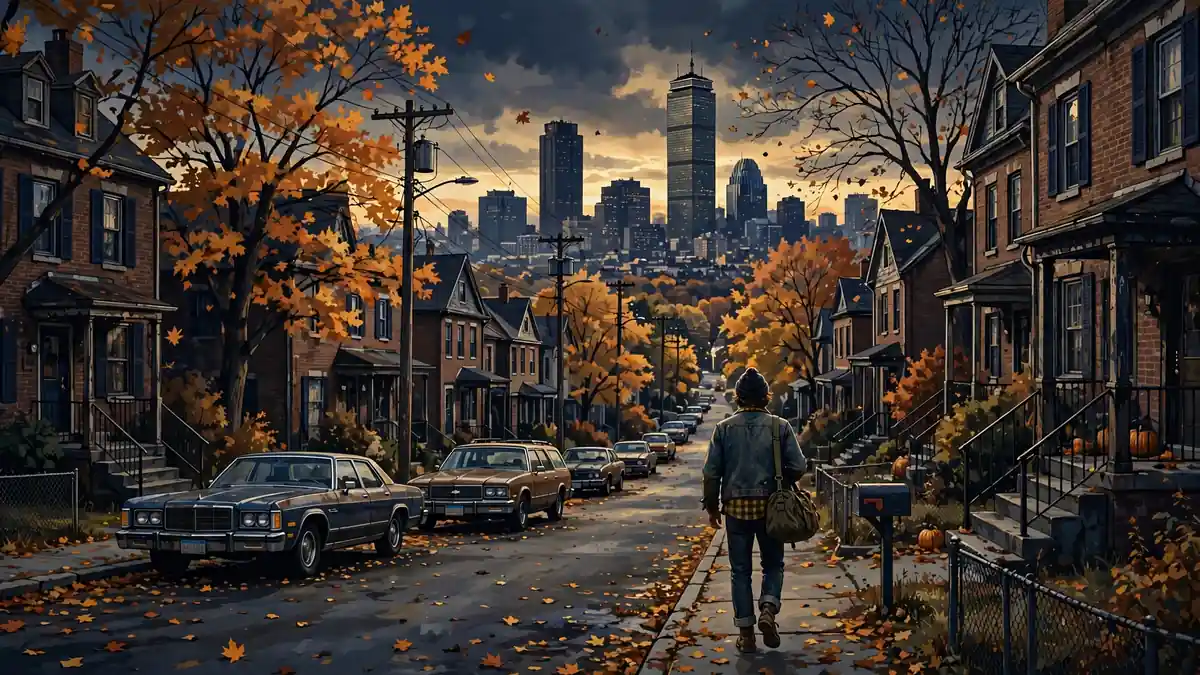
Canton in the seventies and eighties was a town of brick houses, commuter trains and youth sports, and Burr has described his childhood there as ordinary in the way that feeds a comedian: enough boredom to notice things, enough structure to push against. He graduated from Canton High School in 1987. He has said he was distantly related to Aaron Burr, the third vice president of the United States — a claim that is hard to verify and easy to enjoy, and one he has repeated often enough that it has become part of the lore. Whether the genealogy holds or not, the joke tells you something about how Burr sees himself: a loudmouth from Massachusetts with a famous name and nothing to show for it, which is roughly the premise of the entire act.
The family left two marks on him that show up in everything he has done since. The first is the work ethic. A nurse and a dentist run a household on schedules, shifts and showing up, and Burr’s career runs the same way — a weekly podcast for nineteen years, a tour that never really stops, a new special every two or three years like clockwork. The second is the voice. He grew up in a house where people said what they thought, and he built a career out of saying what he thought in public, louder, for money. Canton gave him the accent, the attitude and the audience he would spend his life talking to.
After high school, Burr went to North Carolina State University and lasted two semesters. He came back to Boston and enrolled at Emerson College, where he studied radio and graduated in 1993 with a bachelor’s degree in communications. One of his professors at Emerson was the writer David Foster Wallace, a detail that sounds invented until you check it — Wallace taught at Emerson in the early nineties, and Burr was in his orbit. The radio training shows in the work. Burr’s podcast is, at its core, a radio show: one man, a microphone, and the discipline to fill an hour every week without a guest to hide behind. He learned that in a classroom in Boston before he learned it on a stage.
Before comedy, he worked in warehouses. He has talked about those years often, and fondly — not because the work was good, but because it was free. A warehouse shift ends when it ends. Nobody emails you at home. Nobody asks you to care about the company’s mission. Burr has said he enjoyed the freedom of the job, and the line is worth remembering because it explains the career that followed: he spent thirty years building a working life with no boss, no office and no one to answer to except an audience. The warehouse years were the last time anyone told him what to do, and he has been allergic to it ever since.
The first set came on March 2, 1992. He was 23. The venue was Nick’s Comedy Stop in Boston, and the occasion was a contest to find the city’s funniest college student. He did not win the contest. He kept going anyway. Boston in the early nineties had a real comedy scene — clubs, open mics, a crowd that liked its comics mean and fast — and Burr spent two years working it before he moved to New York City in 1994. The move was the first real bet of his career. He was 26, he had no television credits, and he was walking into the most competitive stand-up market in the country with an accent and an attitude. He stayed. He would spend the next decade grinding through the New York clubs, and the grind is the part of the story that most biographies skip. It took him eleven years from that first set to his first album, and sixteen to his first special. The overnight success took a decade and a half.
New York: Townies, Late Nights and Chappelle’s Show
New York in 1994 was where Burr learned to be a professional. The clubs ran showcases all night, the audiences were brutal, and a comic either got sharper or got out. Burr got sharper. The television work came slowly: a regular role on the short-lived sitcom Townies in 1996, alongside Molly Ringwald, Jenna Elfman and Lauren Graham — a show that lasted one season and, by Burr’s own later account, slowed his acting career for fifteen years because casting directors could not see past it. Guest spots followed on Two Guys and a Girl in 1998 and Law & Order: Criminal Intent in 2002. The late-night showcases stacked up: Showtime at the Apollo in 2000, Comedy Central Presents in 2003, Just for Laughs in 2004, One Night Stand in 2005, Live at Gotham in 2006. Each one put him in front of a bigger room. None of them made him famous.
The break, such as it was, came in 2004, when he won a recurring role on Chappelle’s Show. Dave Chappelle’s biography is the story of a comic who walked away from $50 million and built a second act on his own terms; Burr’s path through the same show was quieter but just as important to him. Chappelle’s Show was the most talked-about comedy on television, and a recurring spot on it put Burr in front of the audience that would follow him for the next twenty years. He played various characters across the run, and the credit — small as it looks on a résumé — was the first time a national audience saw what the Boston clubs had been seeing for a decade.
The film work started around the same time. He had small parts in Perfect Fit in 2001, then Date Night in 2010 and The Heat in 2013. He released his first comedy album, Emotionally Unavailable, in 2003, with an expanded edition following in 2007. In 2008 he voiced Jason Michaels of the biker gang The Lost MC in Grand Theft Auto IV, and returned for the expansion The Lost and Damned in 2009. None of these was a starring role. That was the point of the decade: Burr was building a career out of small parts, late-night sets and club dates, and the audience was growing one room at a time. By the end of the 2000s he was a comic other comics knew. The public was about to catch up.
The Specials: Eight Hours That Built the Name
Burr has released eight hour-long stand-up specials between 2008 and 2025, and the run is the spine of his career. The first, Why Do I Do This?, arrived in 2008, recorded at NYU’s Skirball Center for the Performing Arts and released by Image Entertainment; it landed on the Billboard Comedy Albums chart. Let It Go followed in 2010, recorded at The Fillmore in San Francisco and premiered on Comedy Central on September 18, 2010. Then came the one that changed the business: You People Are All the Same, released in 2012, was the first stand-up special to premiere exclusively on Netflix — a distribution model that is now standard and was, at the time, an experiment Burr was early to.
I’m Sorry You Feel That Way arrived in 2014, the same year Burr won Stand-Up Comedian of the Year at the Just for Laughs festival in Montreal — the one outright competitive win of his career, and the award that marked his arrival as a headliner rather than a club comic. Walk Your Way Out followed in 2017 on Netflix. Paper Tiger, his sixth hour, was shot on March 4 and 5, 2019, at the Royal Albert Hall in London, in the middle of a UK and European tour, and debuted on Netflix on September 10, 2019. Its album brought him his first Grammy nomination, for Best Comedy Album at the 63rd Grammy Awards in 2021 — and an Emmy nomination as well.
Live at Red Rocks arrived on Netflix in 2022, shot at the Colorado amphitheatre that is a bucket-list room for any touring act. Then came Drop Dead Years, his eighth hour, taped in June 2024 at the Moore Theatre in Seattle with Ben Tishler directing, and premiered on Hulu on March 14, 2025 — the first production of North Hill, Burr’s own production company. The streaming album followed on August 1, 2025, through 800 Pound Gorilla and All Things Comedy, and earned him his second Grammy nomination, for Best Comedy Album at the 68th Grammy Awards in 2026, along with an Emmy nomination for Outstanding Variety Special (Pre-Recorded). Two Grammy nominations, two Emmy nominations, no wins — a record that fits a comic whose act is built on being the overlooked guy in the room.
| Special | Year | Outlet | Note |
| Why Do I Do This? | 2008 | Image Entertainment | First hour; Billboard Comedy Albums chart |
| Let It Go | 2010 | Comedy Central | Recorded at The Fillmore, San Francisco |
| You People Are All the Same | 2012 | Netflix | First special to premiere exclusively on Netflix |
| I’m Sorry You Feel That Way | 2014 | Netflix | Same year as the Just for Laughs win |
| Walk Your Way Out | 2017 | Netflix | Fifth hour |
| Paper Tiger | 2019 | Netflix | Royal Albert Hall; Grammy nom 2021 + Emmy nom |
| Live at Red Rocks | 2022 | Netflix | Red Rocks Amphitheatre, Colorado |
| Drop Dead Years | 2025 | Hulu | Grammy nom 2026 + Emmy nom 2025; first North Hill production |
The style never changed, and that is the point. Burr does not do characters, props or crowd work as a crutch. He walks out, stands at the microphone, and talks — about marriage, about flying, about his father, about the news — until the hour is up. Rolling Stone ranked him 17th on its 2017 list of the 50 best stand-up comics of all time, and the ranking holds up because the act holds up: the same material, delivered with the same fury, in rooms that kept getting bigger. The specials are the record of that growth. Watch the 2008 hour and the 2025 hour back to back and the comic is the same man. The rooms are what changed.
The Monday Morning Podcast and All Things Comedy
In May 2007, Burr started recording a weekly one-hour podcast. He called it Bill Burr’s Monday Morning Podcast, and he has recorded it, twice weekly in recent years, ever since. Nineteen years of it. The format is simple: Burr talks about his week, the news, sports and whatever is annoying him, then answers questions sent in by listeners. There is no co-host, no producer in the room doing bits, no guest to carry the hour. It is the radio training from Emerson, finally used the way it was meant to be used — one man and a microphone, every week, without fail.
The podcast did two things for the career that nothing else could. First, it gave him a direct line to the audience that no network or club could cut. When Burr rants about an airline or a neighbor on a Monday, the clip is on the internet by Tuesday, and the tour dates sell a little faster. Second, it made him a businessman. In 2012, Burr co-founded the All Things Comedy network with Al Madrigal, turning the podcast into the anchor of a network of comedy shows — a move that put him on the ownership side of the medium rather than the talent side. The network is the quiet money in the Burr story: not a salary, but equity in a platform that other comics build their audiences on.
He is also a regular guest on other people’s shows — The Joe Rogan Experience, WTF with Marc Maron, The Adam Carolla Show, You Made It Weird with Pete Holmes, Opie and Anthony in its day — and the guest spots matter because they show the range. On his own show he is the ranter. On someone else’s he is the listener, the storyteller, the guy who can sit for two hours and be funny without a microphone in his own hand. Fellow stand-up podcasters such as Bert Kreischer, whose own biography runs on a similar touring-and-podcasting engine, built their careers on the same model Burr helped prove: the podcast is not promotion for the tour, it is the tour’s foundation. Burr was doing it before the model had a name.
Kuby and Mayfeld: The Acting Breakthroughs
The acting career has two roles that matter, and they could not be more different. The first is Patrick Kuby, the fixer on Breaking Bad, which Burr played from 2011 to 2013 across the final seasons of the AMC series. Kuby is a quiet, competent criminal — a man who shows up, does the job, and leaves — and Burr played him straight, without a hint of the stand-up persona. It was the first time a mass audience saw him act rather than perform, and it worked because the casting was honest: Kuby is a working man with a temper, and Burr is a working man with a temper. The role put him in the cast of one of the most acclaimed dramas ever made, and it opened the door to everything that followed.
The second is Migs Mayfeld in The Mandalorian, the ex-Imperial sharpshooter Burr has played since 2019. The casting is a joke with a punchline: Burr used to mock the Star Wars movies in his stand-up, and The Mandalorian creator Jon Favreau cast him anyway — or, more precisely, because of it. Mayfeld is a mercenary who used to shoot for the Empire and now shoots for whoever pays, and Burr plays him as a guy who has seen too much and trusts too little, which is the same character he plays on stage with the volume turned down. The role ran through the series’ three seasons, and in 2026 Burr returned to voice Mayfeld in LEGO Star Wars: The Mandalorian, the Disney+ special that retold all three seasons in bricks. A comic who once made fun of Star Wars for a living ended up inside it, and the franchise was better for the joke.
Between the two roles, the film work filled in. Daddy’s Home in 2015 and its sequel in 2017 put him in mainstream studio comedies. The King of Staten Island in 2020 cast him as Ray Bishop, the firefighter stepfather-to-be in Judd Apatow’s semi-autobiographical film, and the performance drew some of the best acting notices of his career — a dramatic turn from a comic who had spent years being told he could only play himself. He voiced a role in Netflix’s animated Leo in 2023, appeared in the third season of Barry the same year, and played John F. Kennedy in Unfrosted, Jerry Seinfeld’s 2024 Netflix film about the invention of the Pop-Tart. Seinfeld’s own biography is the story of a comic who turned a sitcom into a billion-dollar fortune; Burr’s cameo in his film is a passing of the torch between two generations of stand-up who both learned to act on the job.
F Is for Family: The Show He Built Himself
If the specials are the spine of Burr’s career, F Is for Family is the heart of it. Burr created the Netflix animated sitcom with Michael Price, co-wrote it, and voiced its lead character, Frank Murphy — a short-fused, working-class father in 1970s America who loves his family and resents almost everything else about his life. The show ran for five seasons on Netflix, from 2015 to 2021, and it is the most personal thing Burr has ever made. Frank Murphy is Burr’s father, Burr’s neighbors, Burr himself at his worst and his most honest, drawn in animation so the truth can land without anyone getting hurt.
The show works because it is specific. Frank Murphy works at an airport, comes home tired, yells at his kids, feels guilty about yelling, and does it again the next day. The 1970s setting is not nostalgia — it is the decade Burr grew up in, rendered with the detail of a man who remembers the furniture. The writing is unsentimental in the way Burr’s stand-up is unsentimental: the jokes come from the characters, not from punchlines bolted on top of them. Critics praised it, the audience stayed with it for five seasons, and it proved something the specials could not: that Burr could build a world and keep it going, week after week, year after year.
It also proved something about the business. F Is for Family was Burr’s show — his creation, his voice, his writing room — and it ran on Netflix at the same time his specials were running on Netflix. The streamer was, for a stretch, the Burr network: specials, a series, and an audience that found one through the other. The show ended in 2021, but the model stayed. Burr’s next move as a creator was not another series. It was a film he would write, direct and star in himself.
Old Dads: Directing His Own Movie
Old Dads premiered on Netflix on October 20, 2023, and it was Burr’s feature directorial debut — a film he co-wrote with Ben Tishler, directed, and starred in as the lead. The premise is pure Burr: three middle-aged fathers, out of step with the modern world, trying to raise their kids without getting fired, cancelled or divorced. The film was the most-watched film on Netflix worldwide in its first and second weeks, pulling 29.6 million views in its first ten days. For a first-time director working in a genre the industry had mostly abandoned — the mid-budget adult comedy — those numbers were a statement: the audience that fills arenas for the stand-up will follow the same comic into a movie, if the movie is honest about who he is.
The directing debut matters because it changed what Burr is allowed to do next. A comic who directs a number-one Netflix film is no longer just talent for hire; he is a filmmaker with a track record, and the industry treats him accordingly. The proof is in the slate that followed. In 2027, Burr will shoot Born Losers, a film he will co-write, produce and star in. He will also star alongside Chris O’Dowd and Ruth Bradley in Bender, a coming-of-age comedy. The directing credit is the newest line on the résumé, and it is the one with the most room to grow. He was 55 when he directed his first feature. The second one is already on the calendar.
There is a second point about Old Dads that the numbers hide. The film is about fathers who feel obsolete, and Burr made it in the same year he became a father for the second time — his son was born in June 2020, and the film’s anxieties about modern fatherhood are the anxieties of a man living them. The comedy lands because the fear underneath it is real. That is the Burr method in every medium: take the thing that scares you, say it out loud, and let the audience laugh at the recognition. It worked on stage in 1992. It worked on Netflix in 2023.
Broadway: Glengarry Glen Ross
In March 2025, at the age of 56, Bill Burr made his Broadway debut. The play was David Mamet’s Glengarry Glen Ross, the 1984 Pulitzer winner about desperate real-estate salesmen lying to each other for a living, and Burr played Dave Moss opposite Kieran Culkin and Bob Odenkirk. The production ran from March through June 2025, and by the time it closed on June 28, it had grossed approximately $35.85 million across previews and regular performances, per the reporting on Celebrity Net Worth’s Burr page. Burr was nominated for Favorite Featured Actor in a Play at the Broadway.com Audience Awards. The reviews were strong, and the surprise in them was genuine: a stand-up comic, holding his own in Mamet, on Broadway, at 56, in his first stage play.
The Broadway run is the most unlikely chapter of the biography, and the most revealing. Mamet’s dialogue is famously rhythmic — short bursts, interruptions, overlapping lines — and it is not far from stand-up timing. Burr spent thirty years learning to hold a room with words alone, and a Mamet play is a room held with words alone. The skill transferred. The casting also transferred something else: credibility. A comic who can do Mamet on Broadway is a comic no casting director can dismiss as a one-note ranter, and the roles that followed — Sorkin, in 2026 — bear that out. Broadway did not make Burr an actor. It proved he already was one.
The money tells its own story. A production gross of $35.85 million for a play is a hit by any measure, and Burr’s share of it — salary, plus the career value of the credit — is part of why the net-worth estimates moved in 2026. The old $25 million figure, the one Parade was still printing in January, belonged to the Burr who had not yet done Broadway. The $35 million figure belongs to the Burr who has. That is how a fortune grows for a working comic: not in one deal, but in one more room, one more medium, one more audience that had not been counted yet.
SNL, Fenway Park and the Arena Years
Burr hosted Saturday Night Live twice: on October 10, 2020, and again on November 9, 2024, for the post-Election show. The first hosting gig landed in the middle of the pandemic year, when the show was running under restrictions and the monologue — Burr’s natural habitat — carried more of the night than usual. He did it the way he does everything: walked out, stood at the microphone, and talked. The second, four years later, came with the weight of a post-Election audience and a comic who had spent the intervening years becoming a bigger star. Hosting SNL twice is a mark of standing in the comedy world. The show does not invite back comics it does not trust.
The arena years peaked on August 21, 2022, when Burr became the first comedian ever to perform at Fenway Park. The show sold out — around 35,000 people, the largest comedy show in Boston history — in the ballpark of the team he grew up watching, fifteen miles from the town he grew up in. Burr joked on stage that he had not counted the crowd himself to confirm the number, which is the kind of line that only works if the crowd is actually there. It was. The Fenway show is the single most cinematic fact of the biography: a kid from Canton, headlining the ballpark, thirty years after his first set at a Boston comedy club.
A year later, on September 11, 2023, he became the first comedian to perform at the Odeon of Herodes Atticus, the 5,000-seat ancient Roman amphitheatre in Athens, Greece. Madison Square Garden sold out in 2015 and again in 2023. The Royal Albert Hall filled in 2019 for Paper Tiger. Red Rocks filled in 2022. The Wilbur Theatre in Boston holds a record that says more about the local audience than any arena number: 19 consecutive sold-out shows. Burr is a Boston comic, and Boston has never let him forget it — or let him go.
Personal Life: Nia, Lola and a Son
Burr married actress and producer Nia Renee Hill in September 2013. Hill is a performer in her own right — she has acted, produced and directed — and she appears as a guest on Burr’s podcast often enough that the audience knows her voice as well as his. The marriage is the anchor of the personal life, and Burr talks about it on stage the way he talks about everything: honestly, loudly, and with the affection buried under the complaint. The act’s best marriage material comes from a real marriage, and the audience can tell.
Their daughter, Lola, was born on January 20, 2017. Their son was born in June 2020. The family lives in Los Angeles. Burr is 58 years old — the full age story, year by year, is set out in Bill Burr’s age profile — and he is 5 ft 10 in tall, a figure his height profile records in full. He is a drummer, and he routinely performs alongside the Goddamn Comedy Jam, the show that pairs comedians with live bands. The personal details that matter to the biography are all on the record: the wife, the two children, the house in Los Angeles, the drums. The rest is his business, and this page does not go looking for more of it.
Fatherhood changed the act without softening it. The early specials are the rants of a single man with no one to answer to. The later ones — Paper Tiger, Live at Red Rocks, Drop Dead Years — are the rants of a married father of two who has to explain himself at home. The anger is still there. It has an audience now, and a curfew. Old Dads is the film version of the same shift: a man who used to be the angry young guy, realizing he is now the old dad. Burr turned 58 in June 2026, and the act has grown up with him — which is rarer than it sounds. Most comics freeze at the age they got famous. Burr kept aging in public, and the audience aged with him.
The Million Question: What Bill Burr Is Worth in 2026
Celebrity Net Worth put Bill Burr’s fortune at $35 million in November 2026, and that is the freshest named figure available — the anchor this page uses. The full picture is in the table below, because the published estimates disagree by nearly threefold, and the disagreement itself tells you something about how fast his money changed. The detailed money-side breakdown, deal by deal, is set out in Bill Burr’s net worth profile on this site, and CelebAmerica’s net-worth profile of Bill Burr puts the same $35 million figure at the top of its page. The honest range, on the reporting available, is $14 million to $35 million.
| Source | Date | Estimate | Method |
| Celebrity Net Worth | November 2026 | $35 million | Freshest named estimate; anchor. Reports Pollstar touring gross and Broadway gross |
| Parade | January 2026 | $25 million | Citing Celebrity Net Worth at the time — CNW’s OLD figure before its Nov 2026 update |
| The Bridal Box / UnNetWorth / Comedyville / MirrorDigi | 2026 | $20M–$25M | Consensus cluster of 2026 trackers; pre-dates CNW’s $35M update |
| Famous People Today / older trackers | Pre-2026 | $12M–$14M | STALE — pre-date the Fenway, Broadway and Drop Dead Years earnings run |
| Net Worth Spot | November 1, 2026 | $229K | YouTube ad revenue ONLY — methodologically wrong for a touring comic; discarded |
The range is wide because the evidence moved during 2026. Before the Broadway run and the Drop Dead Years release, the $20 million to $25 million cluster was defensible: Burr was a big touring act with a steady catalog, and the trackers had not repriced him since the Fenway year. After March 2025, the same comic had a Broadway gross of $35.85 million on his résumé, a Hulu special with a Grammy nomination, and a Pollstar year-end tally of $14,101,432 from 30 reported North American performances, selling approximately 157,852 tickets. Celebrity Net Worth updated its figure to $35 million. The trackers that did not update still print the old numbers. When you see a $14 million figure for Bill Burr in late 2026, you are looking at a page that has not been touched in years.
How the estimate is made, in short: Burr files no public accounts, so no outlet can audit his fortune. Every figure is an estimate built from public reporting. The anchor is Celebrity Net Worth, the only named outlet to have repriced him after the Broadway run. The floor of the range, $14 million, is the oldest defensible published figure still in circulation. The ceiling, $35 million, is the freshest. The touring data supports the top end: $14.1 million from 30 reported shows is a partial tally — Pollstar only counts reported performances — and a comic who sells 157,852 tickets in the shows that get counted is earning far more across a full touring year, before specials, acting fees, the podcast network and the Netflix film. The $35 million anchor is the number this page stands behind; the $14 million to $35 million range is the honest statement of what the reporting can prove.
What he owns, on the public record, is modest for a man worth $35 million. In 2011, he bought a house in Los Angeles for $1 million. There is no reported fleet of cars, no watch collection, no real-estate portfolio splashed across the property pages. The money, as far as anyone can tell, went into the career: a production company, North Hill, which produced Drop Dead Years; a podcast network, All Things Comedy; and a working life with no boss. That is the Burr fortune in one line — not a pile of things, but a machine that keeps producing, year after year, with the owner still doing the work himself.
Riyadh: The Gig That Drew Fire
In September 2025, Burr accepted a gig at the Riyadh Comedy Festival in Saudi Arabia, a festival hosted by the Saudi government that ran from September 26 to October 9 and billed itself as the world’s largest comedy festival, with more than 50 comedians on the bill — including Dave Chappelle, Louis C.K., Pete Davidson and Kevin Hart, whose own biography runs on the same touring-and-specials engine at a much larger scale. The criticism arrived before the first set. Human Rights Watch condemned the festival as a “deliberate effort to whitewash the country’s human rights record”. The festival coincided with the seventh anniversary of the assassination of Jamal Khashoggi, the Saudi dissident journalist, and critics said the event was designed to put a friendly face on a government accused of severe human rights abuses.
The criticism from inside comedy was sharper than the criticism from outside it. David Cross, a comic Burr admires, wrote a blog post on September 30, 2025, saying he was “disgusted, and deeply disappointed in this whole gross thing” — that comics he admired would “condone this totalitarian fiefdom for… what, a fourth house? A boat? More sneakers?” Cross called the Saudi regime “the most oppressive regime on earth” and said the performers had given up the right to complain about cancel culture and free speech at home while signing contracts that forbade criticism of the Saudi government abroad. Marc Maron criticized the festival in his routines. Shane Gillis openly declined an offer to perform, citing principle. Nimesh Patel withdrew and announced 40 additional US shows instead. A parody song, “Riyadh Money”, went viral mocking the performers by name.
Burr defended the appearance on his podcast. He called the experience a “top three experience” of his life, said the audience was enthusiastic and receptive, and said the Saudis he met were “just like” Americans — regular people, dressed differently, in a modern city that did not match the picture he had been fed. He said the festival organizers had negotiated with Saudi authorities to allow comedians to discuss most topics, with jokes about the Saudi royals and religion banned, and he argued that events like these “have to happen to push progress forward”. He criticized the outrage on social media as driven by misinformed internet users rather than genuine concern, and he pointed to fellow performer Jessica Kirson, who performed her act despite the backlash, as proof the festival mattered to the people in the room.
The episode is recorded here in full because it is part of the biography, and because it shows the tension at the center of Burr’s career. He built his name on saying the unsayable — on free speech as a working principle, not a slogan. In Riyadh, he performed under a contract that barred jokes about the royals and religion, for a government his fellow comics called the most oppressive on earth, and he came home and said it was one of the best experiences of his life. His critics say the two positions cannot both be true. Burr says they can. The reader can decide. What is not in dispute is the fact of it: he went, he performed, he was criticized by name by comics he respects, and he has not apologized.
2026 and What’s Next: Sorkin, Lego Star Wars and Two Films
As of November 2026, Burr is in the middle of the busiest film year of his career. The Social Reckoning, Aaron Sorkin’s sequel to The Social Network, opened in theaters on October 9, 2026, with Jeremy Strong playing Mark Zuckerberg, Jeremy Allen White playing Wall Street Journal reporter Jeff Horwitz, and Burr in an undisclosed role alongside Mikey Madison. The film is based on the Journal’s Facebook Files reporting, and the casting puts Burr — a stand-up comic — in the middle of a prestige drama about the company that reshaped the century. It is the Broadway effect, again: a comic who proved he could do Mamet gets the call for Sorkin.
The second 2026 project is lighter. LEGO Star Wars: The Mandalorian premiered on Disney+ on September 2, 2026, a 45-to-50-minute special that retells all three seasons of the live-action series in bricks, with Burr returning to voice Migs Mayfeld alongside Amy Sedaris, Katee Sackhoff, Giancarlo Esposito, Rosario Dawson and Taika Waititi. The special debuted at number 2 on the Disney+ movie chart in the United States and scored 75% positive on Rotten Tomatoes. Pedro Pascal did not return as Din Djarin — Gavin Hammon took the role — but nearly the whole supporting cast did, and Burr’s presence in it closes a loop that started with a stand-up joke about Star Wars and ended with the comic inside the franchise, twice.
The calendar after 2026 is already set. In 2027, Burr will shoot Born Losers, the film he will co-write, produce and star in — his second feature as a filmmaker after Old Dads. He will also star alongside Chris O’Dowd and Ruth Bradley in Bender, a coming-of-age comedy. The stand-up continues: the Bill Burr Live tour runs through arenas and theaters, and the podcast records twice a week, as it has since 2007. He is 58, he has been doing this for 34 years, and the work is not slowing down. The next special has not been announced, but the pattern says it will come — every two or three years, like clockwork, since 2008.
Why Bill Burr Lasts
Burr lasts because the act is built on something that does not go out of fashion: a man saying what he actually thinks, in plain language, at full volume. Comedy trends come and go — the observational wave, the alt wave, the podcast wave, the special-as-event wave — and Burr surfed none of them. He stood at a microphone and ranted, and the audience came to him. The rooms got bigger. The act did not change. That is the whole trick, and it is harder than it looks: most comics who refuse to change disappear. Burr refused to change and filled Fenway Park.
The career is also a lesson in ownership. Burr owns his podcast. He co-founded his network. He created his animated series. He directed his film through his own production company. At every step where a comic his age would normally be taking orders from a network, Burr built the thing himself and kept the keys. The $35 million is the result of that habit, not of any single payday. A comic who owns the means of reaching his audience does not need permission to work, and Burr has not needed permission since 2007.
He is 58 years old, 34 years into the job, with eight specials, two Grammy nominations, two Emmy nominations, a Broadway credit, a Fenway record, a wife, two children, and a film slate that runs into 2027. The biography, for now, is the story of a kid from Canton who worked in warehouses, did his first set at 23, and refused to stop — until the world caught up with him. The Celebrity Net Worth archive tracks the fortunes of the comics Burr now stands alongside, and his page in it will keep moving as the touring, the specials and the films keep earning. The $35 million anchor from November 2026 is a snapshot, not a final figure. The rant goes on.
Frequently Asked Questions
How old is Bill Burr?
Bill Burr is 58 years old. He was born William Frederic Burr on June 10, 1968, in Canton, Massachusetts, and turned 58 on June 10, 2026.
What is Bill Burr’s net worth in 2026?
Celebrity Net Worth put Bill Burr’s net worth at $35 million in November 2026, the freshest named estimate available. The honest range, on the reporting available, is $14 million to $35 million: most other 2026 trackers cluster at $20 million to $25 million, and older pages still print $12 million to $14 million. Burr files no public accounts, so every figure is an estimate, not an audited number.
Is Bill Burr married, and who is his wife?
Yes. Bill Burr married actress and producer Nia Renee Hill in September 2013. Hill appears as a guest on Burr’s Monday Morning Podcast, and the couple live in Los Angeles with their two children.
Does Bill Burr have kids?
Yes, two. His daughter, Lola, was born on January 20, 2017, and his son was born in June 2020. Burr’s later specials and his film Old Dads (2023) both draw on fatherhood.
How tall is Bill Burr?
Bill Burr is 5 ft 10 in tall (178 cm).
What is Bill Burr’s most famous stand-up special?
Paper Tiger (2019), shot at the Royal Albert Hall in London, is the most acclaimed — it earned Burr his first Grammy nomination for Best Comedy Album. You People Are All the Same (2012) is the most historically important: it was the first stand-up special to premiere exclusively on Netflix. Drop Dead Years (2025, Hulu) is the latest, with a Grammy nomination in 2026 and an Emmy nomination in 2025.
What movies and TV shows has Bill Burr been in?
On TV: Townies (1996), Chappelle’s Show (2004), Breaking Bad as Patrick Kuby (2011–2013), The Mandalorian as Migs Mayfeld (2019–2023), F Is for Family (2015–2021, which he created), Barry (2023), and Saturday Night Live as host (2020 and 2024). In film: Date Night (2010), The Heat (2013), Daddy’s Home (2015, 2017), The King of Staten Island (2020), Old Dads (2023, which he directed), Unfrosted (2024, as JFK), and The Social Reckoning (2026).
Why was Bill Burr criticized for the Riyadh Comedy Festival?
Burr performed at the Riyadh Comedy Festival in Saudi Arabia in September–October 2025. Human Rights Watch condemned the festival as a “deliberate effort to whitewash the country’s human rights record”, and fellow comedian David Cross publicly called out Burr, Dave Chappelle and Louis C.K. for performing. Burr defended the appearance on his podcast, calling it a “top three experience”, saying the Saudis he met were “just like” Americans, and arguing such events “have to happen to push progress forward”. He also noted jokes about the Saudi royals and religion were banned.
Sources & Reporting
Every figure on this page is attributed to the outlet that reported it. The net-worth anchor of $35 million comes from Celebrity Net Worth (November 2026), which also reports the Pollstar year-end touring figure of $14,101,432 from 30 reported North American performances and the Glengarry Glen Ross production gross of approximately $35.85 million. The $25 million figure comes from Parade (January 2026), citing Celebrity Net Worth at the time. Biographical facts — birth, family, education, first set, specials, awards, roles, marriage and children — are drawn from Wikipedia, cross-checked against AllMusic, BroadwayWorld, TV Insider and Ticketmaster’s artist biography, which also confirms the 2026–2027 film slate (The Social Reckoning, Born Losers, Bender) and the two Saturday Night Live hosting dates. The Riyadh Comedy Festival account draws on Wikipedia, Yardbarker’s report of David Cross’s September 30, 2025 blog post, and Daily Comedy News’ transcript of Burr’s podcast defence. The 2026 LEGO Star Wars special details come from Superhero Hype, Laughing Place and CBR reporting. Same-person facts were cross-checked against Guide Net Worth’s own live profiles of Burr’s net worth, age and height. Where sources disagree, the disagreement is shown rather than smoothed over, and where a figure is an estimate, it is labelled as one. Figures were checked in November 2026; if a source updates its estimate, this page will be revisited.
Corrections: if you spot an error in this article, please contact us through the contact page and we will correct it promptly, with a note recording the change.
About the Author
Nathan Cole is the editor of Guide Net Worth, where he covers the money behind music, sport and entertainment. He writes from public reporting — chart data, touring figures, court records and named-source estimates — and every fortune on this site is labelled as an estimate, with the outlet behind each figure named in the text. His work follows the site’s editorial policy and fact-checking policy.
References & Sources
This article has been fact-checked and verified against multiple public sources, financial disclosures, SEC filings, Forbes reports, Celebrity Net Worth databases, and official records. All net worth estimates are based on publicly available information and financial analysis.